
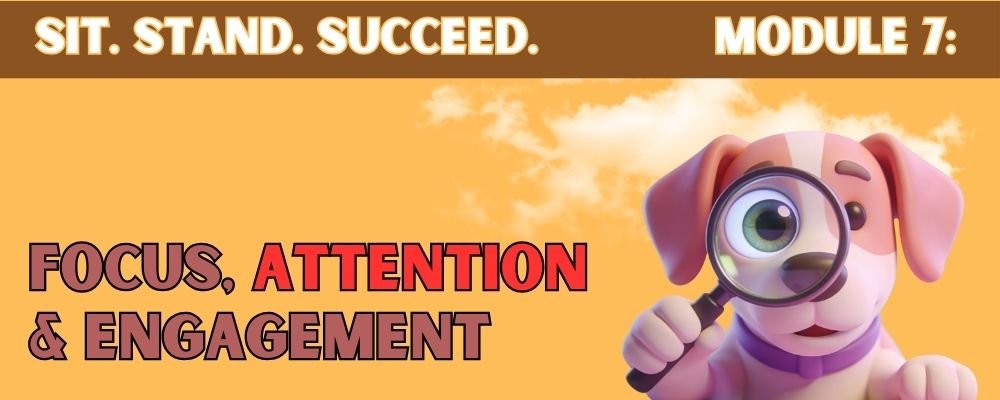
Teach your dog to pay attention to you — even around distractions. You’ll build engagement and motivation, creating a dog that wants to listen.
Module 7 is one of the MOST important modules in the entire course, because focus is the foundation of ALL training:
- Recall
- Loose-lead walking
- Stay
- Impulse control
- Calm behaviour
- Obedience around distractions
If your dog can’t focus, they can’t learn.
If you teach focus, everything else becomes easy.
Teach your dog to listen, build powerful engagement, and maintain attention even around distractions.
This module gives you the tools professional trainers use to create dogs who want to pay attention — not because they’re forced, but because you become more interesting than the distractions around them.
Once your dog understands focus work, training becomes smoother, calmer, and dramatically more effective.
🔵 1. Teaching Your Dog to Listen
Dogs don’t listen because:
- they’re overstimulated
- the environment is too difficult
- the reward isn’t motivating enough
- you haven’t taught focus intentionally
- your voice blends into background noise
This module teaches you how to build attention from the ground up.
✔ Step 1: Name Recognition (“Name = Attention”)
This is the first layer of all communication.
Exercise:
- Say your dog’s name once.
- The moment they look at you → “Yes!” + reward.
- Repeat until fast and automatic.
Rules:
- Don’t repeat the name.
- Don’t use it when angry.
- Make sure your dog LOVES hearing it.
Goal:
Head turn within 1 second.
✔ Step 2: The Attention Cue (“Watch Me”)
Teach your dog to make eye contact on cue.
Exercise:
- Hold treat between eyes.
- Dog looks at treat → move treat behind your back.
- Dog looks at your eyes → “Yes!” + reward.
- Add verbal cue: “Watch.”
Build up to:
- 1 second
- 3 seconds
- 5 seconds
- distractions
Eye contact = engagement.
✔ Step 3: The Engagement Circle
This powerful exercise teaches your dog:
- to check in automatically
- to stay connected while moving
- to respond quickly to changing direction
Exercise:
- Walk in a small circle.
- When dog checks in → “Yes!” + reward.
- Change direction randomly.
- Reward again when dog turns with you.
Builds a dog that stays with you.
🔵 2. Building Strong Focus Around Distractions
Dogs cannot focus if the environment is too hard.
We raise distraction levels gradually using the Focus Ladder.
🪜 The Focus Ladder (Progression System)
Level 1: Indoors (Low Distraction)
Start with:
- name training
- eye contact
- engagement circle
Goal: automatic focus.
Level 2: Backyard / Quiet Street (Medium Distraction)
Add:
- light sounds
- mild smells
- moving background
Reward generously.
Level 3: Public Area (High Distraction)
Start at a distance from triggers:
- other dogs
- children
- bikes
- smells
- high movement
Reward for:
- looking at you
- choosing calm behaviour
- checking in voluntarily
Level 4: Trigger Proximity Work
This is advanced.
Reward:
- head turns away from triggers
- calm focus
- walking beside you
This builds impulse control AND engagement.
🔵 3. Creating a Willing, Motivated Learner
You cannot force attention.
You build attention by becoming:
✔ predictable
✔ rewarding
✔ calm
✔ consistent
✔ more interesting than the options around you
Here’s how:
✔ Use “Engagement Sessions” (1–2 minutes each)
An engagement session is NOT obedience.
No sit.
No down.
No stay.
It is simply:
- rewarding eye contact
- celebrating check-ins
- turning together
- having fun
Dogs trained this way:
- stay connected
- stay close
- learn faster
- offer behaviours voluntarily
✔ Use Movement to Build Attention
Movement creates:
- focus
- curiosity
- following behaviour
Professional trainer secret:
“If focus drops, move — don’t talk.”
Try:
- walk away
- change direction
- jog 2 steps
- stop suddenly
Reward when your dog follows your movement.
✔ Use the Right Reinforcer for the Right Moment
Use:
- high-value treats for high distraction
- quick treats for rapid repetition
- toys for intense engagement
- praise for calm focus
If your dog loses interest, your reward isn’t high enough for the environment.
✔ Make Yourself the “Source of Good Decisions”
This transforms your relationship.
Reward when your dog:
- looks back during walks
- chooses you over a distraction
- waits calmly
- sits before greeting
- ignores something tempting
Good choices = rewards
Bad choices = no reward
No punishment needed.
🔵 4. Practical Exercises for Module 7
Here are the exact exercises trainers use to build world-class focus.
Exercise 1: The “10 Automatic Check-Ins” Game
Goal: train your dog to check in without being asked.
Steps:
- Stand still
- Reward every time dog looks at you
- Aim for 10 check-ins
If dog gets bored → move around → reset.
Exercise 2: The Choose Me Over That Game
- Walk your dog at a distance from a distraction.
- When your dog glances at distraction → then looks back at you:
“Yes!” + reward
This is the foundation of reducing reactivity.
Exercise 3: The 3-Second Rule
In high distraction:
- If dog looks at you for 3 seconds → reward
- Builds impulse control and patience
Exercise 4: Pattern Games (from Control Unleashed)
Patterns calm the dog and create focus.
Simple patterns:
- 1-2-3 Treat
- Up-Down
- Side-to-Side
Predictability = calm attention.
Exercise 5: The Engagement Walk
- Clip long line.
- Walk in a quiet area.
- Reward every check-in.
- Add sudden turns and stops.
- Celebrate connection.
This builds a dog that pays attention before pulling begins.
🔵 5. What Success Looks Like After Module 7
By the end of this module, your dog will:
✔ Look at you quickly when you say their name
✔ Offer attention voluntarily
✔ Stay engaged on walks
✔ Choose you instead of distractions
✔ Learn new commands faster
✔ Work with excitement AND calmness
✔ Maintain focus around real-world triggers
And YOU will:
✔ Understand how to build attention intentionally
✔ Know how to structure engagement sessions
✔ Be able to raise (or lower) distraction levels
✔ Use reinforcement strategically
✔ Have the foundation for loose-lead walking, recall, and impulse control
Everything in Modules 8–12 becomes dramatically easier once your dog knows how to focus.
Responses