
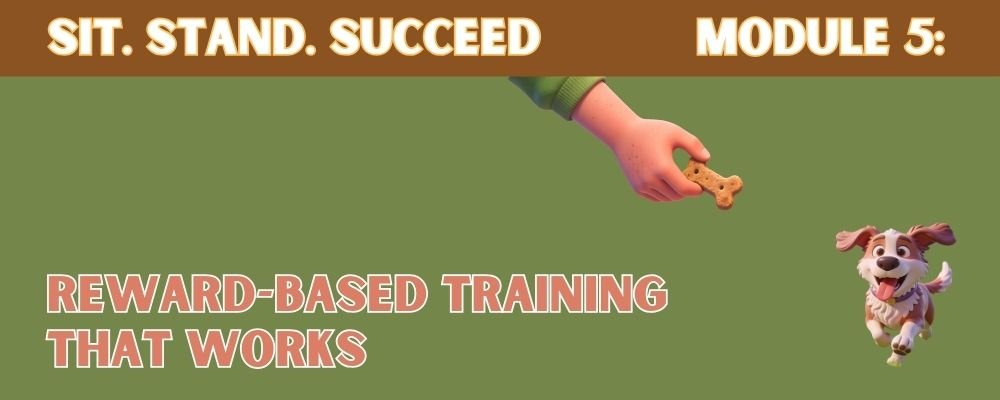
Master the fundamentals of positive reinforcement. You’ll learn how timing, consistency, and clear markers create faster learning and better results.
This is one of the most IMPORTANT modules in the entire course, because reward-based training isn’t about “treats” — it’s about communication.
When owners understand how rewards actually shape behaviour, dog training becomes easy, fast, and enjoyable.
Master the fundamentals of positive reinforcement, perfect timing, clear communication, and consistent results.
Reward-based training is not about spoiling the dog or “bribing” them.
It’s about teaching through clarity:
“THIS is the behaviour I want.
THIS is the moment you did it right.”
Rewards tell the dog exactly what worked — and that clarity creates fast, reliable learning that lasts a lifetime.
This module teaches you world-class reinforcement methods used by professional trainers.
🔵 1. Why Positive Reinforcement Works Faster
Positive reinforcement strengthens the exact behaviours you want to see more of.
Dogs are constantly evaluating:
- What gets me rewarded?
- What gets me attention?
- What gets me closer to what I want?
When you control the reward system, you control behaviour.
Here’s why it works so well:
✔ 1. It creates eager, motivated learners
Dogs work harder when training feels like play.
Reward-based training makes your dog think:
“Training is fun — and I want to keep trying.”
✔ 2. It removes fear and confusion
Punishment shuts learning down.
Rewards open it up.
When a dog knows exactly how to succeed, they relax, think clearly, and learn quickly.
✔ 3. It builds trust and cooperation
Your dog learns that:
- you are predictable
- you are safe
- listening to you makes good things happen
This reduces anxiety, reactivity, and stubborn behaviour.
✔ 4. It prevents problem behaviours before they start
A rewarded dog is a calm dog, and a calm dog:
- pulls less
- barks less
- jumps less
- reacts less
Good behaviour becomes a habit — not a command.
🔵 2. Perfect Timing, Markers & Delivery
Timing is the most important skill in dog training.
If you reward too late, you risk reinforcing the wrong behaviour.
This module teaches you to time rewards correctly using the marker system.
✔ The Marker Word (“Yes!”)
A marker is a precise signal that tells the dog:
“The exact behaviour you did at this moment is correct.”
- Say it once
- Use a normal tone
- Reward immediately afterward
Examples:
- Dog’s bum hits floor → “Yes!” → treat
- Dog looks at you → “Yes!” → treat
- Dog walks beside you → “Yes!” → treat
This creates lightning-fast clarity.
✔ Reward Placement (Where You Deliver the Treat Matters)
Different placements influence behaviour:
Reward at your side
Builds loose-lead walking.
Reward on the ground
Builds calm, low-arousal behaviour.
Reward in front of you
Builds engagement and attention.
Tiny placement changes = big behavioural differences.
✔ Reward Frequency
Use this rule:
- Teaching a new behaviour: reward every success
- Building confidence: high reward rate
- Advancing the skill: reward intermittently
- Proofing the behaviour: use life rewards (movement, environment, freedom)
This creates a smooth transition from “training with treats” to “living with good habits.”
🔵 3. Types of Rewards & When to Use Them
Rewards are communication tools.
Each type sends a different message.
✔ 1. Food Rewards (Most Effective)
Use soft, high-value treats for:
- shaping
- learning new commands
- working in distractions
- building calm behaviours
Examples of high-value rewards:
- cooked chicken
- cheese
- liver treats
- commercial training treats
- roast beef
Low-value rewards (kibble) are best for:
- easy tasks
- indoor training
- warmups
✔ 2. Toy Rewards
Best for:
- high-drive dogs
- outdoor training
- recall
- engagement building
Use:
- tug toys
- balls
- squeakers (sparingly)
Toy rewards build ENERGY — great for engagement, not great for calm behaviours.
✔ 3. Praise & Affection
Great for:
- reinforcing calm
- rewarding polite behaviour at home
- lowering arousal
Praise works best when paired with food early in training.
✔ 4. “Life Rewards”
These are powerful, natural reinforcers:
- going through a door
- being let off leash
- sniffing
- jumping into the car
- playing with another dog
- chasing a ball
Real-world rewards build long-term reliability.
🔵 4. Avoiding the Most Common Training Mistakes
Most training failures come from simple errors that are easy to fix.
❌ Mistake 1: Using food as a bribe
Holding the treat in front of the nose before asking is bribery.
The dog learns:
“I only listen when you show me food.”
Fix:
Ask → dog behaves → then food appears.
❌ Mistake 2: Incorrect timing
Rewarding too late reinforces the wrong behaviour.
Fix:
Use your marker word (“Yes!”) for instant timing.
❌ Mistake 3: Rewarding while dog is excited
If your dog is over-aroused:
- they can’t think
- rewards lose value
- behaviour becomes chaotic
Fix:
Use calm rewards:
- slower delivery
- ground placement
- praise after the behaviour, not before
❌ Mistake 4: Training too long
Long sessions = mental fatigue = slow learning.
Fix:
Use micro-sessions:
- puppies: 2 minutes
- adults: 5 minutes
- multiple times per day
❌ Mistake 5: Skipping steps
If your dog can’t perform a behaviour in a park, it’s because you advanced too fast.
Fix:
Follow the 3-stage environment system:
- indoors
- medium distraction
- public place
Progress only when the behaviour is reliable.
🔵 5. Practical Exercises for Immediate Results
These exercises build lightning-fast learning and strong engagement.
Exercise 1: 10-Reward Focus Drill
- Say your dog’s name
- Dog looks at you
- “Yes!” + reward
- Repeat 10 times
Builds automatic attention.
Exercise 2: Reward on Calm
Reward when your dog:
- takes a breath
- lowers shoulders
- relaxes
- sits quietly
- settles on mat
This builds calm behaviour without commands.
Exercise 3: The “Magic Hand” Game
- Treat in your closed hand
- Dog sniffs/licks → ignore
- Dog backs off or sits → “Yes!” → open hand
Teaches impulse control instantly.
Exercise 4: Fast Teaching (3-Second Rule)
Ask → dog succeeds → “Yes!” + reward → reset → repeat.
Short repetitions = fast learning.
Exercise 5: Reward Placement Shaping
Reward:
- at left side for loose-lead walking
- at your feet for calm
- in front for attention
This shapes behaviour without force.
🔵 6. What Success Looks Like After Module 5
At the end of this module, your dog will:
✔ Learn new behaviours faster
✔ Focus better
✔ Work happily and willingly
✔ Respond to your marker word instantly
✔ Understand exactly what earns rewards
✔ Start building strong, consistent habits
And YOU will:
- have professional-level timing
- use rewards strategically
- know how to motivate your dog effectively
- communicate with clarity and consistency
This paves the way for Module 6: Rules, Boundaries & Daily Structure, where good habits become reliable behaviour.
Responses