

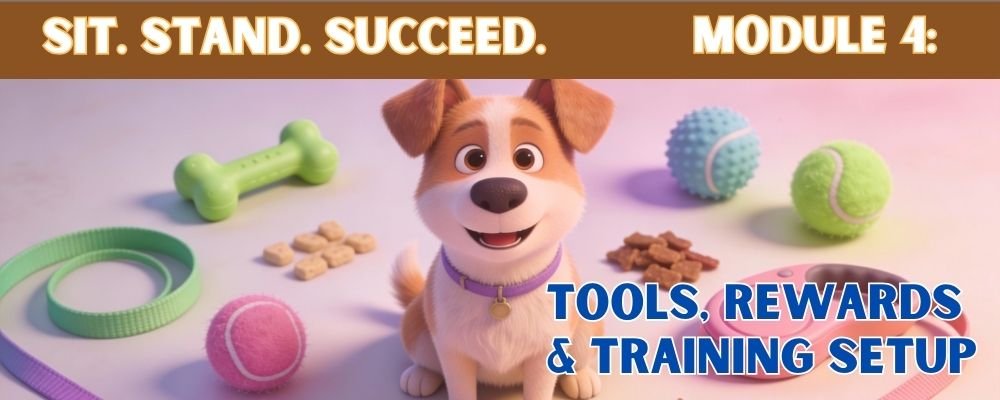
Learn which training tools actually help — and which ones don’t. You’ll set up the right environment, choose effective rewards, and prepare for success before training even begins.
This module is one of the most important in the entire system — because your tools, rewards, and setup determine whether training is clear and effective, or frustrating and confusing.
Choose the right equipment, set up the right environment, and learn how to use rewards that make training fast, fun, and frustration-free.
Training doesn’t begin when you say “Sit.”
It begins with the environment, the equipment, your preparation, and the reward strategy you bring into the session.
This module teaches you how to set up training correctly — so every session is calm, clear, and successful.
🔵 1. Choosing the Right Equipment for Success
The right tools make training easier, safer, and far more effective.
Here’s what works — and what doesn’t.
✔ Flat Collar
Best for:
- ID tags
- safe walking for calm dogs
- everyday use
Avoid using for:
- dogs that pull
- excited adolescents
- training new behaviours
It does NOT help stop pulling — it simply attaches the lead.
✔ Y-Front Harness (Recommended for 90% of dogs)
Allows:
- full shoulder movement
- comfort
- safer control
- reduced pulling pressure
Look for:
- Y-shape (never straight bar across chest)
- two lead points (front + back)
- adjustable straps
Best for:
- puppies
- strong dogs
- training loose-lead walking
✔ Front-Clip Harness (Training Tool)
Helps gently turn the dog toward you during pulling.
Use when:
- teaching loose-leash walking
- training strong or excitable dogs
Avoid:
- pulling harshly — the harness does the work
- relying on it forever
It’s a teaching tool, not a permanent solution.
✔ Long Line (5m–10m)
One of the most powerful training tools.
Used for:
- recall training
- safe outdoor practice
- controlled freedom
Allows:
- distance
- exploration
- safety
- training that works BEFORE off-leash freedom
✔ Treat Pouch
Keeps rewards:
- accessible
- fast to deliver
- consistent
A must-have for effective timing.
❌ Tools to Avoid
These tools create fear, pain, or confusion — and make behaviour worse long-term:
- prong collars
- choke chains
- slip leads used for correction
- spray collars
- shock/e-collars (unless used by certified specialists for severe cases)
This course focuses on clear, humane, effective training only.
🔵 2. Using Food, Toys & Praise Effectively
Rewards are how we communicate success to a dog.
Without rewards, training becomes unclear and frustrating.
Different rewards serve different purposes.
✔ Food Rewards (Primary Training Tool)
Use food for:
- teaching new behaviours
- shaping
- fast learning
- calm behaviours
- precision training
Types of food:
- soft, moist treats
- cheese, chicken, beef
- commercial training treats
- kibble (only for easy tasks)
Rule:
The harder the task, the better the treat.
✔ Toy Rewards
Best for:
- high-energy dogs
- working breeds
- outdoor training
- recall building
Toy types:
- tug toys
- balls
- flirt pole (use sparingly)
Toys build excitement and engagement — but they are not ideal for calm behaviours like “Stay.”
✔ Praise (Social Reward)
Use for:
- reinforcing calm behaviour
- maintaining focus
- building relationship
Praise works best when your dog:
- already enjoys you
- is in a low-arousal state
Never rely on praise alone for new behaviours.
✔ Reward Delivery — Timing Matters
Reward:
- within 1 second of the correct behaviour
- using a marker word (“Yes!”)
- consistently
This creates clarity:
“THIS is the moment you did it right.”
🔵 3. Creating a Training Environment That Works
Where you train determines how well your dog learns.
Dogs do NOT generalise well — meaning:
“Sit in the kitchen” does NOT automatically translate to
“Sit at the park.”
Follow the 3-Stage Environment System:
✔ Stage 1: Low-Distraction Environment (Indoors)
Best for:
- new commands
- shaping behaviour
- early learning
Choose:
- living room
- hallway
- quiet space
- minimal noise
Goal:
Success and clarity.
✔ Stage 2: Medium-Distraction Environment (Yard / Driveway)
Add mild distractions:
- sounds
- smells
- light movement
Perfect for advancing:
- sit, down, stay
- loose-lead basics
- recall with long line
Goal:
Real-world readiness.
✔ Stage 3: High-Distraction Environment (Public Areas)
Use only when:
- behaviour is already reliable
- your dog can succeed at Stage 2
Examples:
- parks
- walking paths
- beaches
- near dogs and people
Goal:
Proofing and reliability.
🔵 4. Practical Step-by-Step Training Setup
Use this before every training session.
✔ 1. Pre-Session Checklist
- Treat pouch filled
- Long line or harness ready
- Distraction level appropriate
- Dog not over-aroused
- YOU calm and patient
If you start wrong, the session fails before it begins.
✔ 2. Warm-Up Routine (30–60 seconds)
- gentle strokes
- slow breathing
- eye contact
- name recognition
- one easy behaviour (“Sit”)
This lowers excitement and opens the learning brain.
✔ 3. Training Flow
A session should look like:
- Ask behaviour
- Mark (“Yes!”)
- Reward
- Reset
- Repeat
Consistency = results.
✔ 4. Session Length
Follow this rule:
- Puppies: 2 minutes
- Teens: 3–5 minutes
- Adult dogs: 5–8 minutes
- Total sessions per day: 3–5 micro sessions
Short. Fun. Clear.
🔵 5. Troubleshooting (Common Problems & Fixes)
❌ Dog ignores food
Cause: too distracted or wrong treat.
Fix:
- lower distraction
- use a higher-value treat
- shorten session
❌ Dog pulls during training
Cause: starting in wrong environment.
Fix:
- begin indoors
- teach focus first
- use front-clip harness
- use long line outdoors
❌ Dog loses interest
Cause: session too long or rewards too predictable.
Fix:
- shorten sessions
- alternate food + toys
- increase difficulty slowly
❌ Dog becomes hyperactive
Cause: tug reward or excitement too early.
Fix:
- switch to calm food rewards
- include mat work
- add structure & pauses
🔵 6. What Success Looks Like After Module 4
You will be able to:
✔ Use the right tools for your dog’s needs
✔ Deliver rewards clearly and effectively
✔ Set up training sessions that lead to success
✔ Control distraction levels like a professional trainer
✔ Prevent 80% of training frustration
This module sets the stage for the real training that begins in Module 5.
Responses