

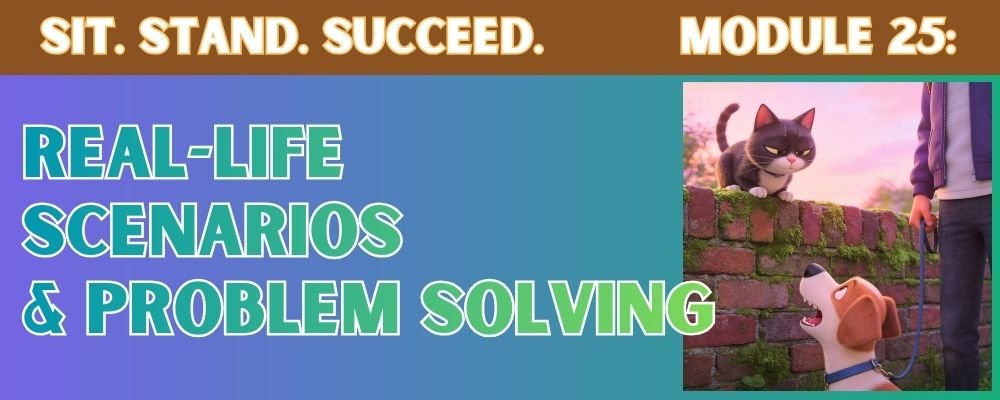
Prepare for the unexpected. Learn how to adapt training, handle setbacks, and maintain progress long-term.
This module is a big one because it brings everything together:
skills → confidence → real-life behaviour → calm problem-solving.
The goal is to prepare owners for the unpredictable nature of everyday life — and teach them how to respond calmly, confidently, and effectively when things don’t go to plan.
Learn how to handle unexpected challenges, adapt training on the fly, and guide your dog through everyday situations with clarity, structure, and calm leadership.
Real life isn’t a controlled training session.
It’s:
- dropped leashes
- off-leash dogs
- loud noises
- children running
- wildlife bolting
- surprise visitors
- stressful vet trips
- unexpected setbacks
This module teaches you how to respond to these challenges without fear or frustration — and how to help your dog feel secure no matter what’s happening.
You’ll learn:
- scenario-based training
- critical thinking
- environmental awareness
- calm crisis handling
- adaptive problem-solving
- how to reset a training plan when things go wrong
This is the module that truly turns owners into competent handlers.
🔵 1. Why Real-Life Problem Solving Matters
Many dogs can perform beautifully:
- at home
- in the backyard
- in a quiet park
But real life throws surprises.
A competent handler:
- predicts issues before they happen
- stays calm under pressure
- adapts cues to new environments
- protects the dog from danger
- communicates clearly
- resets calmly after setbacks
This module builds those skills.
🔵 2. The Three Components of Real-Life Dog Handling
Every real-world scenario requires:
✔ 1. Environmental Awareness
Know what’s around you:
- dogs
- bicycles
- children
- wildlife
- noises
- escape points
- triggers
- traffic
Good handlers scan the environment like lifeguards.
✔ 2. Emotional Control
Your dog reads your:
- breathing
- tone
- movements
- energy
If you remain calm, your dog has a chance to stay calm.
✔ 3. Behavioural Strategy
You choose:
- what cue to use
- whether to increase distance
- how to redirect
- whether to avoid or approach
- when to leave the situation
This is how you turn training into instinctive, confident action.
🔵 3. The Handler’s Decision Framework (Used by Professionals)
Here is the exact 4-step method behaviourists use in real-life scenarios:
✔ Step 1: Assess
What’s happening?
Where is the risk?
What does your dog need right now?
✔ Step 2: Adjust
Increase distance
Change direction
Lower criteria
Remove pressure
✔ Step 3: Act
Use:
- focus cues
- pattern games
- recall
- leave it
- mat behaviour
OR simply walk away calmly.
✔ Step 4: Anchor
Reward calm
End session on success
Reset emotionally
Move on
This stops you from panicking or reacting emotionally.
🔵 4. Real-Life Scenario Training (10 Practical Situations)
Below are examples of real-world scenarios and step-by-step instructions on what to do.
🟧 A. Off-Leash Dog Approaching Your Dog
This is one of the most stressful real-life situations for owners.
What to Do:
- Step calmly in front of your dog (body block)
- Say firmly to the other dog: “Stop!” or “Go home!”
- Toss a handful of treats behind the approaching dog
(redirects them away) - Quickly leave with your dog in the opposite direction
- Avoid tension on the leash
- Reward your dog for following calmly
What Not to Do:
❌ pick your dog up
❌ panic
❌ tighten leash (triggers fight response)
🟧 B. Dog SUDDENLY Pulls Toward Something (bird, smell, dog)
What to Do:
- Stop
- Wait for slack in leash
- Ask for eye contact
- Reward
- Continue walking calmly
This resets the moment and prevents escalation.
🟧 C. Visitor Arrives at the Door Unexpectedly
Steps:
- Cue: “Go to your mat”
- Reward calmness
- Open door only when dog is still
- Allow greeting only if calm
- If excited → quick reset back to mat
🟧 D. Dog Refuses to Come When Called Outdoors
Steps:
- Move AWAY from dog (never toward)
- Get low and inviting
- Use happy voice
- Reward massively
- Reduce distraction level next session
Recall failure = training issue, not disobedience.
🟧 E. Children Running Toward Your Dog
Steps:
- Step between children and dog
- Ask children to stop
- Put dog behind your leg
- Cue “sit” or “watch”
- Reward calm
- Allow quiet greeting only if safe
You are your dog’s advocate.
🟧 F. Loud Noise Frightens Your Dog (fireworks, motorbikes, storms)
Steps:
- Get distance
- Soften your tone
- Use pattern game (1-2-3 treat, up-down)
- Reward calm
- Avoid forcing the dog toward the noise
🟧 G. Dog Reacts (barks, lunges) at Another Dog
Steps:
- Increase distance immediately
- Turn sideways (less threatening)
- Cue “watch” or “touch”
- Reward ANY small moment of calm
- Exit the situation
This is NOT the time for discipline — it’s fear.
🟧 H. Dog Growls or Guards a Resource
Steps:
- DO NOT punish (dangerous)
- Freeze
- Toss high-value treat to create distance
- Remove resource once dog moves
- Begin resource-guard training later
- Protect the dog’s sense of safety
Never take things by force.
🟧 I. Meeting Another Dog on Footpath
Steps:
- Move to side
- Create space
- Walk in soft arc (not straight line)
- Reward focus on you
- Pass calmly
Arc movement prevents frontal pressure.
🟧 J. Dog Overexcited in the Car or Jumping Out
Steps:
- Ask for “wait”
- Open car door slightly
- Close if dog moves
- Only open fully when calm
- Release cue to exit
Car control = calm travel.
🔵 5. How to Handle Setbacks (The Reset System)
Training setbacks are normal and predictable.
Dogs regress when:
- stressed
- overstimulated
- in new environments
- during teenage phase
- sick or uncomfortable
Here is how to reset correctly:
✔ Step 1: Lower the difficulty
Go back to a simpler environment.
✔ Step 2: Reduce distraction
Remove competing stimuli.
✔ Step 3: Increase rewards
Rebuild confidence.
✔ Step 4: Shorten sessions
End on success.
✔ Step 5: Go back one module
Often solves the issue instantly.
🔵 6. The “One-Metre Rule” for Instant Behaviour Improvement
If something goes wrong:
Move one metre away from the trigger.
One metre can turn:
- reactivity → calm
- fear → curiosity
- confusion → clarity
Distance = safety.
🔵 7. Pattern Games for Crisis Management
Pattern games help dogs stay calm when situations escalate.
✔ Up-Down
Dog looks at environment → then at you → reward.
✔ 1-2-3 Treat
You say “1…2…3!” → treat on 3 → dog stays engaged.
✔ Side-by-Side Walking
Dog matches your movement → builds connection.
✔ Look at That (LAT)
Dog looks calmly at trigger → reward → confidence grows.
🔵 8. Common Real-Life Mistakes & Corrections
❌ tightening leash
✔ increase distance calmly
❌ yelling
✔ quiet voice, breathing
❌ forcing dog toward fear
✔ allow distance and observation
❌ punishing reactive behaviour
✔ manage emotions + reward calm
❌ letting situations escalate
✔ intervene early with space and direction
🔵 9. Practical Exercises for Module 25
Exercise A: Surprise Recall Drill
Call your dog randomly in safe areas.
Reward enthusiastically.
Builds responsiveness.
Exercise B: Emergency U-Turn Practice
Teach dog to turn with you instantly.
Great for avoiding triggers.
Exercise C: Threshold Training for Visitors
Mat → settle → greet calmly.
Exercise D: Sudden Distraction Rehearsal
Drop items or make mild noises.
Reward calm.
Exercise E: Real-Life Walk Simulation
Practice:
- passing dogs
- stopping
- sitting for calm
- arc walking
Exercise F: Controlled Surprise Exposure
Introduce mild surprises (new objects, sounds)
Reward curiosity and calm.
🔵 10. What Success Looks Like After Module 25
By the end of this module, your dog will:
✔ handle surprises with confidence
✔ recover from stress more quickly
✔ respond to cues even under pressure
✔ look to you for direction
✔ remain calmer in unpredictable environments
✔ improve behaviour through experience
✔ stay emotionally balanced
✔ build resilience and adaptability
And YOU will:
✔ know how to handle ANY real-life scenario
✔ stay calm under pressure
✔ apply training instantly and effectively
✔ make smart, safe decisions
✔ intervene early to prevent problems
✔ adapt your dog’s training on the fly
✔ feel confident in unpredictable situations
✔ become a truly competent, real-world handler
Responses