

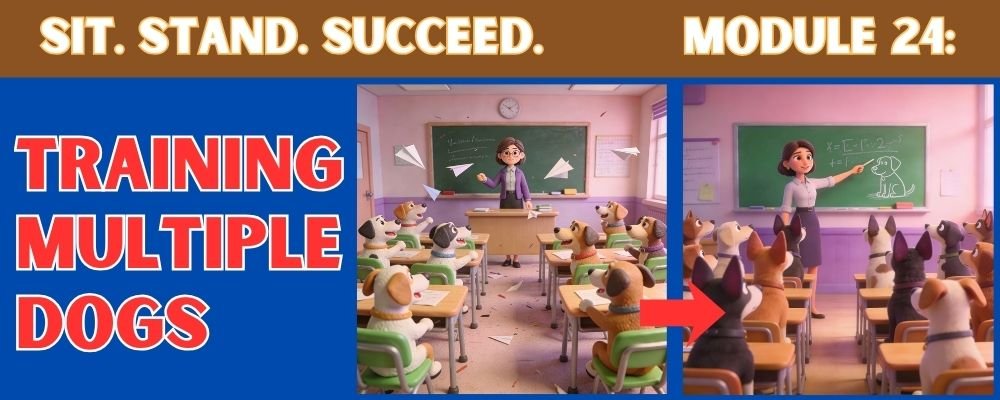
Manage multi-dog households effectively. Learn how to balance individual training while maintaining harmony and structure.
This module is especially important because multi-dog households often experience:
- competition
- jealousy
- resource guarding
- chaotic play
- inconsistent rules
- overstimulation
- uneven training results
- conflict between dogs
When managed well, a multi-dog home becomes harmonious, calm, and deeply rewarding.
When managed poorly, it becomes unpredictable and stressful — for the dogs AND the humans.
This module gives you the full system to train, manage, and build a peaceful, structured multi-dog household.
Learn how to train, manage, and create harmony between multiple dogs by using structure, individual attention, fair routines, and clear leadership.
Training more than one dog is NOT simply “training one dog but twice.”
It requires:
- twice the structure
- twice the clarity
- individual training
- group management
- controlled interactions
- fair access to resources
- well-designed routines
This module teaches you how to build the exact environment multi-dog homes need to thrive.
🔵 1. Why Multi-Dog Households Need Special Training
Dogs in multi-dog homes often struggle with:
- impulse control
- competition for attention
- resource guarding
- copying each other’s bad behaviours
- overstimulation
- jealousy
- selective obedience
They develop group behaviour patterns — good or bad.
Your job:
Shape the group, support the individuals.
🔵 2. The Golden Rule of Multi-Dog Training
👉 Train each dog separately BEFORE training them together.
Group training fails when:
- dogs distract each other
- one dog does all the thinking
- shy dogs get overshadowed
- excitable dogs set the tone
- bad habits “spread” across the dogs
Success depends on individual competence first.
🔵 3. The Three-Phase Multi-Dog Training System
Trainers follow these phases:
✔ Phase 1: Train Each Dog Individually
Teach every dog:
- sit
- down
- stay
- recall
- mat training
- name recognition
- impulse control
- leash skills
- calmness exercises
Individual training prevents dependency and creates clarity.
✔ Phase 2: Parallel Training (Dogs Working Side-by-Side, Not Interacting)
Dogs remain:
- on leash
- on mats
- focused on you
- rewarded for ignoring each other
This teaches calm coexistence.
✔ Phase 3: Group Training (Controlled Interactions)
Gradually introduce:
- group sits
- group stays
- group recalls (one at a time)
- calm greetings
- structured play
Now dogs learn to behave even in shared environments.
🔵 4. Managing the Household (Critical for Peace & Safety)
Multi-dog homes need structure to prevent conflict.
✔ A. Individual Spaces
Each dog should have:
- their own bed
- their own crate (highly recommended)
- their own feeding area
- access to personal rest time
Reduces competition and overstimulation.
✔ B. Separate Feeding (Non-Negotiable)
Even calm dogs can develop food guarding.
Feed dogs:
- in crates
- behind baby gates
- in separate rooms
This prevents conflict, anxiety, and competition.
✔ C. Controlled Access to High-Value Items
Bones, chews, stuffed Kongs, and toys can trigger conflict.
Rules:
- give these items separately
- supervise always
- remove items after use
- reward calm behaviour
✔ D. Rotational Attention System
Give:
- one-on-one training
- one-on-one affection
- one-on-one walks
This prevents:
- jealousy
- attention guarding
- clinginess
- insecurity
Every dog gets individual, meaningful connection.
🔵 5. Managing Competition & Preventing Conflicts
Dogs in a group compete for:
- your attention
- food
- toys
- doorways
- space
- positions on furniture
Here’s how to prevent issues:
✔ 1. Use Structured Greetings
When you arrive home:
- no crowding
- one dog greets at a time
- reward calm behaviour
- redirect overexcited dogs to mats
✔ 2. Enforce “Wait Your Turn” Rules
Teach dogs:
- sit before doors
- sit before treats
- one dog moves at a time
This prevents chaotic pushing and tension.
✔ 3. Manage Play Sessions
Rules:
- supervise
- interrupt if arousal skyrockets
- teach dogs to pause
- separate if play becomes one-sided
Healthy play is:
- loose
- bouncy
- reciprocal
- relaxed
✔ 4. Use Gates & Barriers Wisely
Gates create:
- calm transitions
- safe feeding
- controlled excitement
- stress-free training sessions
Gates are a multi-dog household’s best friend.
✔ 5. Identify Early Warning Signs of Tension
Watch for:
- freezing
- lip licking
- hard stares
- standing tall
- blocking access
- hovering around resources
- sudden silence
Intervene early with redirection.
🔵 6. Training Behaviours That Are Essential for Multi-Dog Homes
✔ Name recognition
Dogs respond when THEIR name is called.
✔ Individual recall
Never recall all dogs at once unless trained.
✔ Place/mat training
Each dog learns to settle independently.
✔ Wait cues
Stops crowding and competition.
✔ Polite greetings
Prevents chaos when people arrive.
✔ Leave it
Vital around shared environments.
✔ Release cues
Dogs learn that only the dog released moves.
🔵 7. Group Training Exercises (Professional Techniques)
✔ Exercise 1: One Dog Works, One Dog Waits
One dog trains with you
The other stays on mat
Switch roles
Builds patience & impulse control.
✔ Exercise 2: Group Sit & Stay
Start with short duration
Increase gradually
Reward individually
End before dogs break position.
✔ Exercise 3: Controlled Group Doorway Exit
Dogs sit
One name called
That dog exits
Rotate
Prevents pushing or conflict.
✔ Exercise 4: Sequential Recall
Call:
- “Bella, come!”
- reward
- release
- “Max, come!”
- reward
Teaches dogs NOT to rush when another dog is called.
✔ Exercise 5: “Calm Together” Mat Practice
Each dog on its own mat
Reward for calmness
Practice during:
- meals
- TV time
- visitors
- excitement
🔵 8. Handling Problem Scenarios in Multi-Dog Homes
❌ Resource Guarding
Solution:
separate feeding, teach trade-up, reward calm, remove triggers.
❌ One dog bullies another
Solution:
interrupt early, separate play, reward balanced interactions, create safe spaces.
❌ Dogs copy each other’s unwanted behaviour
Solution:
train individually, prevent rehearsal, reinforce calm behaviour.
❌ Jealousy over attention
Solution:
rotational one-on-one time, boundary training, predictable routines.
❌ Play becomes chaotic
Solution:
structured play, stop/start cues, calm breaks.
❌ Dogs rush the door when guests arrive
Solution:
assign mats, reward calm, greet one dog at a time, practice desensitisation.
🔵 9. The Multi-Dog Harmony Formula
To create peace and structure in a multi-dog household:
✔ Individual training
✔ Structured group training
✔ Separate feeding & resources
✔ Clear routines
✔ Fair rules
✔ Calm leadership
✔ Supervised play
✔ Consistent boundaries
✔ Emotional neutrality
✔ Predictable interactions
When all of this is in place, multi-dog homes become easy, calm, and joyful.
🔵 10. What Success Looks Like After Module 24
By the end of this module, your dogs will:
✔ cooperate calmly with each other
✔ follow individual cues reliably
✔ work side-by-side without tension
✔ share space respectfully
✔ play safely
✔ wait their turn
✔ settle on mats peacefully
✔ obey rules without conflict
✔ trust each other and you
And YOU will:
✔ feel fully in control of the household
✔ understand how to prevent conflict
✔ manage resources safely
✔ train each dog effectively
✔ balance individual and group needs
✔ maintain harmony with confidence
✔ lead the group with calm, fair authority
Responses