

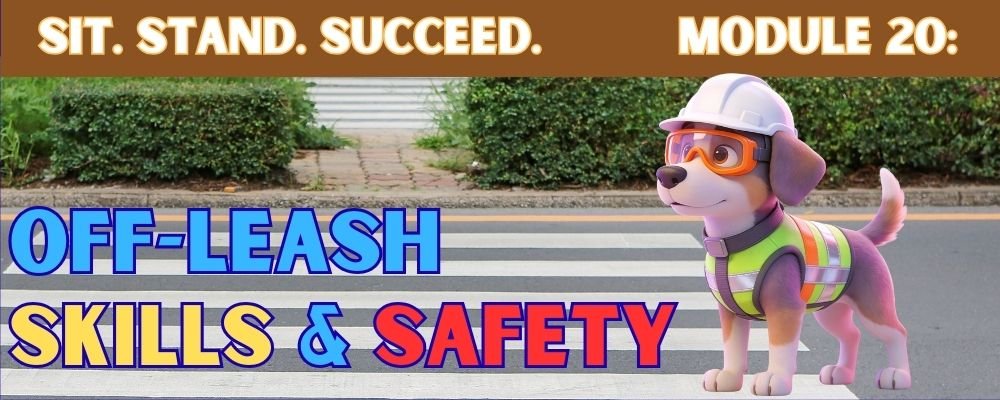
Learn when — and when not — to allow off-leash freedom. This module focuses on safety, control, and responsible decision-making.
This is one of the most critical modules in the entire program, because off-leash freedom is both the dream and the danger zone for many dog owners.
A reliable off-leash dog is:
- calm
- connected
- safe
- responsive
- confident
- predictable
But off-leash reliability doesn’t happen by chance — it happens by deliberate, structured, safety-focused training.
This module teaches you exactly how to develop that reliability step by step, without shortcuts or risk.
Teach your dog safe, controlled freedom through structured training, strong recalls, and real-world awareness.
Off-leash freedom is only safe when:
- your dog can recall reliably
- your dog can disengage from triggers
- your dog stays connected to you
- your dog remains calm under excitement
- YOU understand environmental risks
- you build freedom gradually and responsibly
This module ensures you and your dog earn that freedom the right way.
🔵 1. The Three Requirements for Off-Leash Training
Before a dog is ever allowed off-leash, they must demonstrate these 3 core skills:
✔ 1. Reliable Recall (10/10 indoors, 8/10 outdoors on long line)
Your dog MUST come when called — even around:
- smells
- sounds
- wildlife
- other dogs
- distractions
If recall is weaker than this → dog is not ready yet.
✔ 2. Disengagement Ability
Your dog must be able to:
- look at a distraction
- think
- turn away
- come back to you
Disengagement = safety.
✔ 3. Environmental Awareness (Your Responsibility)
Owners need to know how to assess:
- terrain
- dogs nearby
- wildlife
- escape routes
- hazards
- legal off-leash zones
Off-leash training is as much about YOU as your dog.
🔵 2. The Off-Leash Readiness Checklist
Your dog is almost ready for controlled freedom if they can:
✔ Respond to their name instantly
✔ Recall from 10–15 metres on long line
✔ Come away from other dogs on cue
✔ Return even when sniffing
✔ Walk past distractions calmly
✔ Stay engaged voluntarily outdoors
✔ Check in with you without being asked
✔ Handle unexpected events with calmness
If 80% of this list is true → you can begin controlled off-leash training.
🔵 3. The Long-Line Training System (The Professional Method)
A long-line (5–15 metres) is the bridge between on-leash and off-leash reliability.
Never skip this step.
✔ Stage 1: Drag-Line Training
Attach a 3–5 metre line but let it drag behind the dog.
Dog feels free
BUT you still have emergency control.
Practice:
- recalls
- engagement checks
- disengagement
- leave-it
- mini distance stays
✔ Stage 2: Long-Line Freedom (10–15 metres)
Here, you practice real-world freedom while staying safe.
Training includes:
- calling dog out of play
- calling dog off smells
- calling dog away from movement
- rewarding heavily for rapid response
This is where you proof behaviours under mild distractions.
✔ Stage 3: Long-Line Under Heavy Distraction
Dogs, birds, people, new environments.
You’re still practicing:
- disengage
- focus
- recall
- check-ins
Only when your dog succeeds HERE is off-leash safe.
🔵 4. The Critical Skills Every Off-Leash Dog Must Know
These are non-negotiable.
✔ A. Super Recall (“Emergency Recall”)
A special cue used ONLY in emergencies:
- different word (“Here!”, “NOW!”, “Party!”, “To Me!”)
- always rewarded with best treats
- practiced frequently but never overused
This recall must pay the jackpot every time.
✔ B. Auto Check-Ins
Your dog looks back at you voluntarily every few seconds.
This shows:
- emotional connection
- situational awareness
- readiness for freedom
Reward these heavily.
✔ C. Stop Cue (“Wait” / “Stop”)
Allows you to halt your dog immediately.
Used when approaching:
- cliffs
- roads
- unknown dogs
- hazards
Teach indoors → outdoors → long-line → off-leash.
✔ D. Leave-It
Your dog must disengage instantly from:
- rubbish
- food
- dead animals
- wildlife
- other dogs’ toys
Strong leave-it = huge safety.
✔ E. Follow Cue (“This Way”)
Instead of yelling or chasing your dog:
- cheerful cue
- turn your body
- dog follows
- reward
This creates voluntary movement toward you.
✔ F. Staying Near You
Teach your dog to stay within a “working radius” (5–10 metres).
Reward:
- staying close
- slowing down
- checking in
Most dogs naturally widen their distance unless trained.
🔵 5. Controlled Off-Leash Training Environments
You must choose appropriate training locations.
✔ Best Starter Locations
- fenced ovals
- empty parks
- quiet beaches
- tennis courts
- school grounds (when allowed)
Your dog gets space
without real-world danger.
✔ Intermediate-Level Locations
- dog parks during quiet hours
- open fields
- calm walking trails
- bush paths with visibility
Still low risk, but more distractions.
✔ Advanced Locations
Only when dog is 100% safe:
- busy parks
- off-leash beaches
- open forest trails
- rural fields
- social dog areas
Never attempt advanced environments too early.
🔵 6. What NOT to Do During Off-Leash Training
These mistakes cause most failures.
❌ Overusing the recall cue
Soon the dog stops responding.
❌ Recalling only to end fun
Dog learns “recall = fun ends.”
Fix: recall → treat → release back to play.
❌ Shouting or panicking
Dogs avoid fearful or angry tones.
❌ Chasing the dog
Turns it into a game you cannot win.
❌ Allowing off-leash play too early
Rewards disconnection instead of engagement.
❌ Practicing in unsafe environments
Roads, cliffs, livestock, or crowded dog areas.
❌ Forgetting to reward check-ins
These are GOLD — reward every time.
🔵 7. Building Off-Leash Confidence Through Structured Games
These games massively strengthen reliability.
✔ Game 1: The Boomerang Recall
Let dog walk ahead → call → reward → release.
Builds speed + enthusiasm.
✔ Game 2: Hide & Seek
Hide behind a tree → dog finds you → huge reward.
Teaches dog YOU disappear when they don’t check in.
✔ Game 3: Two-Person Recall Relay
Great for families.
Dog runs joyfully between handlers → reinforcement explosion.
✔ Game 4: Freedom → Check-In → Release
Dog gets freedom when checking in — not randomly.
✔ Game 5: Changing Directions Walk
Dog learns to:
- track you
- follow movement
- pay attention
Increases off-leash awareness.
🔵 8. Wildlife, Livestock & High-Risk Scenarios
Many dogs lose reliability around:
- kangaroos
- birds
- rabbits
- livestock
- scents
- fast movement
Use:
- long line
- emergency recall
- distance
- arcing movement
- structured disengagement
NEVER allow off-leash freedom where wildlife or livestock are present unless your dog is fully reliable.
🔵 9. Practical Exercises for Module 20
Exercise A: 5-Level Recall Progression
Practice recall in 5 environments of increasing difficulty.
Exercise B: 20 Rep Check-In Drill
Reward 20 spontaneous check-ins per walk.
Exercise C: Drag-Line Freedom Training
Use short line indoors → yard → quiet park.
Exercise D: Emergency Recall Conditioning
1 cue → 1 huge reward → release → no repetition.
Exercise E: Stay Within Radius Game
Reward staying within 5–8m of you.
Exercise F: Controlled Greetings Practice
Recall away from friendly dogs → reward → release to play.
🔵 10. What Success Looks Like After Module 20
By the end of this module, your dog will:
✔ recall reliably in many environments
✔ disengage from distractions quickly
✔ maintain voluntary check-ins
✔ stay within safe distance naturally
✔ respond to emergency recall instantly
✔ behave predictably around dogs and people
✔ explore with confidence but stay connected to you
And YOU will:
✔ know when off-leash freedom is safe
✔ use long-line training like a professional
✔ prevent dangerous situations before they occur
✔ read your dog’s emotional state accurately
✔ feel confident allowing controlled off-leash time
✔ understand safety laws and environmental risk
Responses