
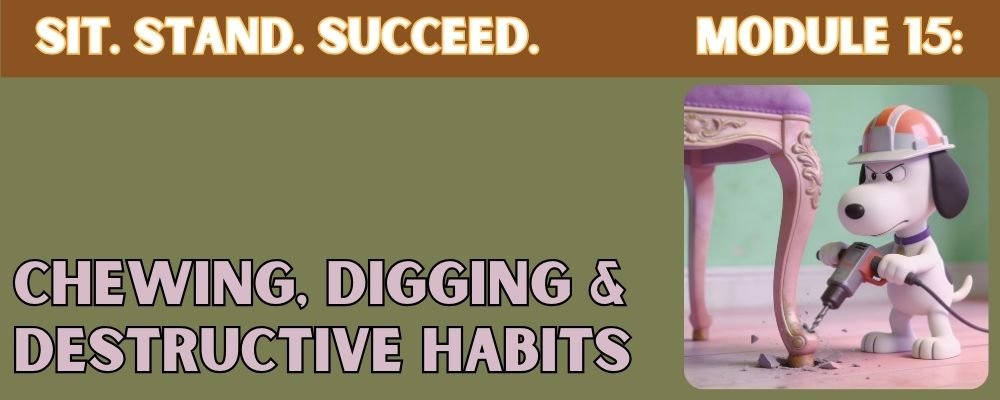
Manage natural dog behaviours in healthy ways. Learn redirection strategies and prevention techniques that protect your home and your dog.
This module tackles some of the most common, misunderstood, and often frustrating behaviours.
But here’s the truth:
👉 Chewing, digging, shredding, and stealing are NOT “bad behaviours”…
They’re normal dog behaviours expressed in the wrong context.
Once owners learn why they happen and how to redirect them, these issues can be dramatically reduced — often within days.
Understand why dogs destroy things, redirect natural instincts into appropriate outlets, and prevent damage before it starts.
Destructive behaviour is almost always caused by:
- boredom
- excess energy
- teething
- stress
- unmet instincts
- lack of structure
- unclear boundaries
- anxiety or frustration
- lack of supervision
This module teaches you how to prevent, redirect, and replace destructive habits with healthy, calm behaviours.
🔵 1. Why Dogs Chew, Dig & Destroy Things
Before you fix these behaviours, you must understand what drives them.
✔ 1. Chewing
Dogs chew because:
- it relieves stress
- it soothes teething pain (puppies)
- it releases pleasure chemicals
- it prevents boredom
- it is instinctive
Chewing is necessary for dogs — our job is to provide the right outlets.
✔ 2. Digging
Dogs dig because:
- they’re genetically wired to (terriers, hounds, working breeds)
- it cools them down
- it provides entertainment
- it relieves frustration
- prey scent stimulates instinct
Digging cannot be punished away — it must be redirected or managed.
✔ 3. Destroying Objects
Dogs tear up items because:
- destruction releases energy
- shredding is extremely satisfying
- it relieves anxiety
- it’s self-rewarding (feels good)
- the human accidentally reinforced it once
Destruction is rarely “naughty.”
It’s an outlet.
🔵 2. The Three-Phase Fix for Destructive Behaviour
Professional trainers use a structured approach:
✔ Phase 1: Management (Preventing Rehearsal)
You must stop the dog from practicing unwanted behaviours because:
What is practiced becomes stronger.
What is prevented becomes weaker.
Tools for management:
- baby gates
- crates/playpens
- closed doors
- putting tempting objects away
- chew-proof bins
- supervision
Management is NOT punishment —
it’s setting your dog up to succeed.
✔ Phase 2: Redirection (Replace Bad Habits With Good Ones)
Instead of “NO!”
We teach:
“This instead.”
You give the dog an outlet for the same instinct:
- chew → give chew toys
- dig → create dig zones
- shred → offer shreddable toys
- steal → offer tug toys
- carry objects → give safe items to carry
Redirection is powerful because it works with your dog’s instincts, not against them.
✔ Phase 3: Fulfilment (Meet the Dog’s Needs)
Most destructive behaviour disappears once needs are met:
Mental needs:
puzzle toys
scent work
training
foraging
Physical needs:
walks
play
structured exercise
Emotional needs:
calm routines
predictable structure
self-soothing skills
A fulfilled dog = a calm dog.
🔵 3. Solving Chewing Problems — Step-by-Step
✔ Step 1: Give Appropriate Chewing Options
Recommended chews:
- stuffed Kongs
- long-lasting chews
- raw bones (if appropriate)
- bully sticks
- antlers (soft ones for gentle chewers)
- rope toys
- rubber toys
- food-dispensing toys
Rotate options — novelty increases interest.
✔ Step 2: Remove or Manage Forbidden Items
Dogs don’t automatically know “don’t chew that.”
Put away:
- shoes
- remotes
- kids’ toys
- glasses
- socks
- loose items
This reduces failure.
✔ Step 3: Teach “Trade” Instead of Correction
If dog is chewing something wrong:
- Do NOT yell or chase.
- Say cheerful “Trade?”
- Offer a high-value treat or toy.
- Take inappropriate item calmly.
- Reward when dog drops it.
This builds trust and improves cooperation.
✔ Step 4: Increase Enrichment
Chewing is often a symptom of under-stimulation.
Increase:
- sniffing
- puzzle meals
- training
- scent games
✔ Step 5: Supervise Until Trustworthy
If your dog rehearses chewing behaviour:
- use gates
- use crate
- use tether training
Build freedom slowly.
🔵 4. Solving Digging Problems — Step-by-Step
Digging can be one of the hardest behaviours to change —
unless you work WITH the dog’s instinct.
✔ Step 1: Identify the Reason for Digging
Ask yourself:
- Is dog bored?
- Is dog hot?
- Is dog anxious?
- Is dog hunting prey?
- Is dog left alone too long?
- Is dog under-exercised?
Each reason = different solution.
✔ Solution for Boredom Digging
- add enrichment
- more exercise
- scent work
- rotate yard toys
- short training sessions
✔ Solution for Cooling Digging
Dogs dig cool spots.
Provide:
- shaded resting area
- cooling mat
- access indoors
✔ Solution for Hunting/Prey Digging
If the yard smells like prey:
- block access
- supervise
- scent-redirection games
- provide digging alternatives
✔ Solution for Stress Digging
If dog digs to release tension:
- add calm routines
- increase predictability
- reduce alone time
- provide enrichment chews
✔ Create a “Legal Digging Zone” (Powerful!)
Instead of “stop digging”…
Give your dog a place to dig.
Steps:
- Pick a corner of the yard.
- Fill with sand, soil, or safe substrate.
- Bury toys or treats.
- Encourage dog to dig there.
- Reward digging in correct zone.
Dogs quickly learn:
“Dig here = yes.
Dig lawn = no reward.”
🔵 5. Solving Destructive Habits
Destruction is often:
- self-rewarding
- emotional release
- boredom behaviour
Here’s how to fix it.
✔ 1. Increase Supervision
Destruction happens when dog is unwatched.
Use:
- gate
- crate
- pen
- tether
✔ 2. Add Daily Mental Enrichment
Scent work reduces destructive behaviour dramatically.
Examples:
- snuffle mats
- hide-and-seek treats
- scatter feeding
- puzzle toys
- muffin tin game
✔ 3. Add Physical Exercise — But Not Overstimulation
Balanced exercise improves behaviour.
Examples:
- sniff-walks
- structured tug
- fetch (limited time)
- agility-style play
✔ 4. Fulfil Instincts
If dog needs:
- to chew → provide chews
- to shred → provide cardboard boxes
- to dig → provide dig zone
- to chase → use flirt pole safely
- to carry → provide carry toys
Meet the need → behaviour reduces.
✔ 5. Teach Calmness
Calm routines reduce destruction by lowering arousal.
Use:
- mat training
- settle cues
- breathing exercises
- quiet time
🔵 6. Teaching Dogs What NOT To Chew — The Gentle Way
Never punish.
Instead:
- Interrupt calmly
- Redirect to chew toy
- Reward for choosing correctly
- Rotate toy selection
- Reinforce calm engagement
Punishment teaches fear — not good habits.
🔵 7. Preventing Repeat Offences (The “No-Rehearsal Rule”)
If your dog destroys something once, it may happen again unless prevented.
Use:
- management
- supervision
- clear redirection
- environmental changes
Break the cycle → behaviour disappears.
🔵 8. Special Situations: Puppies vs Adults
✔ Puppies
Chew because:
- teething
- exploration
- boredom
- lack of impulse control
They need:
- frozen teething toys
- supervision
- chew cycle rotation
- training short bursts
✔ Adolescent Dogs
Peak destruction age: 6–18 months
Because:
- high energy
- high curiosity
- low impulse control
- surplus hormones
They need:
- structured days
- impulse-control training (Module 9)
- exercise + enrichment
✔ Adult Dogs
Often destroy due to:
- boredom
- lack of mental stimulation
- lack of routine
- separation anxiety
They need:
- structure
- routine
- calmness practices (Module 17)
🔵 9. Practical Exercises for Module 15
Exercise A: Trade Game
Builds cooperation and prevents guarding.
Exercise B: Chew Station Setup
Set up a chew corner with:
- chews
- toys
- food puzzles
Reward dog for using it.
Exercise C: Digging Zone Training
Bury treats → encourage digging → reward.
Exercise D: Redirect & Reward Cycle
Interrupt inappropriate chewing → offer toy → reward.
Exercise E: Daily Enrichment Rotation
Choose:
1 toy
1 chew
1 puzzle
1 scent activity
Rotate daily.
🔵 10. What Success Looks Like After Module 15
By the end of this module, your dog will:
✔ chew the right things instead of your belongings
✔ dig less (or only in the allowed zone)
✔ shred toys instead of household items
✔ settle more easily and quickly
✔ show fewer signs of boredom or frustration
✔ become calmer and more balanced in daily life
And YOU will:
✔ know EXACTLY why destructive behaviour happens
✔ be able to redirect instincts rather than fight them
✔ prevent destruction before it starts
✔ fulfil your dog’s mental, physical, and emotional needs
✔ confidently manage both puppies & adolescent dogs
Responses