

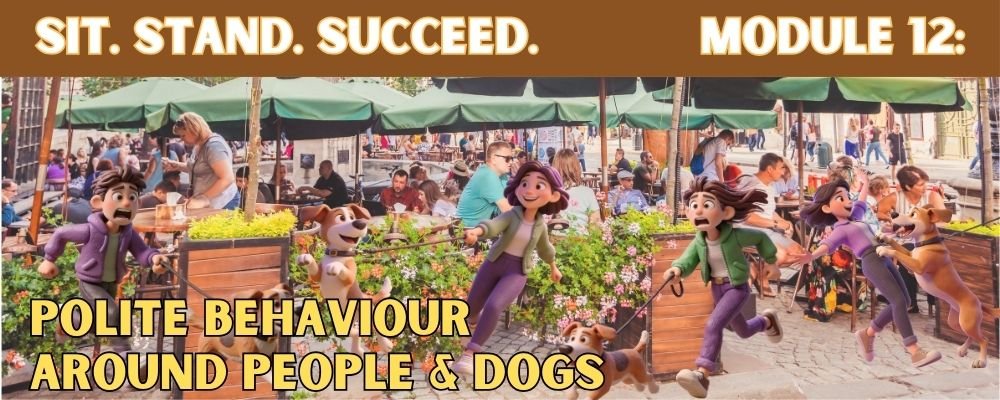
End jumping, over-excitement, and chaotic greetings. You’ll teach calm, polite behaviour at home and out in the world.
This module is extremely valuable because most “bad manners” aren’t disobedience — they’re emotional overflow, confusion, or instinct.
When dogs learn HOW to behave politely around people and other dogs, life becomes calmer, safer, and much more enjoyable.
Teach your dog calm greetings, controlled behaviour in social settings, and better manners at home and outdoors.
Most dogs aren’t naturally polite.
They:
- jump
- rush forward
- bark with excitement
- get overwhelmed
- pull toward people or dogs
- greet too intensely
- react when frustrated
This module teaches your dog:
- calm approaches
- controlled greetings
- healthy social skills
- emotional stability
- positive interactions
Let’s turn chaotic greetings into calm, confident behaviour.
🔵 1. Why Dogs Struggle With Social Manners
Dogs often misbehave around people/dogs because:
✔ they are overstimulated
✔ they lack clear routines and boundaries
✔ humans reinforce unwanted behaviours
✔ they don’t understand what we expect
✔ greetings happen too fast
✔ they’ve never practiced calm behaviour
This module corrects these problems with structure, practice, and controlled exposure.
🔵 2. Polite Greetings with People
Jumping, pawing, barking, pulling — these aren’t dominance behaviours.
They’re excitement behaviours.
✔ The Calm Greeting Formula
(Used by professional trainers)
Excitement = no greeting
Calmness = greeting
Simple, powerful, effective.
✔ Step-by-Step Training for Calm Greetings
Step 1: Pre-Greeting Calm
Before approaching a person:
- ask for sit (or stand if dog prefers)
- reward calm body language
If dog cannot sit from excitement —
move away, reset, try again.
Step 2: Approach Using the 3-Step Rule
- Take 2–3 steps toward person
- If dog stays calm → keep moving
- If dog becomes excited → step back
This teaches the dog:
“Calm gets you closer.
Excitement makes the greeting go away.”
Step 3: The Greeting Moment
When within 1–2 yards/metres:
- dog must be calm AND have four paws on the ground
- person must ignore the dog until calm
Then person may:
- offer a hand
- speak softly
- give a gentle pat
Only praise when dog remains calm.
Step 4: Release Cue
Greeting ends with:
- “All done”
- “Free!”
- or your release word
This prevents lingering excitement.
✔ Training the Polite Greeting Indoors First
Practice with:
- family
- friends
- visitors invited for training
You teach:
- sit for greeting
- stay calm when someone enters
- mat training (dog stays on mat while person enters)
Mat training works brilliantly:
Door opens → dog stays on mat → gets rewarded → greeting happens calmly.
🔵 3. Stopping Jumping on People
Jumping is usually caused by:
- excitement
- seeking attention
- humans accidentally rewarding it
Here’s how to eliminate it.
✔ Set a Clear Rule
Jumping NEVER gets attention.
When dog jumps:
- turn away
- no talking
- no touching
- no eye contact
When dog stops jumping:
- “Yes!” → reward calm behaviour
- offer greeting
Dogs learn FAST with this clarity.
✔ Replace Jumping With a Functional Behaviour
Teach:
- sit
- hand target (“touch”)
- calm stand
Give them something TO DO instead of jumping.
🔵 4. Polite Behaviour Around Other Dogs
Social behaviour with other dogs must be taught —
it does not happen automatically.
Dogs often:
- pull toward other dogs
- become overexcited
- bark with frustration
- rush into greetings
- greet too intensely
- ignore warning signals
This module fixes all of these issues.
✔ Step 1: Controlled Distance (Critical for Success)
Start at a distance where your dog:
- can look at a dog
- remain calm
- respond to cues
- check in with you
This is called the Awareness Zone, not the Explosion Zone.
✔ Step 2: Reward Calmness on Approach
As you walk toward another dog:
- reward check-ins
- reward calm body behaviour
- reduce pace
- speak softly
If your dog becomes excited:
- increase distance
- reset
Distance = control.
✔ Step 3: Side-by-Side Walking Before Greeting
Before dogs actually meet:
- Walk parallel to the other dog
- Dogs face the same direction
- Humans remain calm
- Reward calm walking
This reduces frontal pressure (which causes tension).
✔ Step 4: The “3-Second Dog Greeting Rule”
This prevents:
- tension
- intimidation
- escalation
- over-arousal
The Rule:
- Dogs sniff briefly (3 seconds)
- Humans gently call dogs away
- Reward both dogs
Short, controlled greetings = success.
✔ Step 5: Call Away & Release
Teach your dog to return to you after greeting:
- Call your dog back
- Reward generously
- Release with “Go say hi” for a second greeting
This reinforces control + social opportunities.
🔵 5. Preventing & Fixing Overexcited Greeting Behaviours
✔ Problem: Dog pulls toward people/dogs
Fix:
- increase distance
- use 3-step approach
- reward check-ins
- teach loose-lead walking (Module 10)
✔ Problem: Dog barks in excitement
Fix:
- increase distance
- use engagement games
- reward quiet moments
- avoid high-pressure greetings
✔ Problem: Dog becomes mouthy or jumpy
Fix:
- use sit or hand-target as alternative
- reward calm behaviour
- keep greetings short
✔ Problem: Dog ignores owner when others are around
Fix:
Go back to Module 7 — strengthen focus and engagement first.
🔵 6. Teaching Calm Behaviour Around Visitors at Home
Visitors are one of the top triggers for overexcitement.
Here’s the professional routine:
✔ Routine: The Visitor Protocol
Step 1: Dog goes to mat
Step 2: Visitor enters quietly
Step 3: Dog stays on mat until release
Step 4: Calm greeting allowed only when dog is settled
Reward heavily for staying calm.
This prevents:
- barking
- jumping
- rushing door
- overwhelm
🔵 7. Reading Dog Body Language During Social Interactions
Knowing what dogs are saying during greetings stops problems early.
✔ Signs of Calm, Polite Interaction
- loose body
- soft tail wag
- curved body approach
- brief sniffing
- turning away afterwards
✔ Signs of Over-Arousal
- stiff body
- high tail
- intense pulling
- whining or barking
- weight shifted forward
Increase distance immediately.
✔ Signs of Discomfort or Stress
- lip licking
- yawning
- looking away
- tucking tail
- moving behind you
End the greeting calmly.
🔵 8. Practical Exercises for Module 12
Exercise A: Step-In, Step-Out Greeting Drill
Move toward person 2 steps → reward calm
Move back 2 steps → reset
Repeat until calm behaviour increases.
Exercise B: Hand Target Greeting
Teach dog to “Touch” person’s hand instead of jumping.
Exercise C: Visitor Mat Routine
Train calmness on a mat before greeting.
Exercise D: Parallel Walking with Another Dog
Side-by-side walking → calm → controlled greeting.
Exercise E: The 3-Second Rule Practice
Short sniff → recall → reward → optional second greeting.
🔵 9. What Success Looks Like After Module 12
By the end of this module, your dog will:
✔ greet people without jumping or pulling
✔ stay calm when visitors arrive
✔ approach dogs politely and confidently
✔ disengage on cue after greetings
✔ control excitement in social settings
✔ walk calmly around dogs and people
✔ show better emotional stability overall
And YOU will:
✔ understand social body language
✔ know exactly how to structure greetings
✔ prevent over-arousal before it starts
✔ confidently manage interactions
✔ give your dog safe, positive social experiences
✔ know when to step in and when to step back
Module 12 turns chaos into calm, and confusion into confident, polite behaviour.
Responses