

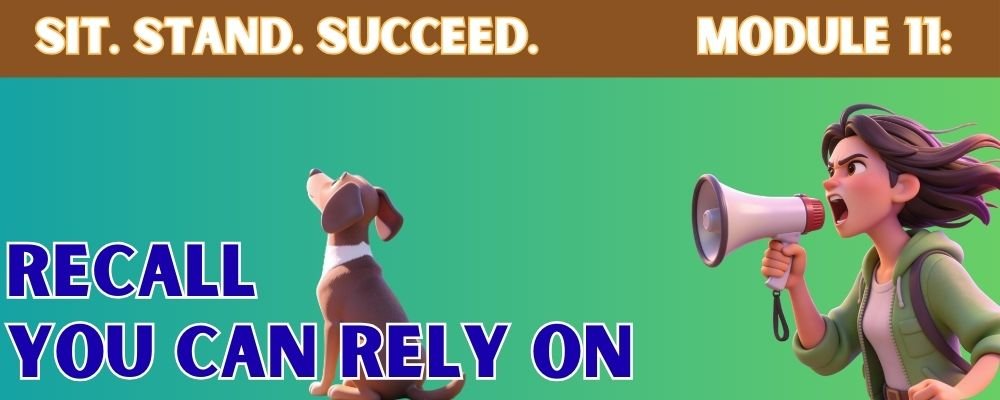
Teach your dog to come when called — even in real-life situations. This module focuses on building a recall that’s fast, reliable, and safe.
This module is CRITICAL because recall is the one cue that can literally save a dog’s life.
A reliable recall gives your dog:
- more freedom
- more off-leash exploration
- more confidence
- more safety
- a stronger bond with you
And it gives you:
- peace of mind
- control in emergencies
- enjoyable adventures
- a dog you can trust anywhere
This isn’t “just teaching come.”
This is building a dog who runs to you with joy — no matter what the distraction is.
Teach your dog to come when called — reliably, happily, and even around distractions.
Most recall problems come from:
- calling the dog too often
- calling when the dog is distracted
- calling only to end fun
- calling with an annoyed voice
- calling in situations the dog isn’t ready for
- inconsistently reinforcing coming back
This module builds a recall that is:
✔ fast
✔ joyful
✔ automatic
✔ reliable in the real world
🔵 1. The Golden Rules of Recall
Follow these rules and recall becomes much easier.
✔ Rule 1: “Come” must ALWAYS be positive.
Never call your dog to:
- punish
- scold
- end play
- take something away
- put them inside
- stop their fun without rewarding
Recall must be a party, every single time.
✔ Rule 2: Use a cheerful, friendly tone.
Dogs come faster to:
- higher pitch
- excited tone
- inviting energy
Tone matters more than the word.
✔ Rule 3: Always reward recall generously.
Great recalls = great rewards.
Use:
- chicken
- cheese
- tug toy
- ball
- freedom (sniffing!)
Low-value rewards create slow recall.
✔ Rule 4: Never chase your dog.
If you chase them:
They learn running away = fun.
Instead:
- run backwards
- crouch
- act playful
Draw the dog toward you.
✔ Rule 5: Use a long line until recall is reliable.
A long line:
- prevents failure
- keeps dog safe
- reinforces lessons
- allows freedom
Never practice recall off-leash too early.
🔵 2. Foundation Recall Training (Indoors First)
You do NOT start recall in the yard or park.
You start where the dog can win.
✔ Exercise 1: The “Charging the Cue” Game
Teach your dog that the recall cue = amazing things.
Steps:
- Say “Come!”
- Immediately give a treat (don’t wait for behaviour).
- Repeat 20 times.
Your dog learns:
“That word means something awesome is coming.”
This builds emotional power behind the cue.
✔ Exercise 2: The “Treat & Retreat” Game
Perfect for nervous, distracted, or unsure dogs.
- Toss treat away.
- Dog goes to get treat.
- Say “Come!” as dog lifts head.
- Dog turns → “Yes!” → treat from you.
This builds a natural return pattern.
✔ Exercise 3: The Two-Person Recall Game
If you have two people available:
- Sit opposite each other.
- Call the dog back and forth.
- Reward heavily for each return.
Builds repetition and speed.
🔵 3. Intermediate Recall — Adding Movement & Excitement
Once the dog is responding indoors:
✔ Exercise 4: “Run Away Recall”
Movement builds engagement.
- Say “Come!”
- Immediately jog backwards.
- Dog chases you → reward.
Chasing YOU is more fun than chasing distractions.
✔ Exercise 5: Hide & Seek Recall
- Hide behind a door or sofa.
- Call the dog.
- Dog finds you → huge celebration + reward.
This creates enthusiastic, natural recall.
✔ Exercise 6: Long Line Recall
Use a 5–10m long line.
- Let dog explore.
- Call once.
- If dog hesitates → gentle reel-in (no yanking).
- Reward the MOMENT they move toward you.
Long line prevents failure and builds reliability.
🔵 4. Advanced Recall — Distraction Proofing
You’ll now add controlled distractions using the Recall Ladder.
🪜 The Recall Ladder
Level 1
Mild distractions indoors
- toys on floor
- soft noise
- someone walking by
Level 2
Backyard distractions
- birds
- smells
- leaves
- sounds
Level 3
Medium outdoor distractions
- dog at a distance
- children playing nearby
- people walking past
- bicycles
Level 4
High-intensity distractions
- dogs running
- off-leash areas
- wildlife
- beaches
- crowded parks
You only move up when your dog succeeds at least 80% of the time.
🔵 5. The Emergency Recall — A Lifesaving Cue
This is a special cue reserved for true emergencies:
- gate left open
- dog heading toward road
- off-leash dog approaches
- wildlife appears
- dog bolts unexpectedly
Choose a cue different from “Come”:
- “Here!”
- “To me!”
- A whistle
- “Let’s go!”
- “Party time!”
✔ How to train the Emergency Recall Cue
- Say the emergency cue.
- Immediately deliver jackpot rewards:
- 10 tiny treats
- tug session
- favourite toy
- rapid-fire rewards
- Use only 2–3 times per week for training.
- NEVER use this cue casually.
Your dog will come running like it’s the best event in their life.
🔵 6. Real-Life Recall Strategies
These tips separate average recall from bulletproof recall.
✔ Strategy 1: Use “Surprise Rewards”
When your dog returns without being called:
- reward
- praise
- release again
This massively increases voluntary check-ins.
✔ Strategy 2: Reward With Freedom
One of the strongest rewards is:
“Go play!”
or
“Go sniff!”
This teaches:
Returning = more freedom.
✔ Strategy 3: Don’t Overuse the Cue
Call your dog:
- intentionally
- sparingly
- only when you can reward
Never “nag” the cue.
✔ Strategy 4: Recall from Low to High Distraction Gradually
You cannot jump from:
living room → park
Success requires:
living room → backyard → quiet oval → quiet park → busy park
This protects your dog’s confidence.
✔ Strategy 5: Build a Habit of Checking In
Use rewards when your dog:
- glances at you
- returns naturally
- walks near you
- chooses you over distractions
This builds an automatic habit of staying connected outdoors.
🔵 7. Common Recall Problems & Fixes
❌ Dog runs away from you
Fix: run backwards or crouch → become more fun.
❌ Dog ignores you outdoors
Fix:
- lower distraction
- add value to rewards
- use long line
- use “run away recall”
❌ Dog comes slowly
Fix: reward faster arrivals more generously.
❌ Dog stops short
Fix: toss treat between your legs to teach full return.
❌ Dog only comes inside
Fix: make outdoors rewarding
→ treats
→ toys
→ sniff breaks
→ freedom
❌ Dog won’t come away from other dogs
Fix:
- increase distance
- use higher value rewards
- practice with calm dogs from distance first
- build engagement before greeting
🔵 8. Daily Recall Training Plan
✔ Day 1–3: Indoors
Charging the cue
Treat & Retreat
Two-Person Recall
✔ Day 4–7: Backyard
Long-line recall
Hide & Seek recall
Run away recall
✔ Week 2: Quiet street or oval
Distraction ladder
Movement-based recall
✔ Week 3+: Real-world
Controlled dog distraction
Sniff rewards
Emergency recall practice
🔵 9. What Success Looks Like After Module 11
By the end of this module, your dog will:
✔ come when called — without hesitation
✔ respond reliably in low, medium, and high distraction
✔ understand that “Come” = huge reward
✔ check in with you naturally
✔ follow you joyfully when you run backwards
✔ come off smells, people, and other dogs
✔ have a powerful emergency recall cue
And YOU will:
✔ know how to train recall step-by-step
✔ prevent failure using a long line
✔ reward effectively and strategically
✔ use the Recall Ladder correctly
✔ trust your dog with increasing freedom
✔ be confident in real-life off-leash situations
Responses