
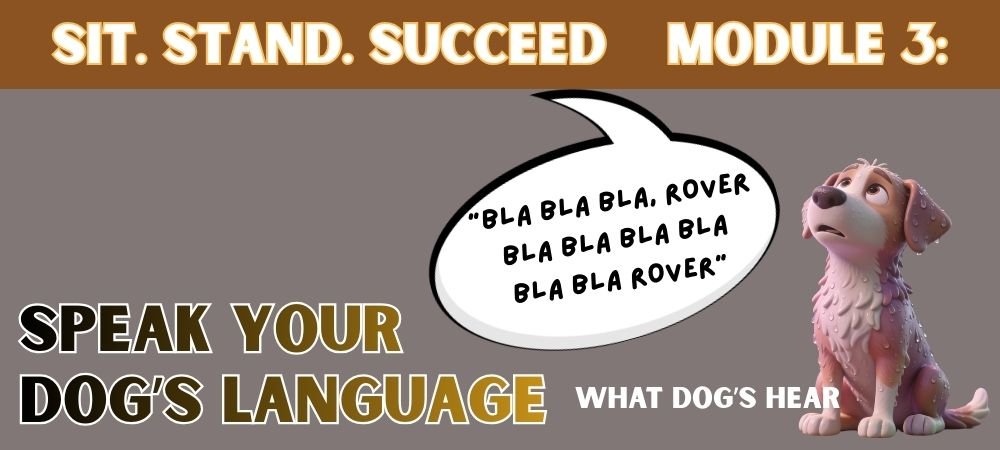
Module 3: Speak Your Dog’s Language
Discover how to read your dog’s body language and emotional signals. You’ll learn to recognise stress, calm, fear, and confidence — and how to adjust your approach accordingly.
This module is extremely powerful — because once an owner can read a dog, everything becomes easier: training, behaviour correction, confidence, calmness, and trust.
Learn to read body language, emotions, and signals so you can train with clarity—not confusion.
Dogs communicate constantly.
They don’t use sentences — they use posture, movement, tension, breathing, facial expressions, and subtle signals that most humans simply never learned to notice.
This module teaches you the real “communication tools” dogs use so you can understand what your dog is feeling before it becomes a behaviour problem.
Once you can read your dog clearly, you will prevent:
- reactivity
- fear
- overstimulation
- pulling
- conflict with other dogs
- training frustration
Communication is a superpower — and after this module, you’ll have it.
🔵 1. Reading Body Language With Confidence
Dogs express their emotions through their entire body.
Here’s how to read the most important signals:
✔ Tail
Loose, sweeping tail:
Happy, relaxed, comfortable.
Low tail, tucked:
Fearful, anxious, unsure.
High, stiff, fast wag:
Over-aroused, overstimulated, may escalate.
Still tail (no wag):
On alert, assessing something carefully.
✔ Eyes
Soft eyes:
Blinking, relaxed, calm.
Whale eye (white showing):
Fear, stress, or warning.
Hard stare:
Intensity, challenge, discomfort, heightened arousal.
✔ Ears
Neutral/relaxed:
Comfortable and at ease.
Forward and stiff:
Alert, stimulated, focused.
Pinned back:
Fear, appeasement, stress.
✔ Mouth
Loose mouth, tongue visible:
Relaxed, calm.
Closed tight mouth:
Concern building.
Panting rapidly (not heat):
Stress, anxiety, excitement.
Lip licking (no food present):
A stress or appeasement signal.
✔ Body posture
Loose, curved body:
Friendly, safe, relaxed.
Leaning forward, stiff:
Tension, defensiveness, potential escalation.
Rolling onto back (loose body):
Trust, comfort, relaxation.
Rolling onto back (stiff body):
Appeasement, uncertainty, “please don’t.”
🔵 2. Recognising Stress, Calm & Emotional Signals
Dogs rarely go from “calm” to “reactive” instantly.
There are early warning signs.
Learning these signs prevents:
- lunging
- barking
- growling
- pulling
- shut-down behaviour
✔ Early Stress Signs
These signals often appear before barking or reacting:
- lip licking
- yawning (out of context)
- sudden freezing
- slow, stiff movement
- turning head away
- sniffing floor suddenly
- paw lift
Trainer tip:
When you see these, increase distance or reduce pressure.
✔ Escalating Stress Signs
These appear when the dog is overwhelmed:
- tail tuck
- ears pinned
- fast shallow panting
- backing away
- refusing food
- whining
- attempting escape
Respond by:
- adding distance
- redirecting calmly
- lowering difficulty
- NOT “pushing through it”
✔ Signs of Calm & Trust
Celebrate these — they mean your training is working:
- soft eye contact
- slow blinking
- relaxed breathing
- tail wagging low and loose
- leaning into you
- offering behaviours voluntarily
- listening even around distractions
🔵 3. How Your Actions Shape Your Dog’s Behaviour
Your dog is reading YOU just as much as you’re reading them.
Your:
- body movement
- tone
- posture
- breathing
- tension
all communicate to your dog, even when you don’t mean them to.
✔ Your posture matters
Leaning over a dog:
Can feel intimidating.
Standing side-on:
Feels safer and more inviting.
Quick movement:
Creates excitement or tension.
✔ Your tone changes behaviour
- high, excited voice = increases energy
- calm, low voice = reduces energy
- sharp tone = stops behaviour
- soft tone = encourages behaviour
Use tone intentionally — it’s one of your strongest tools.
✔ Your timing is communication
Rewarding too late teaches the wrong behaviour.
Example:
If you reward after your dog stands up, they learn:
“Standing gets the reward.”
Timing creates meaning.
✔ Your breathing affects your dog
Dogs read the emotional state of their humans.
If you:
- hold your breath
- tense your shoulders
- tighten the lead
Your dog becomes more alert and tense.
Trainer tip:
Use slow breathing to calm yourself → your dog will mirror it.
🔵 4. Practical Exercises to Build Communication Skills
These are real-world exercises used by professional trainers.
Start today.
Exercise 1: 2-Minute Observation Drill
For two minutes:
- watch your dog
- no talking
- no commands
- no interaction
Write down:
- tail position
- eyes
- ears
- posture
- breathing rate
- how emotions change in different contexts
This trains your “trainer’s eye.”
Exercise 2: Body Language Labeling
Say out loud (or write):
- “soft eyes”
- “stiff tail”
- “relaxed posture”
- “ears forward”
This trains your brain to recognise patterns in real time.
Exercise 3: Watch-and-Respond
Whenever you notice early stress signs:
- increase distance
- lower intensity
- add calm reinforcement
This prevents escalation.
Exercise 4: Mirror Calmness
Practice:
- slow movements
- gentle voice
- loose shoulders
- relaxed breathing
Then observe your dog’s response.
Your dog mirrors your state.
This is your secret advantage.
🔵 5. What Success Looks Like After Module 3
By the end of this module, you will be able to:
✔ Identify stress vs excitement instantly
✔ Spot the early warning signs before behaviour escalates
✔ Respond to emotional changes with confidence
✔ Communicate through posture, tone, and timing
✔ Build a calm, trusting bond with your dog
✔ Prevent 80% of behaviour issues before they even start
This module sets the foundation for all leash training, recall, impulse control, reactivity reduction, and advanced obedience work in later phases.
Responses