
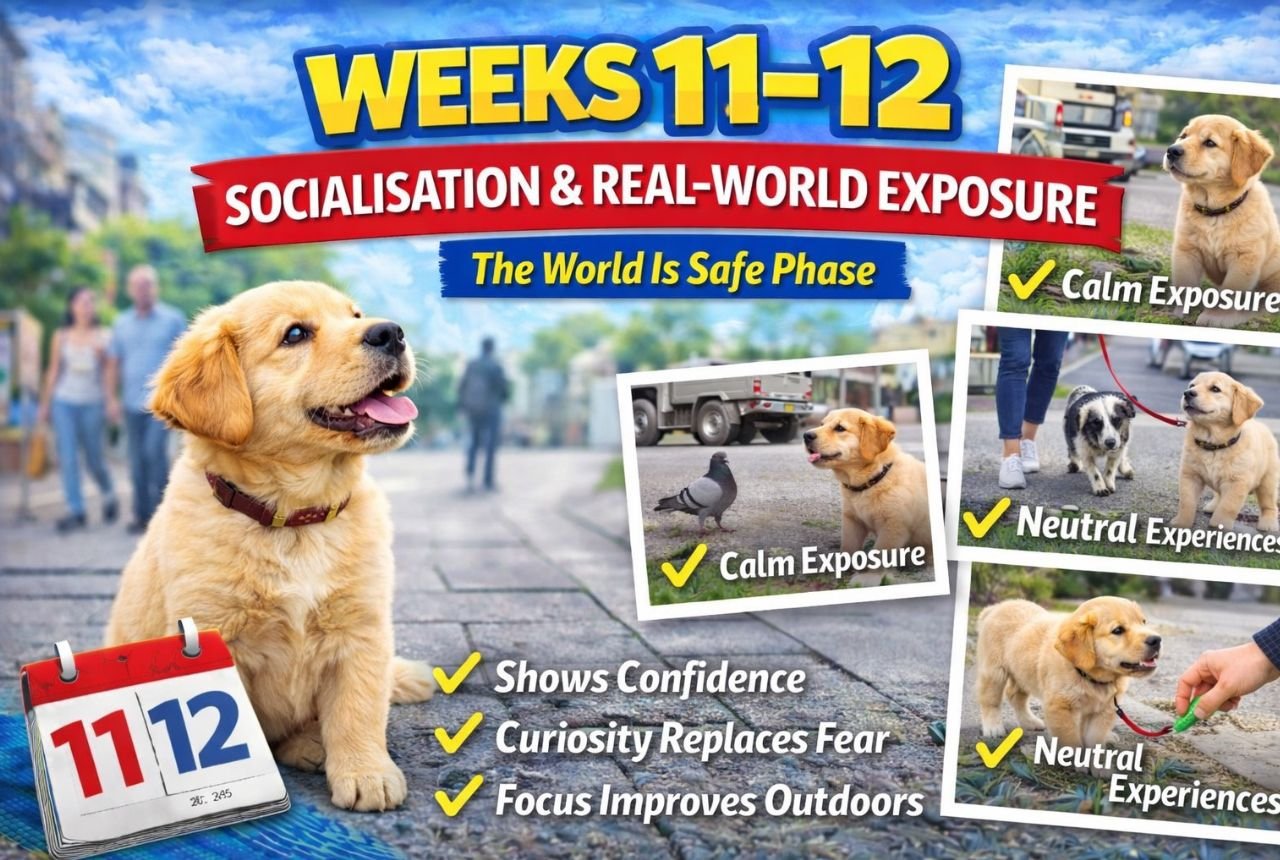
(“The World Is Safe” Phase)
Welcome to the stage where your puppy starts discovering that the world is:
-
loud
-
unpredictable
-
full of moving things
-
and occasionally terrifying for no obvious reason
Bins move. Doors slam. Humans wear hats.
Clearly… chaos.
Your job in Weeks 11–12 is not to make your puppy “friendly with everything.”
Your job is to teach them something far more valuable:
The world is safe. I don’t need to panic.
🎯 Primary Goals (What We’re Really Teaching)
✔ Build Confidence
Confidence is not boldness.
Confidence is:
-
noticing something new
-
staying calm
-
recovering quickly
A confident puppy doesn’t rush forward or retreat — they observe and think.
✔ Prevent Fear Responses
Fear often comes from:
-
too much, too fast
-
forced interactions
-
well-meaning humans pushing puppies past their comfort zone
This phase teaches your puppy:
“I can handle new things at my own pace.”
That mindset prevents:
-
reactivity
-
anxiety
-
fear-based aggression later in life
🧠 Focus Skills
✔ Calm Exposure
Exposure does not mean:
-
touching everything
-
greeting everyone
-
chaos disguised as “socialisation”
Calm exposure means:
-
seeing
-
hearing
-
smelling
without needing to do anything about it.
✔ Environmental Confidence
Your puppy learns that:
-
new places are not emergencies
-
strange sounds don’t require panic
-
unfamiliar surfaces won’t eat them
Confidence comes from repetition — not intensity.
✔ Neutral Dog & People Experiences
Neutrality is the goal.
Not:
-
excitement
-
fear
-
obsession
A puppy who can calmly notice dogs and people without reacting is set up for success everywhere.
🗓️ Daily Work (Think “Field Trips,” Not “Free-For-All”)
🌍 Visit New Environments
Choose calm, controlled locations:
-
quiet parks
-
parking lots
-
outside shops
-
different streets
Let your puppy:
-
watch
-
sniff
-
process
There is no rush.
🏆 Reward Calm Observation
If your puppy:
-
looks at something new
-
stays relaxed
-
chooses to check in with you
✔ Reward
You are reinforcing:
“Calm curiosity is the correct response.”
🚫 Avoid Forced Interactions
No dragging your puppy toward:
-
strangers
-
dogs
-
loud situations
If your puppy wants to approach — fine.
If not — also fine.
Choice builds confidence.
⚖ Focus on Neutrality, Not Excitement
Excited puppies often become:
-
reactive adults
-
frustrated greeters
-
leash screamers
Calm puppies become:
-
adaptable
-
focused
-
easy to live with
Calm always wins long-term.
🏁 Success Looks Like (Weeks 11–12)
By the end of this phase, you’ll notice:
✔ Puppy recovers quickly from surprises
✔ Curiosity replaces fear
✔ Focus improves in new environments
✔ Puppy checks in with you naturally
Your puppy may still hesitate — that’s normal.
What matters is recovery, not fearlessness.
🧠 Final Thought for This Phase
A well-socialised puppy is not one who loves everything.
It’s one who can:
-
handle change
-
stay calm
-
trust their human
-
move through the world without panic
That’s confidence.
That’s safety.
That’s the dog everyone hopes for.
Course Wrap-Up Reminder
If you’ve followed these phases:
-
calmly
-
consistently
-
without rushing
You are no longer raising a puppy.
You’re shaping a dog who understands how to live in the human world —
and that is the real goal 🐾
Responses