
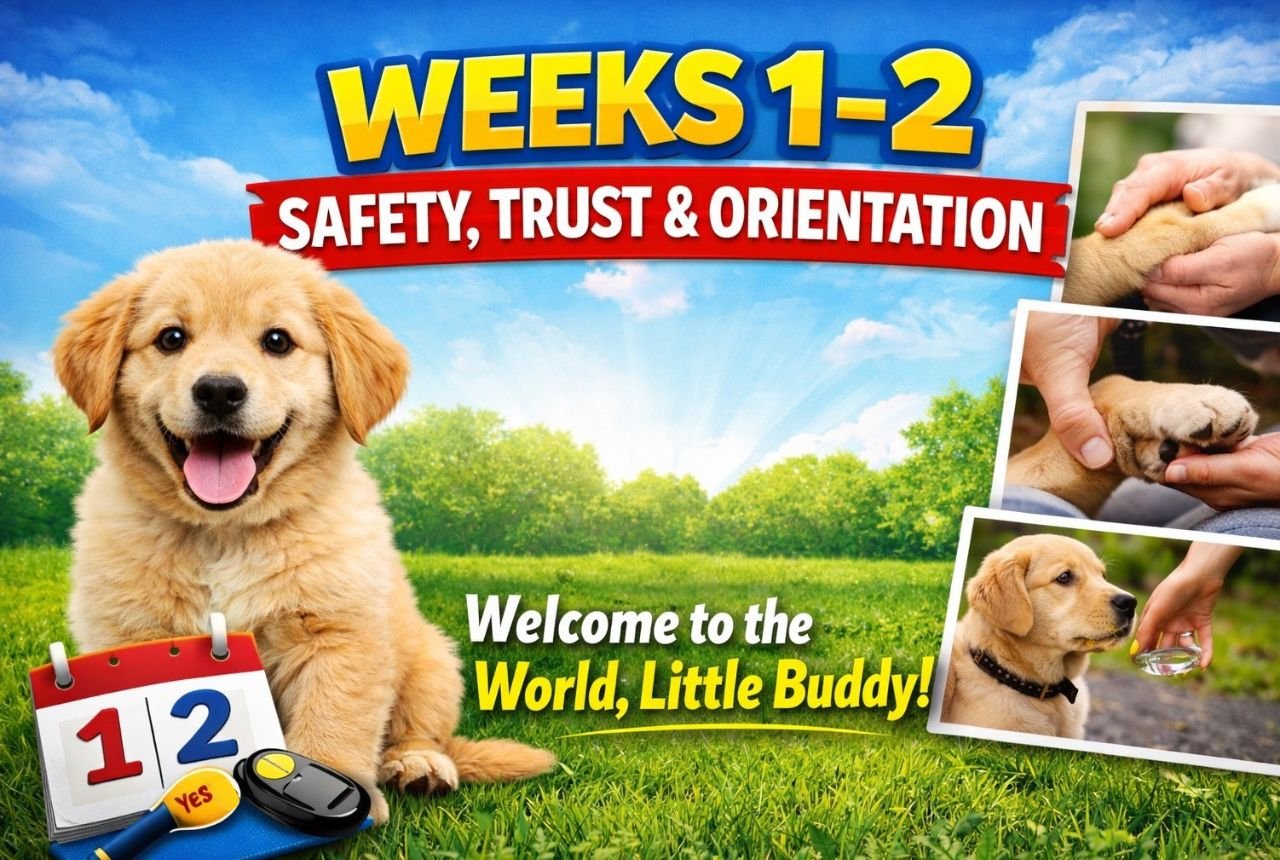
(“Welcome to the World” Phase)
Welcome to life with a puppy.
Everything is new. Everything is confusing.
Your puppy has just been:
- removed from their mother
- removed from siblings
- transported to a strange new place
- handed to you, a very tall, very loud creature
So before we worry about obedience, manners, or being “a good dog” —
we focus on safety, trust, and predictability.
Think of these first two weeks as your puppy learning:
“I am safe here. These humans make sense. Life follows patterns.”
🎯 Primary Goals (What Actually Matters Right Now)
In Weeks 1–2, we are not trying to:
- train tricks
- demand obedience
- show off to friends
We are trying to:
✔ Build Trust
Your puppy learns that:
- humans are kind
- hands bring good things
- mistakes don’t mean danger
✔ Create Predictability
Dogs thrive on patterns.
Predictable routines = calmer puppies.
✔ Prevent Overwhelm
A calm puppy learns faster.
An overwhelmed puppy… screams internally.
If you get this stage right, everything later becomes easier.
🧠 Focus Skills (Your Puppy’s First Life Lessons)
These are the only “skills” we care about right now — and they’re more important than they sound.
✔ Name Recognition
Your puppy learning their name is not about control.
It’s about connection.
Name = “Something good is about to happen.”
✔ Marker Word (“Yes!” or Click)
This is how you tell your puppy:
“THAT. That right there. You nailed it.”
The marker bridges the gap between behaviour and reward.
It’s your puppy’s instruction manual, translated.
✔ Toilet Routine
Puppies are not being “naughty.”
They are tiny, confused, and biologically unprepared.
Your job: make success easy.
✔ Handling & Touch Comfort
This is future-proofing.
If your puppy learns early that:
- paws are safe to touch
- ears aren’t scary
- mouths don’t mean panic
You’ll have:
- easier grooming
- easier vet visits
- fewer wrestling matches later
✔ Calmness Foundations
Calm behaviour doesn’t appear by accident.
It is taught — quietly.
🗓️ Daily Work (Simple, Boring, Extremely Effective)
Short, gentle, and repeatable wins the day.
🐶 Name Game (Multiple Times Daily)
Say your puppy’s name once.
When they look at you:
✔ Mark (“Yes!” or click)
✔ Reward
That’s it.
No repeating.
No yelling.
No dramatic speeches.
🚽 Toilet Routine (The Big One)
Take your puppy out:
- after waking
- after eating
- after playing
- when they look suspiciously thoughtful
Reward immediately after success.
Not later.
Not inside.
Not after celebration dancing.
Timing matters.
✋ Gentle Handling (Seconds, Not Minutes)
Once or twice per day:
- touch paws → reward
- touch ears → reward
- briefly touch mouth → reward
Stop before your puppy wants you to stop.
We are building comfort — not tolerance.
🧘 Reward Calm Behaviour (Yes, Really)
If your puppy:
- lies down on their own
- sits quietly
- watches the world without chaos
Reward it.
Calm behaviour is usually ignored.
That’s why it disappears.
🏆 What Success Looks Like (Realistic Expectations)
By the end of Weeks 1–2, success does not look like:
- perfect obedience
- no accidents
- a perfectly behaved angel
Success looks like:
✔ Puppy responds to their name indoors
✔ Toilet accidents are decreasing
✔ Puppy can relax near you — even briefly
That’s a huge win.
🐾 Important Reminder (Read This Twice)
Your puppy is not:
- trying to test you
- being stubborn
- plotting against your carpet
They are learning how to exist in a human world.
Your calm, consistent responses now create the dog you’ll live with later.
Up Next:
In the next module, we’ll introduce calmness, structure, and boundaries —
so your puppy starts to understand how to behave, not just what to do.
And yes — it gets easier.
Responses