
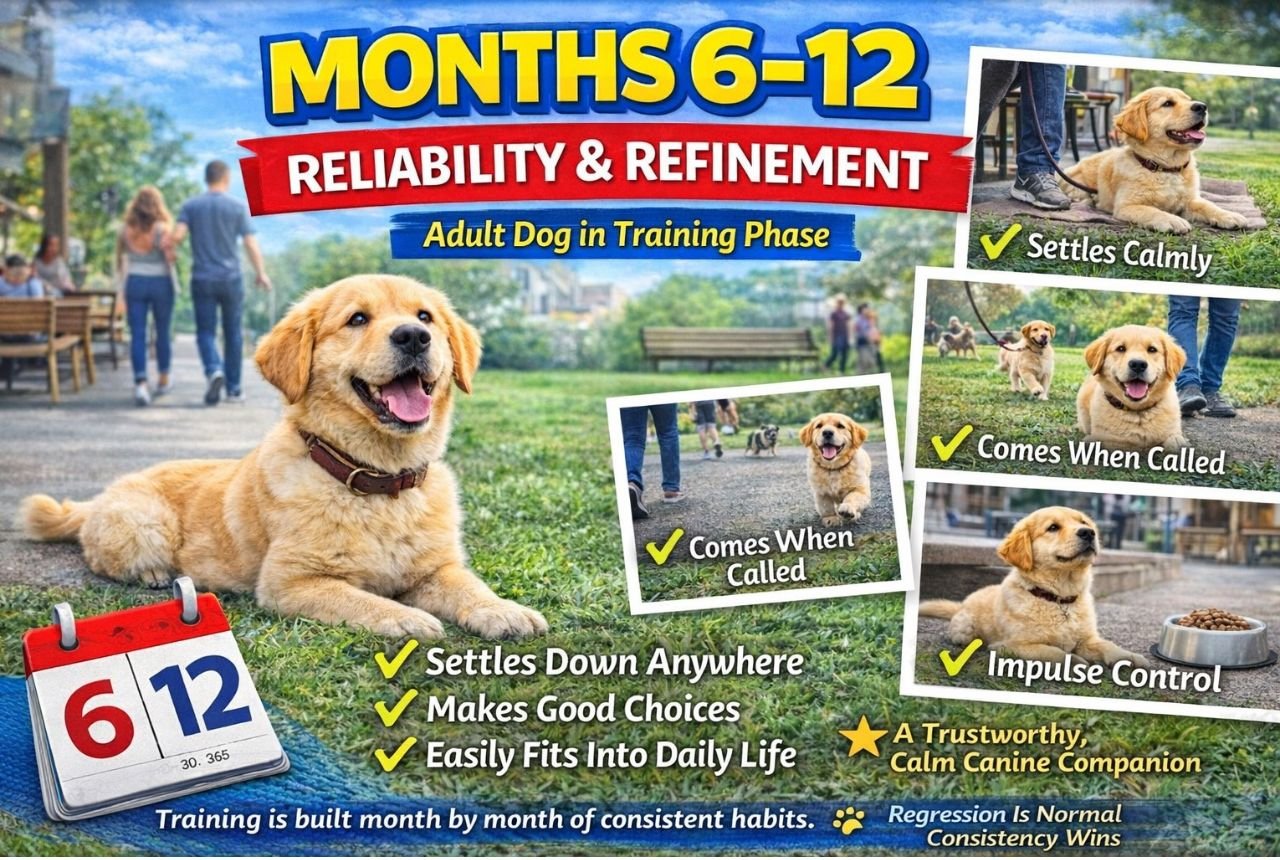
(“Adult Dog in Training” Phase)
Welcome to the phase where your dog looks grown up…
but still occasionally makes choices you did not approve of.
By now, your puppy is:
-
physically bigger
-
mentally sharper
-
emotionally… still a work in progress
This is where training shifts from teaching new skills to making existing skills reliable — across real life, real distractions, and real emotions.
Think of this phase as polishing the dog you’ve already built.
🎯 Primary Goals (What This Phase Is Really About)
✔ Reliability
Reliability means your dog responds:
-
not just when it’s easy
-
not just when treats are visible
-
not just when you’re standing still
But when life is happening.
A reliable dog is one you can trust — even on imperfect days.
✔ Emotional Regulation
This phase is less about commands and more about emotions.
Your dog learns how to:
-
settle themselves
-
recover from excitement
-
handle frustration
-
stay calm when things don’t go their way
A dog who can regulate their emotions is a dog who can function in the human world.
✔ Lifestyle Integration
Training is no longer a “session.”
It’s woven into:
-
walks
-
meals
-
visitors
-
daily routines
-
public outings
Your dog isn’t training for life anymore —
they’re living the training.
🧠 Focus Skills (The Adult Dog Essentials)
✔ Calm Settling Anywhere
Your dog learns:
“No matter where we are, I know how to relax.”
This includes:
-
at home
-
in public
-
around guests
-
near distractions
Calm becomes a default, not a request.
✔ Reliable Recall
Recall at this stage means:
-
your dog comes back even when distracted
-
your dog hesitates less
-
your dog chooses you more often than the environment
Is it perfect? No.
Is it trustworthy? That’s the goal.
✔ Impulse Control in Real Life
Impulse control now applies to:
-
doors
-
food
-
greetings
-
movement
-
excitement
Your dog learns that thinking first gets better outcomes than reacting.
This is what separates a “trained dog” from a well-adjusted one.
🗓️ Daily Work (This Is the Easy Part)
🔁 Maintain Routines
Routine is still your secret weapon.
Consistent:
-
feeding
-
walks
-
rest
-
expectations
Predictability keeps behaviour stable.
🧘 Reinforce Calm Choices
Watch for moments when your dog:
-
settles on their own
-
ignores distractions
-
chooses calm over chaos
Reward those moments — quietly.
Calm behaviour grows when it’s acknowledged.
🎯 Practice Skills Casually, Not Formally
You no longer need:
-
drills
-
long sessions
-
constant repetition
Instead:
-
ask for skills during normal life
-
reward compliance naturally
-
move on
Training should feel automatic — not exhausting.
🏁 Success Looks Like (Months 6–12)
By the end of this phase, success looks like:
✔ Your dog fits into daily life smoothly
✔ Training feels natural, not forced
✔ You trust your dog’s responses
✔ Behaviour is predictable
✔ You feel confident handling your dog anywhere
Your dog may still:
-
have off days
-
test boundaries occasionally
-
surprise you now and then
That’s normal.
What matters is the baseline — and the baseline is solid.
⭐ FINAL REMINDER (This One Matters)
Training is not linear.
Regression is normal.
Consistency always wins.
A fully trained dog is not created in weeks.
They are built through:
-
months of repetition
-
calm responses
-
boring consistency
-
correct habits reinforced quietly
If you’ve made it this far —
you haven’t just trained a dog.
You’ve built a partnership.
And that’s the real goal 🐾
Responses