
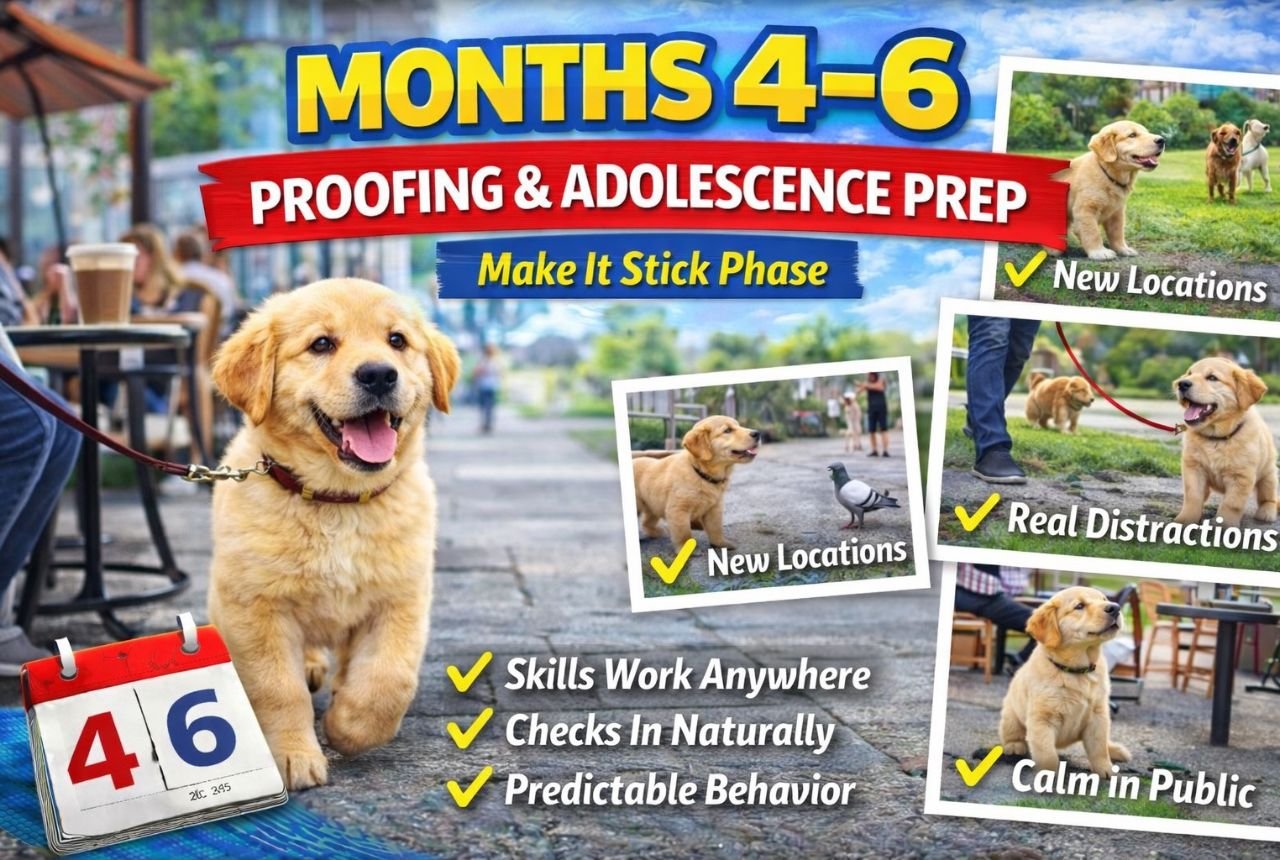
(“Make It Stick” Phase)
Welcome to the stage where your puppy begins experimenting with a bold new personality called:
“I know the rules… but what if I simply didn’t?”
Don’t panic.
Your puppy hasn’t forgotten their training.
Their brain is just under renovation.
This phase is about locking in skills, expanding them into the real world, and preparing you for adolescence — the developmental phase where dogs temporarily audition for chaos.
🎯 Primary Goals (What We’re Really Doing Here)
✔ Generalise Skills
Your puppy currently understands:
“Sit means sit… in my house.”
Now we teach:
“Sit means sit… everywhere.”
Dogs do not automatically generalise skills.
They must learn that cues apply:
-
outside
-
around distractions
-
in new places
-
when life is interesting
✔ Maintain Consistency
Consistency becomes more important now — not less.
This phase is about:
-
reinforcing habits
-
preventing backsliding
-
keeping rules predictable
Structure now prevents confusion later.
✔ Prepare for Teenage Regression
Yes — regression is normal.
Yes — it’s annoying.
No — it doesn’t mean you failed.
Adolescence often brings:
-
selective hearing
-
testing boundaries
-
sudden “forgetting” of known cues
Your job is not to panic — it’s to stay boringly consistent.
🧠 Focus Skills (The Real-World Test)
✔ Obedience in New Locations
Same cues.
Same expectations.
Different environments.
Your puppy learns:
“The rules don’t disappear when the scenery changes.”
✔ Recall Under Distraction
This is where recall becomes real.
We practice coming back:
-
when smells exist
-
when people exist
-
when other dogs exist
-
when your puppy would rather not
Distance and distraction increase slowly — not all at once.
✔ Calm Behaviour in Public
Calm in public is a life skill.
We’re teaching:
-
settling near activity
-
observing without reacting
-
existing without performing
A calm dog in public is a trained dog — not a lucky one.
🗓️ Daily Work (Normal Life, On Purpose)
🌍 Practice Known Skills in New Places
Take training on the road:
-
parks
-
footpaths
-
quiet outdoor cafes
You’re not teaching new skills here.
You’re strengthening old ones.
🍗 Reduce Food Rewards Gradually
Food still exists — but it’s not the only payment anymore.
Begin mixing in:
-
praise
-
movement
-
access to sniffing
-
permission to continue walking
Life itself becomes the reward.
🎉 Increase Real-Life Reinforcement
Let your puppy earn things they want by listening:
-
sit before greeting
-
down before settling
-
check-in before moving forward
This keeps behaviour useful — not just obedient.
🏁 Success Looks Like (Months 4–6)
By the end of this phase, success looks like:
✔ Skills work outside the house
✔ Puppy checks in naturally
✔ Behaviour feels predictable
✔ You trust your dog more
✔ Training feels like part of life — not a chore
Your puppy may still:
-
test limits
-
have off days
-
pretend not to hear you occasionally
That’s adolescence.
What matters is that the foundation holds.
🧠 Final Thought for This Phase
You are not training for today anymore.
You are training for:
-
the teenage phase
-
the adult dog
-
real-world life together
If you stay calm, consistent, and slightly unimpressed by nonsense —
your puppy will come out the other side just fine.
And one day you’ll look back and realise:
“Wow… they actually grew into a really good dog.”
That’s the goal 🐾
Responses