

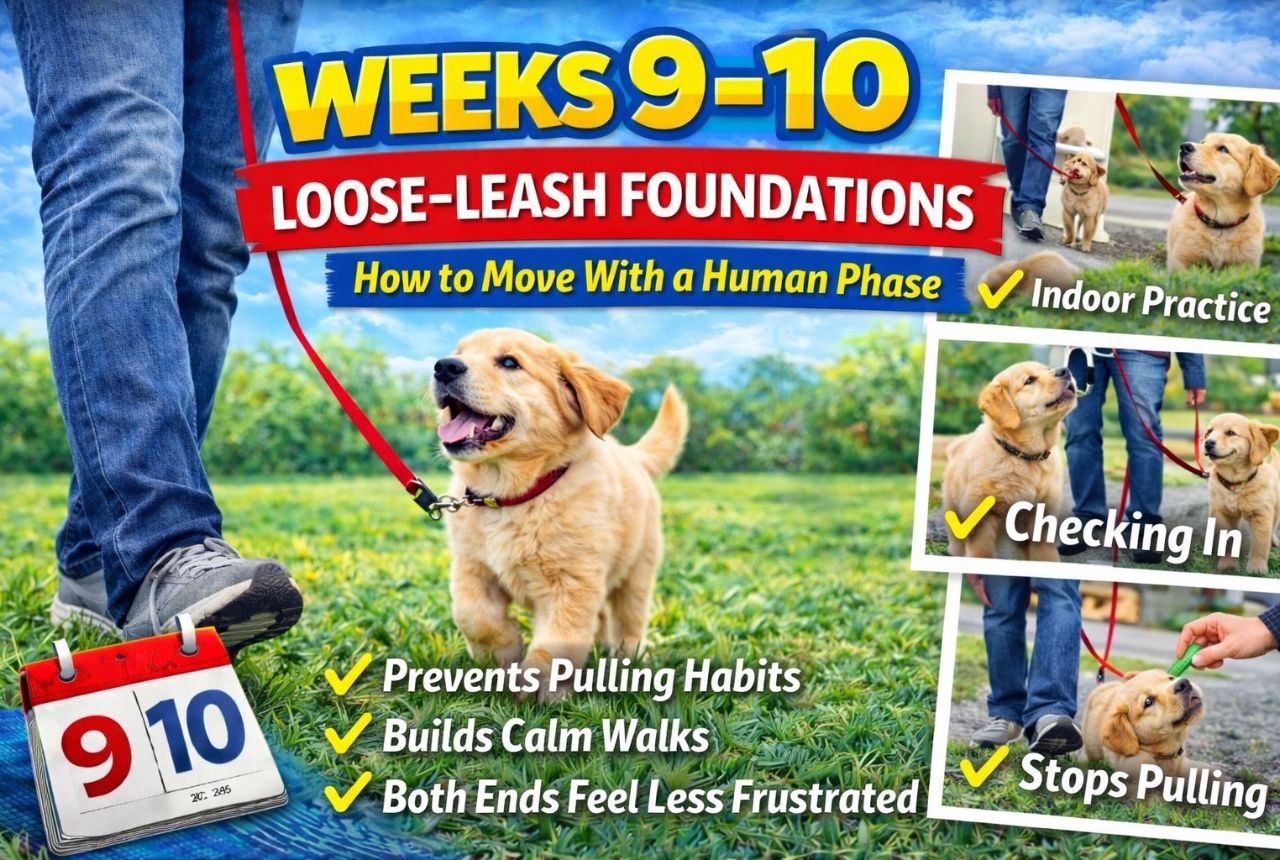
(“How to Move With a Human” Phase)
Welcome to the phase where your puppy discovers something shocking:
The leash is not a tow rope.
And you are not a sled.
Up until now, walking has probably looked like:
-
zig-zagging
-
sudden stops
-
enthusiastic lunges
-
you apologising to strangers while being pulled forward
Good news: this phase is where that starts to change.
Loose-leash walking isn’t about perfect heel positions or military precision.
It’s about teaching your puppy how to move calmly, together, as a team.
🎯 Primary Goals (What We’re Really Teaching)
✔ Prevent Pulling Habits Before They Set In
Pulling is not stubbornness — it’s physics.
Dogs naturally:
-
move faster than humans
-
follow smells
-
pull toward excitement
If pulling works, it becomes a habit.
If pulling never works, it quietly disappears.
This phase stops bad habits before they feel permanent.
✔ Build Walking Manners Early
Walking manners are emotional skills as much as physical ones.
Your puppy learns:
-
how to feel leash pressure
-
how to slow down
-
how to stay connected instead of charging ahead
This sets the foundation for calm walks later — even when distractions appear.
🧠 Focus Skills
✔ Loose-Leash Walking (Indoors First)
We start indoors because:
-
fewer distractions
-
fewer smells
-
fewer squirrels plotting chaos
Inside the house, your puppy can actually think.
Loose leash means:
-
slack in the leash
-
puppy choosing to stay near you
-
no constant tension
✔ Check-Ins on Leash
A check-in is when your puppy:
-
glances at you
-
chooses your direction
-
stays aware of your position
This is the secret sauce of good walking.
Dogs who check in don’t need micromanaging.
🗓️ Daily Work (Short, Calm, Low-Drama)
🏠 Practice in Small Spaces
Start leash practice in:
-
the hallway
-
the living room
-
the driveway
Yes — this feels boring.
That’s why it works.
Calm practice builds calm habits.
🐕 Reward Position Beside You
Any time your puppy:
-
walks near you
-
keeps slack in the leash
-
checks in
→ reward calmly and consistently.
You are teaching:
“This spot works. This spot feels good.”
🛑 Stop Moving When Pulling Happens
When the leash goes tight:
-
you stop
-
you wait
-
you become a very boring statue
The moment the leash loosens:
-
movement resumes
No yanking.
No scolding.
No frustration.
Pulling stops movement. Calm brings progress.
🏁 Success Looks Like (Weeks 9–10)
By the end of this phase, success looks like:
✔ Puppy understands leash pressure
✔ Walks are shorter, calmer, and less chaotic
✔ You feel less frustrated
✔ Puppy feels less frantic
Are walks perfect?
No.
Are they survivable and improving?
Absolutely.
🧠 Important Reminder
Loose-leash walking is not “trained once.”
It’s layered gradually.
Every calm step now:
-
saves frustration later
-
prevents pulling habits
-
builds communication
You’re teaching your puppy how to move with you, not against you.
And one day soon, you’ll realise:
“Hey… that walk was actually nice.”
That’s when you know it’s working 🐾
Responses