
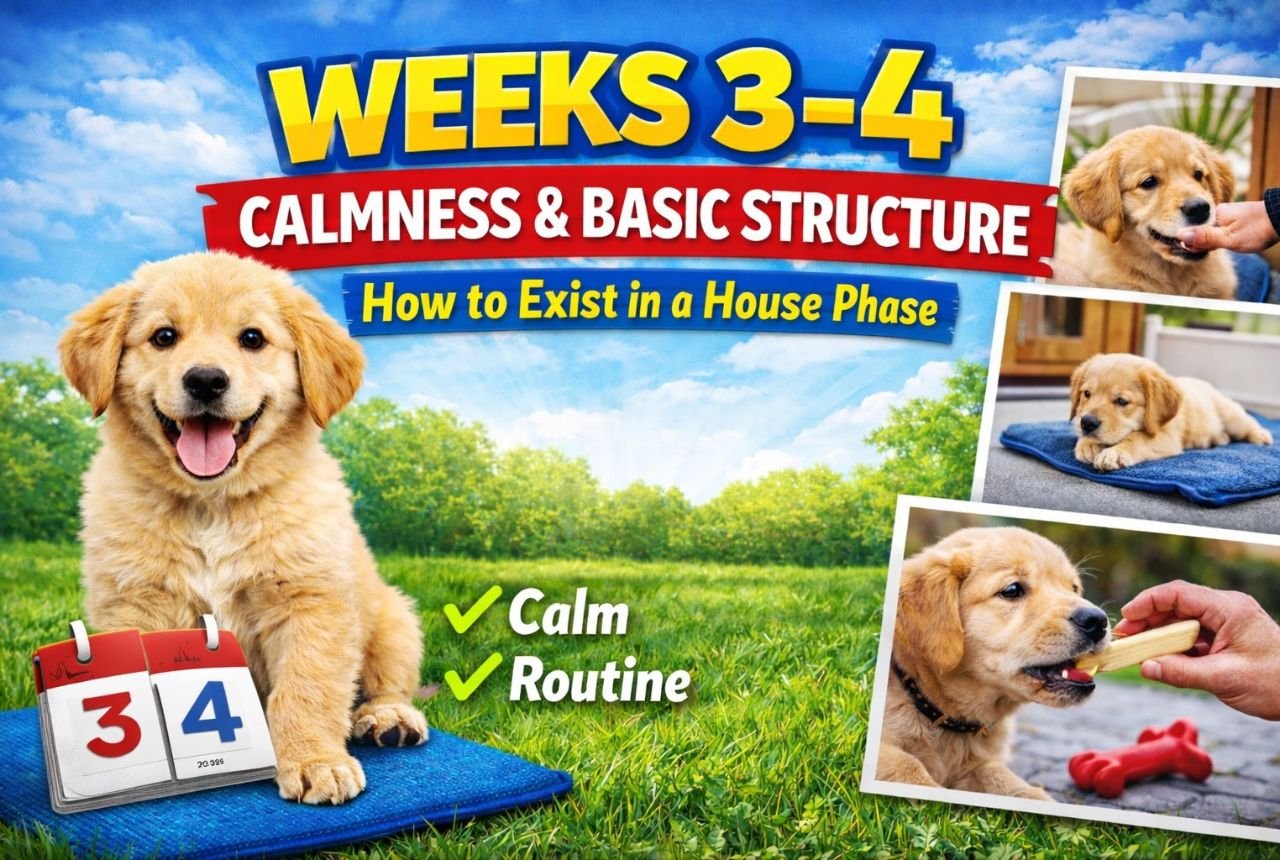
(“How to Exist in a House” Phase)
Congratulations.
Your puppy now understands that this is home.
Unfortunately, they have not yet learned:
-
how furniture works
-
why hands are not chew toys
-
that 3am is not party time
That’s what Weeks 3–4 are for.
This phase is about teaching your puppy how to live indoors like a civilised creature — calmly, predictably, and without constant chaos.
🎯 Primary Goals (What We’re Actually Fixing)
At this stage, we are focused on three things:
✔ Teaching Calm Behaviour
Calm is not something puppies magically “grow into.”
It is learned.
If calm behaviour is rewarded, it increases.
If chaos is rewarded (even accidentally), chaos wins.
✔ Reducing Chaos
Zoomies, biting, barking, and wild behaviour usually come from:
-
overstimulation
-
lack of structure
-
not knowing what to do instead
We don’t punish chaos — we replace it.
✔ Establishing Routine
Routine tells your puppy:
“I know what happens next. I don’t need to panic.”
Predictability lowers stress.
Lower stress = better behaviour.
🧠 Focus Skills (The Life-Changing Stuff)
These skills might not look exciting, but they are the bedrock of a good dog.
✔ Settle on a Mat
This teaches your puppy:
-
how to stop
-
how to rest
-
how to exist without entertainment
This is the opposite of hyperactivity training.
✔ Bite Inhibition
Puppies explore with their mouths.
That’s normal.
What’s not normal is allowing hard, painful biting to continue unchecked.
We teach:
-
gentle mouths
-
redirection
-
appropriate outlets
✔ Alone-Time Foundations
This is where we quietly prevent separation anxiety before it starts.
Your puppy learns:
“Being alone is safe. Humans come back.”
✔ Daily Routine Consistency
Dogs don’t need perfect days.
They need predictable ones.
🗓️ Daily Work (Short, Calm, Repetitive)
This phase is about tiny wins, repeated often.
🧘 Introduce the Training Mat
Place the mat down.
If your puppy:
-
steps on it
-
lies on it
-
even looks at it calmly
✔ Mark
✔ Reward
Do not lure endlessly.
Let curiosity do the work.
Soon, the mat becomes:
“This is where I chill.”
🏆 Reward Calm Choices (This Is Huge)
Watch for moments when your puppy:
-
lies down on their own
-
chews calmly
-
watches instead of reacts
Reward those moments.
Calm behaviour is usually invisible — which is why it disappears.
🦷 Redirect Biting Calmly
When biting starts:
-
stay calm
-
remove your hand
-
offer an appropriate chew
-
reward when they choose it
No yelling.
No drama.
No personal betrayal speeches.
Puppies learn fastest when you don’t turn it into a performance.
🚪 Alone-Time Training (Tiny Steps)
Start with:
-
seconds
-
then minutes
Leave calmly.
Return calmly.
No emotional exits.
No emotional reunions.
We are teaching independence — not creating a soap opera.
🏆 What Success Looks Like (Realistic, Not Instagram)
By the end of Weeks 3–4, success looks like:
✔ Puppy can relax on the mat briefly
✔ Nipping is reducing (not gone — reducing)
✔ Calm moments appear naturally
You may still have:
-
zoomies
-
moments of chaos
-
questionable life choices
That’s normal.
Progress is happening — even when it doesn’t feel like it.
🐾 Important Reminder
Your puppy is not trying to:
-
dominate you
-
control the house
-
ruin your furniture out of spite
They are learning self-regulation for the first time in their life.
Your calm consistency now creates:
-
better focus
-
better behaviour
-
a dog who can settle anywhere later
Up Next:
In the next module, we’ll start building basic obedience and engagement —
so your puppy learns not just how to calm down, but how to listen.
And yes — things keep improving from here 🐶
Responses