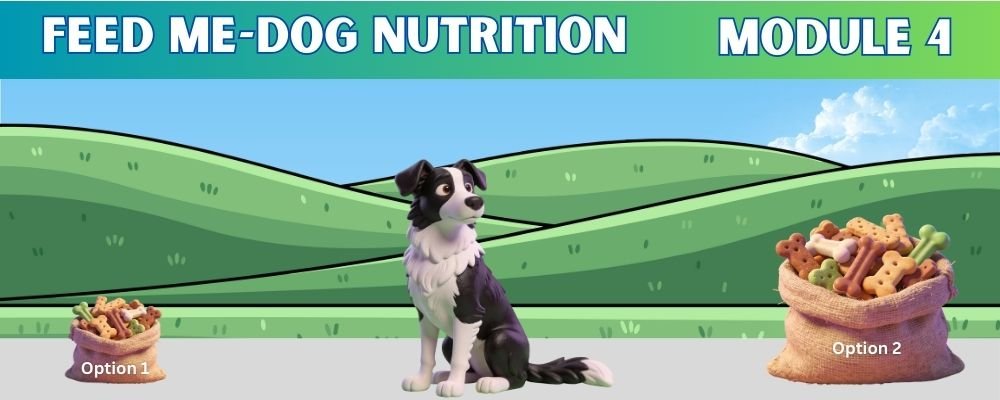
🐾 Module 4
How Much Should You Feed? (The Question Everyone Asks)
Short answer:
The feeding guide on the bag is a starting point, not the law.
You should adjust based on:
- Your dog’s body shape
- Energy levels
- Activity
- Poop quality (yes, we said it)
👀 The Body Condition Check
You should be able to:
- Feel ribs (but not see them)
- See a waist when viewed from above
- Notice a tuck behind the ribs from the side
If your dog is shaped like a coffee table — reduce portions.
👀 How to Adjust Portions (The Smart Owner Test)
Increase food if:
- Ribs are very visible
- Energy is low
- Vet says weight gain is needed
Reduce food if:
- Waist has disappeared
- Ribs can’t be felt
- Your dog looks like a loaf of bread
🥣 Treat Rule (Non-Negotiable)
Treats should be:
- Less than 10% of daily calories
- Counted as food (yes, even training treats)
Your dog will survive fewer snacks.
Your vet will thank you.
🐾 Quick Reminder
- Puppies = more meals
- Adults = consistency
- Big dogs = slower growth
- Begging ≠ hunger
🐶 Feeding Mistakes to Avoid
Common Ways Good Dog Owners Accidentally Mess This Up
You love your dog.
You want to do the right thing.
Unfortunately, dogs are very good at convincing otherwise sensible humans to make poor feeding decisions.
Let’s fix that.
❌ Mistake #1: Feeding Based on the Stare
That look.
The one that says:
“I haven’t eaten in days.”
Your dog is lying.
Politely.
With their eyes.
What to do instead:
Feed measured portions at set times. Ignore the Oscar-worthy performance between meals.
❌ Mistake #2: Free-Feeding All Day
Leaving food down all the time seems kind.
It is not.
Free-feeding:
- Encourages overeating
- Makes weight gain sneaky
- Removes food motivation for training
- Makes it harder to spot appetite changes
What to do instead:
Scheduled meals. Bowl down. Bowl up after 15–20 minutes.
Yes, even if food remains.
❌ Mistake #3: Too Many Treats (Yes, Even Training Ones)
Tiny treats feel harmless.
They are not.
By the end of the day, those “just a few” treats can equal an entire meal.
What to do instead:
- Count treats as part of daily intake
- Use smaller treats
- Reduce meal size on high-training days
Your dog won’t notice.
Your vet will.
❌ Mistake #4: Constantly Changing Food
Switching food every time your dog:
- Itches once
- Skips a meal
- Looks bored
…leads to upset stomachs and zero useful information.
What to do instead:
Stick with a quality food for at least 6–8 weeks before judging results.
Consistency beats panic.
❌ Mistake #5: Feeding Adult Food Too Early
Puppies are not small adults.
They are growing machines with very specific needs.
Feeding adult food too early can:
- Disrupt growth
- Affect joints
- Cause long-term issues (especially in big dogs)
What to do instead:
Use puppy food until the correct age for your dog’s size — especially for large breeds.
❌ Mistake #6: Ignoring the Body Shape
The bowl doesn’t tell the truth.
Your dog’s body does.
If you can’t feel ribs or see a waist, portions need adjusting — regardless of what the bag says.
What to do instead:
Regularly assess:
- Rib feel
- Waist shape
- Energy levels
Adjust food accordingly.
❌ Mistake #7: Sharing Human Food Without Thinking
Some human food is safe.
Some is dangerous.
Some will turn your dog into a walking gas cloud.
What to do instead:
- Stick to dog-safe foods
- Avoid feeding from the table
- Never give foods known to be toxic
Your dog doesn’t need pizza.
They just want it.
❌ Mistake #8: Assuming Hunger = Food
Restlessness, boredom, attention-seeking and habit can all look like hunger.
Adding more food often creates:
- Weight gain
- Behaviour issues
- Even more begging
What to do instead:
Try:
- Exercise
- Mental enrichment
- Chew toys
- Training
Sometimes your dog needs activity, not calories.
🧠 Final Thought
Feeding mistakes usually come from:
- Love
- Guilt
- Softness
Not neglect.
A well-fed dog is not the one who eats the most —
it’s the one who eats the right amount, consistently.
Even if they disagree.
Responses