
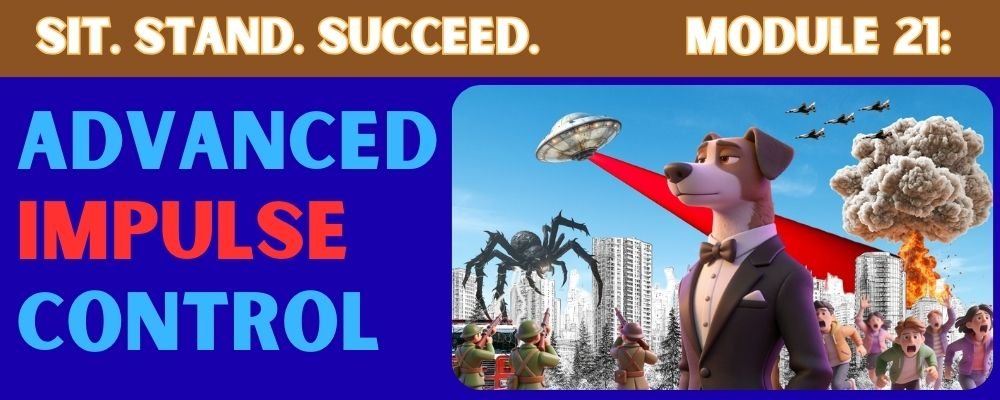
Teach calm behaviour in exciting or high-energy situations. Build reliable self-control you can trust in everyday life.
This is one of the most powerful modules in the entire training system because impulse control is the foundation of:
- polite greetings
- reliable recall
- calm behaviour
- loose-lead walking
- settling at cafés
- reducing reactivity
- safety around roads, wildlife, and other dogs
A dog that can control their impulses is a dog who can think before reacting — even in high-energy situations.
This module teaches you how to build that ability step-by-step.
Teach your dog to stay calm, think clearly, and make good decisions — even during excitement, distraction, or high-pressure situations.
Impulse control is not about dominance or force.
It’s about teaching your dog how to regulate their emotions and make choices calmly, even when their instincts push them toward action.
A dog with strong impulse control can:
- ignore distractions
- resist the urge to chase
- stay calm around food
- remain steady when excited
- pause before reacting
- listen during high arousal
This module transforms dogs from reactive → thoughtful, impulsive → controlled, excitable → composed.
🔵 1. Understanding What Impulse Control Really Is
Impulse control is:
- A trained skill, not a personality trait
- A brain process, not obedience
- A choice your dog learns to make, not something they “should know”
There are two types of impulse control:
✔ 1. Self-Control (Emotional Regulation)
Your dog learns to:
- slow down
- think
- breathe
- choose stillness
- resist urges
This is emotional intelligence for dogs.
✔ 2. Environmental Control (Responding Despite Distractions)
Your dog learns to:
- stay steady around movement
- ignore exciting triggers
- remain calm when highly stimulated
- focus on you instead of the environment
This is “real-world obedience” — the kind you can trust.
🔵 2. Why Impulse Control Fails (And How to Fix It)
Dogs lose impulse control because of:
- overwhelming environmental stimulation
- high arousal (excitement/stress)
- frustration
- lack of structure
- inconsistency from humans
- under-exposure to manageable distractions
This module rebuilds impulse control through:
- teaching calm
- adding structure
- using repetition
- creating predictable routines
- rewarding thoughtful choices
🔵 3. The 5 Pillars of Advanced Impulse Control
Professional trainers build impulse control around these five pillars:
✔ 1. Wait
Dog pauses instead of rushing.
Used for:
- doorways
- car doors
- gates
- food bowls
✔ 2. Leave It
Dog disengages from anything, including:
- food
- rubbish
- animals
- toys
- smells
- other dogs
✔ 3. Stay with Distractions
Calmness + patience in:
- high-energy environments
- busy areas
- around dogs
- around movement
✔ 4. Release Control
Dog learns the difference between:
- staying calm
- and breaking position when released
Release cues are CRITICAL for impulse control.
✔ 5. Calm Response to Excitement
Dog maintains composure around:
- visitors
- children
- wildlife
- play
- sudden sounds
- balls or toys
This takes your dog from excitable → composed.
🔵 4. Training Impulse Control (Professional Step-by-Step System)
Below are the exact methods behaviour experts use to build real, lasting impulse control.
✔ A. Food Bowl Control (“Wait to Eat”)
Step 1: Hold bowl
Dog sits → treat
Step 2: Lower bowl halfway
If dog moves → raise bowl → reset
If dog stays → reward
Step 3: Place bowl on floor
Release cue (“Okay!”)
Step 4: Increase difficulty
Add movement or distractions gradually.
This routine alone improves impulse control dramatically.
✔ B. Doorway Control (“Wait at Thresholds”)
Teach dog to pause at:
- house doors
- car doors
- garden gates
- crate doors
Steps:
- Dog sits at closed door
- Open door 1 inch
- If dog moves → close door
- If dog waits → open slightly more
- Release cue only when dog holds position
This prevents:
- bolting
- unsafe exits
- impulsive behaviour
✔ C. Leave It (Advanced Version)
Step 1: Dog looks at object
Step 2: “Leave it”
Step 3: Dog disengages → reward
Step 4: Increase difficulty with:
- moving toys
- food on ground
- wildlife at a safe distance
The goal:
Dog CHOOSES to disengage.
✔ D. Stay Around Movement
Practice with:
- toys rolling
- people walking
- children playing (controlled distance)
- dogs moving
Steps:
- Begin far away
- Ask for sit or down
- Add mild movement
- Increase intensity gradually
- Reward calmness
This teaches “stillness in chaos.”
✔ E. The “It’s Your Choice” Game (Powerful)
Dog learns:
Impulse control earns rewards.
Steps:
- Hold treats in open hand
- Dog tries to grab → close hand
- Dog backs off or looks away → reward
Dog learns:
“Calm behaviour makes good things happen.”
✔ F. Calmness in High Arousal Situations
Use structured exposure:
- fetch → pause → sit → throw
- tug → drop → calm → resume
- play → stop → settle → restart
This teaches dogs how to regulate energy in real time.
🔵 5. Advanced Impulse Control in Real-Life Scenarios
✔ 1. Around Wildlife & Fast Movement
Use:
- long line
- leave-it
- emergency recall
- distance
- curved movement
Build reliability BEFORE freedom.
✔ 2. Around Other Dogs
Teach:
- calm watching
- engagement checks
- parallel walking
- polite greetings
- impulse-controlled play (start/stop cues)
✔ 3. With Toys & Balls
Dogs who obsess over toys need structured rules.
Rules:
- sit before throw
- wait before chase
- drop on cue
- end game calmly
- This prevents over-arousal and frustration.
✔ 4. With Visitors
Train:
- sit before greeting
- calm behaviour earns attention
- overexcitement pauses the greeting
Use:
- mat training
- controlled approach
- consistent rules
✔ 5. During Walks
Impulse control outdoors prevents:
- lunging
- pulling
- chasing
- jumping
Use:
- random sits
- check-in rewards
- emergency U-turn
- leave-it drills
🔵 6. Teaching Emotional Regulation (The Deep Work)
This is what separates basic obedience from advanced training.
✔ 1. Teach Slow Thinking
Reward:
- pauses
- calm choices
- slower movement
- deliberate behaviour
Your dog learns to think, not react.
✔ 2. Build Tolerance to Frustration
Dogs need to learn:
- waiting
- pausing
- trying again
- being patient
Reward persistence and calm.
✔ 3. Break the Arousal Cycle
If dog becomes overstimulated:
- stop activity
- introduce calm breathing
- use mat training
- lower intensity
Arousal is the enemy of impulse control.
🔵 7. Practical Exercises for Module 21
Exercise A: Doorway Drill
Several reps daily.
Calmness at doors = calmness everywhere.
Exercise B: Food Bowl Control
Practice with different environments and distractions.
Exercise C: Toy Release Pattern
Tug → drop → sit → resume.
Exercise D: Distraction Stay Challenge
Start with mild distractions → increase slowly.
Exercise E: Wildlife Simulation
Use controlled movement like flirt poles (at low intensity).
Teach disengagement + leave-it.
Exercise F: Real-Life Impulse Test
Dog sits calmly while:
- person walks by
- ball rolls past
- other dog moves
- cyclist passes
- children play
Reward success generously.
🔵 8. What Success Looks Like After Module 21
By the end of this module, your dog will:
✔ think before reacting
✔ control their excitement more easily
✔ remain calm during high-energy situations
✔ stay focused around distractions
✔ disengage from temptations
✔ behave predictably in public
✔ show greater emotional maturity
✔ learn faster and respond more reliably
And YOU will:
✔ understand how to shape emotional regulation
✔ know how to reduce over-arousal
✔ prevent reactivity through impulse control
✔ use structured, effective training methods
✔ feel confident handling challenging environments
✔ teach your dog to make great decisions — independently
Responses