

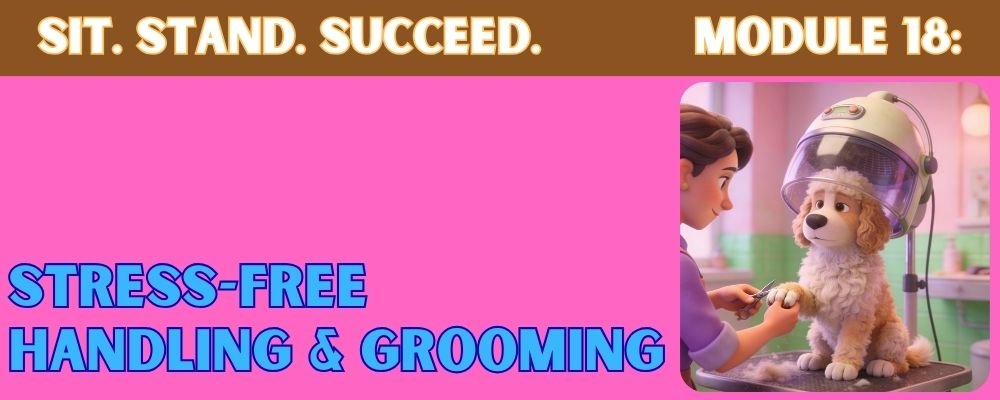
Teach your dog to cooperate during handling, grooming, and vet visits. Reduce stress and build trust through consent-based training.
This module is especially important because grooming and handling are areas where many dogs become fearful, resistant, or reactive — not because they are “difficult,” but because they were never taught HOW to feel safe during handling.
This module transforms grooming and physical care from a stressful chore into a calm, cooperative experience that strengthens trust.
Teach your dog to accept handling calmly, build trust through cooperative care, and prepare them for grooming and vet visits without fear.
Handling and grooming problems are NOT disobedience issues.
They stem from:
- fear
- discomfort
- lack of early exposure
- negative past experiences
- unpredictability
- loss of control
A confident, well-trained dog still needs specific teaching to tolerate:
- nail trims
- brushing
- ear checks
- grooming tools
- baths
- vet examinations
- being lifted
- being touched in sensitive areas
This module provides a complete roadmap for building trust, cooperation, and calm behaviour.
🔵 1. The Three Big Reasons Dogs Resist Handling
Understanding the why prevents frustration and sets the foundation for success.
✔ 1. Loss of Control (Most Common)
When a dog feels:
- restrained
- trapped
- held still
- unable to move
They instinctively panic or resist.
This is biological — not behavioural.
✔ 2. Sensitivity or Physical Discomfort
Dogs may react because:
- knots in fur hurt
- nails are too long
- skin is tender
- ears are inflamed
- teeth or gums are sore
- previous injuries
Always rule out pain when behaviour escalates.
✔ 3. Negative or Unpredictable Experiences
A few unpleasant handling events can teach dogs:
“Grooming is scary.”
“Touch means discomfort.”
“Humans grab me suddenly.”
This module teaches positive, predictable experiences instead.
🔵 2. The Cooperative Care Philosophy (Fear-Free Approach)
Cooperative care means:
- the dog participates willingly
- the dog has choices
- the dog can opt out
- you move at the dog’s pace
- force is avoided
This results in calmer animals and safer handlers.
Cooperative Care Uses These Principles:
✔ Predictability
Dog always knows what to expect.
✔ Permission
Dog learns “consent cues” to participate.
✔ Choice
Dog can back away, reposition, or pause.
✔ Positive Associations
Every step is paired with calmness and reward.
✔ Slow, Step-by-Step Progress
Never rush — smaller steps build faster results.
🔵 3. Foundation Skills for Stress-Free Handling
Before grooming begins, dogs need certain emotional and behavioural skills.
✔ A. Touch Conditioning (“Yes, Touch is Good”)
Start with low-intensity touches:
- Touch shoulder → treat
- Touch chest → treat
- Touch paw → treat
- Touch ear → treat
- Touch tail → treat
- Touch collar → treat
Build a map of positive associations.
✔ B. Consent Cue (“Are You Ready?”)
Teach a simple cue that invites participation:
- Present hand or grooming tool
- Dog moves toward it → reward
- Dog chooses not to → pause
This creates trust.
✔ C. Calm Handling Position
Teach your dog to relax in:
- sit
- down
- on your lap
- on a mat
- between your legs (for small dogs)
- leaning gently against your chest
Stability reduces stress.
✔ D. Chin Rest (Powerful Cooperative Care Behaviour)
Dog rests chin on your hand or knee.
Benefits:
- reduces movement
- builds trust
- indicates participation
- calms the nervous system
🔵 4. Step-by-Step Training for Handling Sensitive Body Areas
Each section below includes a safe, progressive training method.
✔ 1. Paws & Nails (Most Dogs’ Least Favourite)
Step 1: Touch paw → reward
Step 2: Hold paw lightly → reward
Step 3: Touch each toe → reward
Step 4: Introduce nail clipper or Dremel (show only) → reward
Step 5: Touch clipper to nail (no pressure) → reward
Step 6: Clip one nail only → reward heavily
Step 7: Build to more nails gradually
Never force or restrain tightly.
Keep sessions short and positive.
✔ 2. Brushing & Fur Maintenance
Step 1: Show brush → treat
Step 2: Brush one stroke → reward
Step 3: Brush small area → reward
Step 4: Gradually increase duration
Step 5: Work on sensitive areas last (tail, legs, belly)
Tip: Use detangling spray or conditioning spray for long coats.
✔ 3. Ears (Cleaning & Exam Prep)
Step 1: Touch outer ear → reward
Step 2: Lift ear flap → reward
Step 3: Touch inside lightly → reward
Step 4: Introduce ear cleaner (show bottle) → reward
Step 5: Touch cotton pad to ear → reward
Step 6: Add gentle cleaning movement
If dog shakes head afterward — normal.
✔ 4. Teeth & Mouth (Dental Health Training)
Step 1: Lift lip for one second → reward
Step 2: Touch teeth with finger → reward
Step 3: Introduce toothbrush → reward
Step 4: One or two brush strokes → reward
Step 5: Build slowly to full brushing
Use dog toothpaste (never human toothpaste).
✔ 5. Bathing (Reducing Stress)
Step 1: Enter bathroom → reward
Step 2: Stand in empty tub → reward
Step 3: Introduce small amount of water → reward
Step 4: Wet paws → reward
Step 5: Gradually wet rest of body
Step 6: Keep water warm, pressure low
Fear comes from unfamiliar sensation — go slowly.
🔵 5. Handling at the Vet — Confidence, Not Panic
Vet visits are overwhelming for many dogs.
This module builds veterinary-handling confidence.
✔ The “Mock Vet Exam” Routine
Do this at home:
- Examine ears
- Check paws
- Touch under tail
- Check teeth
- Feel chest & ribs
- Lift each leg
- Hold collar gently
Reward after each step.
Dogs become desensitised and confident.
✔ Teaching the “Still” Cue
Dog learns to stay still briefly without fear.
- Place a hand on dog
- Count “1” → treat
- Repeat
- Build to “1, 2” → treat
- Increase to 3–5 seconds
Never exceed the dog’s comfort zone.
✔ Creating a Positive Vet Bag
Store special treats in a bag used ONLY at the vet.
Dog associates vet visits with high-value rewards.
🔵 6. Grooming Salon Preparation (For Dogs Who Fear Groomers)
If your dog has ever had:
- a rushed groom
- pain from knots
- a frightening experience
- loud clippers near them
They need gentle retraining.
✔ Salon-Preparation Training Plan
Step 1: Clip Sessions
Turn on clippers across the room → reward
Gradually move closer over sessions.
Step 2: Table Confidence
Teach your dog to stand on low platforms → reward.
Step 3: Blow Dryer Training
Turn dryer on low → reward
Aim away from dog
Gradually move airflow toward dog.
Step 4: Groomer Handling Simulation
Touch legs gently
Lift paws
Hold muzzle briefly (softly)
Reward frequently
Confidence builds with repetition.
🔵 7. Reducing Stress During Grooming Sessions
Tools that help:
✔ 1. Lick Mats
Spread with peanut butter or yogurt.
Keeps dog focused and calm.
✔ 2. Slow Treat Delivery
Treats delivered every few seconds reduce anxiety.
✔ 3. Frequent Breaks
Short sessions prevent overwhelm.
✔ 4. Calm Energy From Handler
Your tone, breathing, and movement matter.
✔ 5. Safe Surfaces
Non-slip mats help dogs feel stable.
🔵 8. Common Mistakes Owners Make (And How to Avoid Them)
Most handling problems come from:
✘ Going too fast
Fear increases.
✘ Restraining tightly
Triggers panic.
✘ Ignoring early warning signals
Growls, lip licking, stiffening.
✘ Punishing fear
Destroys trust.
✘ Forcing grooming tasks
Creates long-term aversion.
✘ Not using rewards
Removes motivation and comfort.
🔵 9. Practical Exercises for Module 18
Exercise A: Touch Ladder
Touch → treat
Hold → treat
Lift → treat
Extend → treat
Build duration gradually.
Exercise B: Chin Rest Training
Teach dog to rest chin on hand → reward calm.
Exercise C: Grooming Tool Desensitisation
Introduce tool → reward
Touch with tool → reward
Use tool briefly → reward
Exercise D: Handling Bingo
Practice touching every body part lightly once a day.
Exercise E: Vet Exam Simulation
Run through 5–10 vet-style checks calmly.
🔵 10. What Success Looks Like After Module 18
By the end of this module, your dog will:
✔ tolerate grooming calmly
✔ allow handling without fear
✔ show more trust during exams
✔ adapt better at vets and groomers
✔ show reduced panic or resistance
✔ feel safer and more in control
✔ participate willingly in cooperative care tasks
And YOU will:
✔ understand how to handle your dog safely and gently
✔ avoid triggers that increase fear
✔ prepare your dog for real grooming and vet visits
✔ know how to build confidence step by step
✔ strengthen the bond through trust and cooperation
Responses