

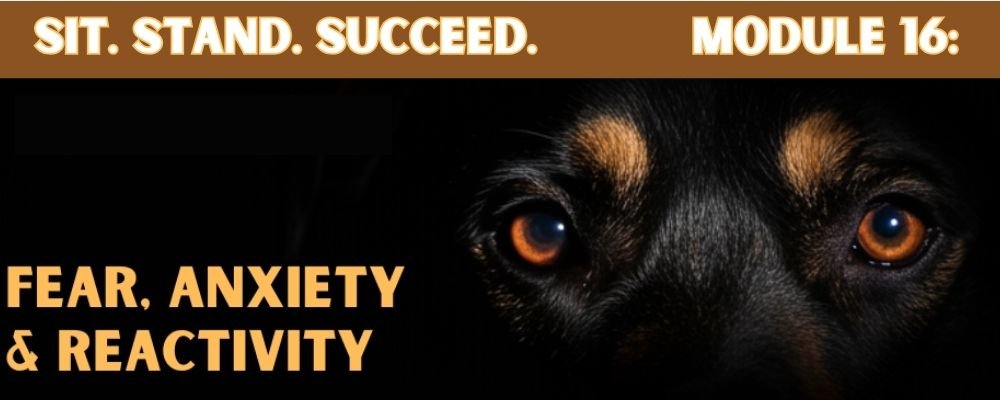
Learn how to help fearful or reactive dogs feel safer. This module introduces calm, gradual techniques to reduce anxiety and build trust.
This is one of the most important modules in the entire course, because fear, anxiety, and reactivity are among the most misunderstood behaviour issues in dogs.
Most owners interpret reactive behaviour as:
- “aggressive”
- “dominant”
- “stubborn”
- “defiant”
But in reality:
👉 Reactive dogs are overwhelmed dogs.
👉 Anxious dogs are trying to feel safe.
👉 Fearful dogs are not giving you a hard time — they’re having a hard time.
This module is designed to give owners clarity, compassion, confidence, and a proven roadmap for transforming their dog’s emotional wellbeing.
Understand emotional-driven behaviour, help your dog feel safe, and build confident responses through calm, structured training.
Fear and anxiety are NOT training problems —
they are emotional problems that must be addressed gently, strategically, and gradually.
Reactivity (barking, lunging, growling) is usually:
- fear
- frustration
- insecurity
- over-arousal
- lack of coping skills
- traumatic past experiences
This module shows you how to reduce emotional overload, give your dog safer coping strategies, and change their behaviour at the root.
🔵 1. Understanding the Emotional System of Dogs
To fix fear-based behaviour, you need to understand what’s happening inside the dog’s brain.
✔ The Three Emotional States That Drive Behaviour
- Fight
Triggered by:
- fear
- insecurity
- threat perception
Appears as:
- barking
- lunging
- growling
- snapping
This is NOT aggression — it’s self-protection.
- Flight
Triggered by fear of danger.
Appears as:
- running away
- hiding
- freezing
- avoiding situations
- Freeze
When fight or flight are not available.
Appears as:
- shutting down
- refusing to move
- becoming still or stiff
- withdrawing
Many owners mistake freeze for obedience — but it’s stress.
🔵 2. Why Punishment Makes Fear Worse
Punishing fear-based behaviour:
- suppresses warning signals
- increases panic
- damages trust
- escalates future reactions
- teaches the dog the world is unsafe
A punished fearful dog becomes:
- more unpredictable
- more anxious
- more reactive
Fear cannot be punished out of a dog.
It must be replaced with safety, trust, and confidence.
🔵 3. The Three-Step Formula for Emotional Change
Professional behaviourists use this simple but powerful process:
✔ Step 1: Reduce Pressure
Distance
Space
Predictability
Controlled environments
A dog cannot learn when in panic.
✔ Step 2: Create Positive Associations
By pairing the scary trigger with good experiences:
- treats
- play
- distance
- praise
This is called counterconditioning.
✔ Step 3: Teach Alternative Behaviours
Instead of barking/lunging, we teach:
- look at me
- calm movement
- disengage on cue
- turn away
- settle
This is called desensitisation + replacement behaviour.
🔵 4. Identifying Triggers and Thresholds
Understanding thresholds prevents setbacks.
✔ Trigger
Anything that causes fear or reactivity:
- dogs
- people
- loud noises
- vehicles
- fast movement
- unfamiliar environments
- being touched
✔ Threshold
The point where the dog becomes overwhelmed.
Below threshold:
- dog can think
- dog can take treats
- dog can follow cues
Above threshold:
- barking
- lunging
- shutting down
- refusal to take treats
- tunnel vision
Your #1 job:
Train below threshold.
This is where progress happens.
🔵 5. The Reactivity Ladder (Important)
Behaviours escalate in predictable ways:
- Looks away
- Freezes
- Hard stares
- Stiffening
- Whining
- Lip licking
- Barking
- Lunging
- Snapping
You must intervene BEFORE the dog reaches high levels.
🔵 6. Building a Safety Plan — The Foundation for ALL Progress
Every reactive/anxious dog needs a Safety Plan:
✔ 1. Increased Distance
Distance = safety
Distance = calmness
Distance = learning
Never force a dog into a scary situation.
✔ 2. Predictable Routines
Anxious dogs thrive on structure:
- waking times
- feeding times
- walking routes
- training sessions
Predictability reduces anxiety.
✔ 3. Safe Spaces at Home
Create a spot where the dog can retreat:
- crate
- bed
- mat
- quiet corner
No children or other pets may disturb them there.
✔ 4. Calm, Slow Movements
Quick movements overwhelm anxious dogs.
Move:
- slowly
- quietly
- deliberately
✔ 5. Reduce Environmental Stress
Examples:
- close blinds
- reduce noise
- avoid crowded areas
- use white noise
- controlled exposure
🔵 7. Practical Training Techniques to Reduce Reactivity
These are core professional techniques used worldwide.
✔ A. LAT Training (Look At That)
This teaches the dog to observe the trigger calmly.
Steps:
- Dog sees trigger
- Dog looks → “Yes!” → treat
- Dog begins to automatically look at you instead of reacting
LAT is one of the fastest ways to reduce reactivity.
✔ B. Disengagement Training (“Look Away”)
Teaches your dog to break attention from the trigger.
- Dog glances at trigger
- You say “Look” or “Turn”
- Dog turns head → reward
Builds control & calmness.
✔ C. U-Turn Training
A lifesaving behaviour for reactive dogs.
- Say cheerful “This way!”
- Turn 180°
- Move away happily
- Reward generously
This prevents escalation.
✔ D. Pattern Games (Powerful for Anxiety)
Patterns give stressed dogs predictability.
Examples:
- 1-2-3 Treat
- Up-Down
- Middle Position (dog between legs)
These reduce reactivity by lowering emotional volatility.
✔ E. Movement-Based Calming
Slow, arcing movements help dogs feel safe.
Avoid:
- direct approaches
- fast movements
- tight spaces
Use:
- curves
- distance
- gentle pacing
✔ F. Treat Scatter (Instant De-escalation)
Throw treats onto the ground → dog sniffs → brain shifts into calm mode.
🔵 8. Special Focus: Noise Sensitivity & Sound Anxiety
Dogs fearful of:
- fireworks
- thunderstorms
- vacuum cleaners
- traffic
- loud bangs
Need:
- safe retreat space
- white noise
- low-intensity sound desensitisation
- gentle reassurance
- calming enrichment
- body wraps (e.g., Thundershirt)
- vet consultation for severe cases
Never force a dog to “face their fears.”
🔵 9. Special Focus: Social Reactivity (Reactive to Dogs or People)
This is usually fear or frustration.
Fix:
- increase distance
- LAT training
- parallel walking
- controlled setups
- avoid greetings until calm
- reward disengagement
- predictable routines
Social reactivity often improves dramatically with structure.
🔵 10. Special Focus: Separation Anxiety
This is a deep emotional issue —
NOT disobedience.
Symptoms:
- barking
- destruction
- pacing
- drooling
- panic when alone
Fix requires:
- desensitisation to departure cues
- extremely gradual alone-time training
- no punishment
- professional help for severe cases
🔵 11. Daily Emotional Balance Routine (Core Program)
Every anxious or reactive dog should follow this routine:
✔ 1. Morning Sniff Walk
Sniffing lowers anxiety and releases dopamine.
✔ 2. Short Training Session (5–8 minutes)
Engagement
Focus
Calm cues
✔ 3. Midday Enrichment
Puzzle toy
Kong
Scent game
✔ 4. Calm Rest Time
No overstimulation.
✔ 5. Predictable Evening Routine
Walk
Training
Settle
This structure alone dramatically reduces anxiety.
🔵 12. Practical Exercises for Module 16
Exercise A: Threshold Test
Determine the distance where dog becomes reactive.
Exercise B: LAT Training (Look At That)
Trigger → Look → Reward → Calm.
Exercise C: Treat Scatter Calm-Down
Used during unexpected triggers.
Exercise D: 1-2-3 Pattern Game
Count “1, 2, 3” → treat on 3.
Creates predictability & calm.
Exercise E: U-Turn Safety Cue
Practice indoors → yard → street → real world.
Exercise F: Confidence Walks
Slow-paced, sniff-heavy, low-pressure walks.
🔵 13. What Success Looks Like After Module 16
By the end of this module, your dog will:
✔ show fewer signs of fear or overwhelm
✔ display calmer behaviour around triggers
✔ disengage from stressful situations voluntarily
✔ look to you for guidance
✔ recover faster after reactions
✔ feel safer and more confident in daily life
And YOU will:
✔ understand the emotional root of behaviour
✔ know exactly how to reduce reactivity step-by-step
✔ know how to prevent meltdowns before they occur
✔ feel confident handling unexpected triggers
✔ build a deeper bond based on trust, not fear
✔ become your dog’s emotional anchor and safe leader
Responses