

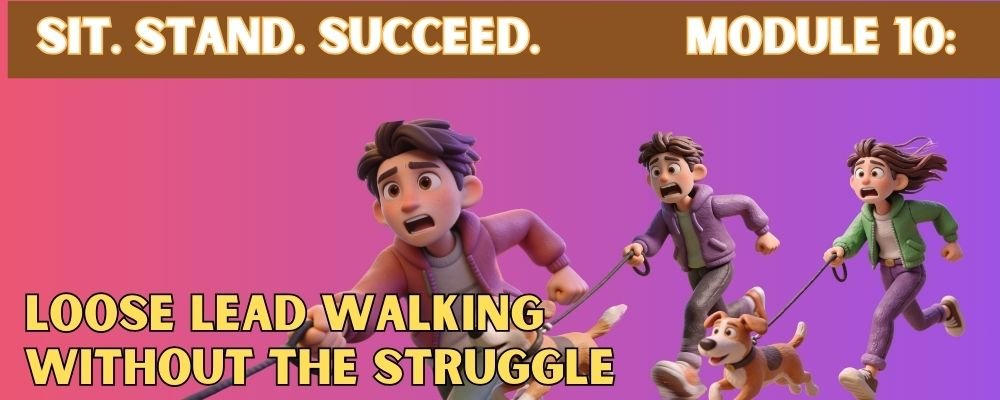
Say goodbye to pulling and frustration. Learn how to teach calm, controlled walking so walks become enjoyable again.
This is one of the most important modules in the entire course, because pulling on the leash is the #1 frustration for dog owners worldwide.
Most dogs don’t pull because they’re “dominant” or “disobedient” —
they pull because:
- pulling WORKS
- humans walk too slowly
- the world is exciting
- they were never taught loose-lead skills
- tension on the leash has become normal
- they don’t understand what “loose lead” means
This module fixes that.
Teach your dog to walk calmly by your side — without pulling, dragging, frustration, or pain.
You’ll learn how to transform walks from chaotic to calm using humane, science-based methods that build connection instead of conflict.
🔵 1. Why Dogs Pull — The Real Reasons
Dogs pull because…
✔ Reason 1: Pulling Works Perfectly For Them
Every single time your dog pulls and moves forward, they learn:
“Pulling = Success.”
This is the primary driver of leash pulling.
✔ Reason 2: Humans Reward Pulling Accidentally
Most owners:
- follow the dog
- keep walking while leash is tight
- allow zig-zagging
- move forward during lunging
Every step forward rewards pulling.
✔ Reason 3: Walks Are Overstimulating
Smells
Movement
Birds
Dogs
People
Sounds
Too much arousal = no focus.
✔ Reason 4: Dogs Walk Faster Than Humans
Human pace = boring
Dog pace = exciting
We must teach the skill of matching pace.
✔ Reason 5: No One Ever Taught Loose-Lead Walking Properly
It is a TRAINED behaviour — not an instinct.
🔵 2. What Loose Lead Walking Actually Means
A loose lead is:
- a soft J shape in the leash
- slack between you and the dog
- no tension
- dog moving in the same general direction
- calm, steady pace
It does NOT mean:
- perfect heel
- staring at you nonstop
- glued to your side
- robotic obedience
Loose lead walking is a partnership, not a drill.
🔵 3. Tools That Make Loose Lead Walking Easier
The right equipment prevents frustration and helps your dog succeed.
✔ Best Choices
- Y-front harness
- Front-clip harness (especially for strong pullers)
- Long line for training in open areas
✔ Avoid
- choke chains
- prong collars
- slip leads used for correction
- retractable leashes (reward pulling automatically)
These tools increase pulling, stress, and reactivity.
🔵 4. Before You Walk — The Pre-Walk Calm Routine
Loose-lead walking starts BEFORE you leave the house.
✔ Step 1: Calm Out the Door
Sit → wait → door opens slowly → release cue.
If your dog rushes:
- close door calmly
- reset
- try again
✔ Step 2: Warm-Up Engagement (30 seconds)
Reward:
- eye contact
- check-ins
- calm behaviour
This puts your dog in “learning mode,” not “zoom mode.”
✔ Step 3: Smell Break Before Training
Let your dog sniff for 1 minute.
This reduces arousal and helps them settle.
🔵 5. Step-by-Step Loose Lead Walking Training
⚡ Exercise 1: The Stop & Reset Method (The Foundation)
The rule:
If the leash tightens, you stop.
If the leash loosens, you walk.
Simple. Clear. Effective.
Steps:
- Start walking.
- Leash tightens → stop immediately.
- Wait.
- Dog turns back or loosens leash → “Yes!” → walk forward.
WHY THIS WORKS:
You remove the reward (movement) whenever the dog pulls.
⚡ Exercise 2: The Change Direction Method
This teaches your dog to pay attention.
Steps:
- Start walking forward.
- Dog pulls → say nothing.
- Turn 180 degrees.
- Dog follows → “Yes!” + reward.
This builds engagement and prevents mindless pulling.
⚡ Exercise 3: Reward at Your Side (The Position Reward)
Rewarding the correct walking position teaches your dog where you want them.
Steps:
- Walk slowly.
- When your dog is by your side → “Yes!” → reward near your leg.
- Keep moving.
Rewarding at the leg builds the habit of staying close.
⚡ Exercise 4: The Engagement Walk
Transform your dog from reactive to connected.
Steps:
- Walk in a quiet area.
- Reward every check-in.
- Add turns, circles, stops.
- Celebrate engagement.
This makes YOU more interesting than the environment.
🔵 6. Using Sniffing as a Reward (Powerful!)
Dogs are sniffing animals.
Sniffing is relaxing.
It also reduces pulling.
Use sniffing as a life reward:
If dog walks nicely for 5–10 seconds:
→ “Go sniff!”
This teaches your dog:
Good walking = freedom.
🔵 7. What to Do When Your Dog Pulls Toward Something
✔ If dog pulls to a smell:
Stop → wait → return to loose leash → THEN release to sniff.
✔ If dog pulls toward another dog:
Increase distance → do engagement exercises → reward check-ins.
✔ If dog pulls toward people:
Practice sit + calm greeting routines from Module 6.
✔ If dog lunges:
Use long line, increase distance, lower arousal, reward for calm choices.
🔵 8. Handling High-Excitement & High-Distraction Areas
Different difficulty levels require different strategies.
✔ Low Distraction (Indoors, backyard)
Teach mechanics
Build success
Reward often
✔ Medium Distraction (quiet street)
Use change-direction drill
Add random stops
Increase duration between rewards
✔ High Distraction (parks, beaches)
Stand still
Reward check-ins
Keep sessions short
Use high-value treats
Move away from triggers calmly
🔵 9. Common Mistakes & How to Fix Them
❌ Mistake: Pulling the dog back
Dogs pull MORE when pulled against.
Fix: stop pulling instantly instead.
❌ Mistake: Talking too much
Commands become noise.
Fix: focus on movement, not chatter.
❌ Mistake: Expecting immediate perfection outdoors
Outdoors is the final exam.
Fix: train gradually (Focus Ladder from Module 7).
❌ Mistake: Long walks with terrible pulling
Rehearsing pulling makes it worse.
Fix: Short, focused training walks.
❌ Mistake: Being inconsistent
If your dog pulls even sometimes, the behaviour survives.
Fix: stop every time leash tightens.
🔵 10. Real-World Walking Structure
Here’s how a perfect walk looks:
- Exit calmly
- Engagement warm-up
- Short burst of loose-lead walking
- “Go sniff!” reward
- Short burst of walking
- “Go sniff!”
- Real-life practice in medium distraction
- Calm return home
- Sit → release to house
This creates calm, confident, enjoyable walks for both of you.
🔵 11. Practical Daily Training Plan
✔ Day 1–3:
Indoors + backyard
Stop & Reset + Engagement Walks
✔ Day 4–7:
Quiet street
Change Direction + Side Rewards
✔ Week 2:
Medium distractions
Sniff breaks + pattern walking
✔ Week 3+:
Parks, pathways
Distance management
High-value rewards
Short training bursts
🔵 12. What Success Looks Like After Module 10
By the end of this module, your dog will:
✔ walk without pulling most of the time
✔ check in with you regularly
✔ respond to your movement and direction changes
✔ understand that loose lead = forward movement
✔ be calmer and more focused on walks
✔ have reduced reactivity and excitability
And YOU will:
✔ enjoy walking your dog again
✔ know exactly what to do when pulling starts
✔ understand how to use rewards and sniffing correctly
✔ be confident handling distractions
✔ have the skills to maintain calm, consistent walks for life
Responses