
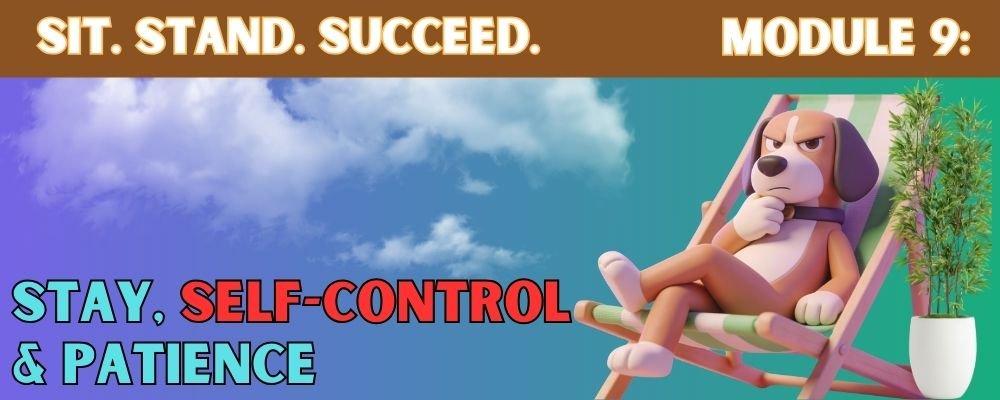
Build impulse control and calm behaviour. You’ll teach your dog to stay reliably while increasing distance, duration, and distractions.
This module is one of the most transformative in dog training because self-control is not natural for dogs — it’s taught.
When you teach patience and impulse control, EVERYTHING improves:
- greeting manners
- door behaviours
- loose-lead walking
- barking
- jumping
- food manners
- reactivity
- general calmness
This module gives you the exact system trainers use to create calm, reliable dogs who can think instead of react.
Teach your dog to remain in position, regulate their impulses, and stay calm even around distractions.
A reliable “Stay” isn’t just a trick — it’s a life skill.
It teaches your dog that:
- calmness works
- waiting pays off
- not all excitement requires a reaction
- patience leads to good things
Self-control is the foundation of real-world obedience.
🔵 1. Why Teaching “Stay” Is About the Mind, Not the Body
Many owners think Stay is about keeping the dog physically still.
Professionals know it’s about something far deeper:
teaching the dog to regulate their emotional state.
A dog that can stay:
- has control over impulses
- can remain calm under pressure
- has good focus
- understands boundaries
- is safer in real-life situations
🔵 2. The Three Pillars of a Reliable Stay
A perfect Stay depends on three elements:
✔ 1. Duration
How long the dog can hold the position.
✔ 2. Distance
How far you can move from your dog.
✔ 3. Distraction
What your dog can ignore while staying.
You train them in this order:
Duration → Distance → Distraction
Never the other way around.
🔵 3. Teaching the “Stay” Step-by-Step
✔ Step 1: Start with Duration Indoors
Exercise:
- Ask your dog to sit or down.
- Wait 1 second.
- “Yes!” → reward → release dog.
- Repeat and gradually increase duration.
Goal: dog holds position calmly, without guessing.
✔ Step 2: Add the Cue “Stay”
When your dog can hold a sit/down for 3–5 seconds:
- Ask for sit/down
- Pause
- Say “Stay” (soft voice)
- Wait 2–3 seconds
- Mark and reward
This teaches:
“Stay means don’t move until I release you.”
✔ Step 3: Add a Release Cue
The release cue ends the behaviour.
Choose one:
- “Free!”
- “Okay!”
- “Release!”
The dog learns:
“I stay until I hear the release word.”
✔ Step 4: Increase Duration Slowly
Use this progression:
1 → 2 → 3 → 5 → 8 → 10 → 12 → 15 → 20 seconds
Reward heavily as duration increases.
🔵 4. Adding Distance (Move Away From Your Dog)
Only add distance when duration is solid.
✔ Distance Progression
- Step back 1 step → return → reward.
- Step back 2 steps → return → reward.
- Walk in a half circle → return → reward.
- Walk around your dog → reward.
Important:
Always return to your dog to reward.
Don’t call them out of the stay — that teaches breaking.
🔵 5. Adding Distractions (This Builds Real Self-Control)
Start small:
Low-level distractions
- touch a chair
- clap once
- walk around them
- jingle keys
- pick up a toy
Medium-level distractions
- walk to door
- knock lightly
- toss low-value toy
- bounce ball once
Higher-level distractions
- people walking by
- food on table
- dog in distance
- birds, bikes, kids
Only increase distractions when success is consistent.
🔵 6. Self-Control Training Beyond “Stay”
Impulse control must be trained in MANY areas of daily life.
Below are the core self-control skills your dog will develop.
✔ Skill 1: Food Bowl Patience
- Place bowl on counter
- Ask for sit
- Lower bowl 10 cm
- If dog moves → bowl goes up
- If dog stays → lower bowl more
Reward with the bowl.
Builds calmness around food.
✔ Skill 2: Doorway Self-Control
- Ask dog to sit
- Touch door handle
- If dog moves → let go of handle
- When calm → open 2 cm
- Gradually increase door opening
Teaches your dog not to bolt out of doors.
✔ Skill 3: Controlled Greetings
- Ask for sit
- Approach person slowly
- If dog stands/jumps → walk away
- Try again
Reward calm greetings.
✔ Skill 4: Toy & Play Restraint (Impulse Control Around Excitement)
- Hold toy still
- Wait for calm behaviour
- “Yes!” → begin play
- Pause game
- Dog must sit or relax
- Resume playing
This teaches LIFELONG emotional control.
🔵 7. The Calmness Formula (Professional Trainer Method)
A dog becomes calm when three things are true:
✔ the environment is predictable
✔ rewards reinforce calm behaviour
✔ arousal is lowered intentionally
Use this formula:
- Slow movements
- Slow voice
- Deliver treats low to the ground
- Reward calmness, not excitement
- End sessions while the dog is still succeeding
This dramatically increases patience.
🔵 8. Troubleshooting Common Stay Problems
❌ Dog keeps breaking the stay
Fix:
- reduce difficulty
- shorten duration
- decrease distance
- remove distraction
- reward more frequently
❌ Dog lies down when supposed to sit
Fix:
Reward earlier for sitting.
Build strength in sit before long duration.
❌ Dog whines or fidgets
Fix:
- drop criteria (make it easier)
- use calm rewards
- practice relaxation exercises in Module 17
❌ Dog becomes too excited when released
Fix:
- use calm rewards
- ask for “sit” before releasing
- reward calm behaviour AFTER release
🔵 9. Real-World Applications (Where This Module Changes Everything)
A solid stay and calm self-control help with:
✔ waiting at doors
✔ sitting politely for grooming
✔ calm behaviour at the vet
✔ not jumping on strangers
✔ loose-lead walking
✔ recall (better impulse control = better recall)
✔ car safety
✔ greeting other dogs
✔ managing excitement around children
This is why Module 9 is life-changing for most owners.
🔵 10. Practical Training Exercises
Exercise A: The 30-Second Sit
Build calmness and patience.
Exercise B: Step-Away Drill
1 step → reward
2 steps → reward
3 steps → reward
Builds distance gradually.
Exercise C: The “Leave That Alone” Game
Reward *
calm choices*
around temptations.
Exercise D: Distraction Ladder
Practice stays while adding:
- sound
- movement
- food
- toys
- people
Slow, controlled progression.
Exercise E: Release Cue Practice
- Ask for sit
- Wait
- “Free!”
- Reward after cue
- Repeat until release cue is clear
A clear release cue makes a strong stay.
🔵 11. What Success Looks Like After Module 9
By the end of this module, your dog will:
✔ stay in position with confidence
✔ hold sits/downs with duration, distance & distractions
✔ wait calmly at doors, meals, toys, visitors
✔ think before reacting
✔ have much better impulse control
✔ be calmer in everyday life
✔ respond reliably to commands even in busy environments
And YOU will:
✔ know how to structure self-control exercises
✔ know exactly when to reward (and when not to)
✔ understand how to raise and lower difficulty
✔ build calm behaviour without force
✔ prevent 80% of behaviour issues naturally
Responses