
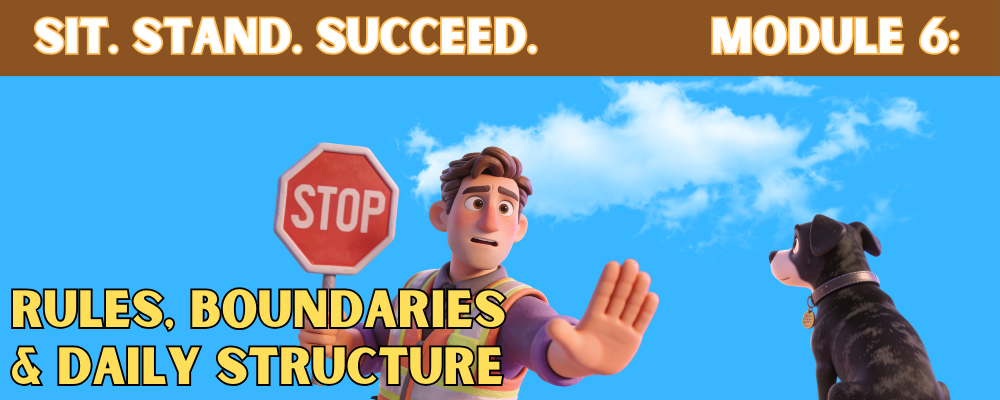
Discover how structure and routine reduce behaviour problems. This module shows you how to set clear rules that create calm, confident dogs.
This is one of the most transformative modules because rules and structure don’t dominate a dog — they free a dog from confusion.
A structured household creates calm, predictable behaviour and eliminates 80% of common issues.
Create a calm, predictable environment that reduces behaviour problems and builds a well-balanced, confident dog.
Dogs thrive when:
- expectations are clear
- routines are predictable
- the environment is consistent
- humans respond the same way every time
Without structure:
- behaviour becomes chaotic
- commands lose meaning
- dogs become anxious or frustrated
- owners become inconsistent
- training progress stalls
This module teaches you how to create simple, healthy rules and household routines that naturally prevent unwanted behaviour — without fear, force, or constant micromanaging.
🔵 1. Why Clear Rules Create Calm Dogs
Most unwanted behaviours happen because the dog doesn’t know the rules, not because they’re misbehaving intentionally.
Dogs ask themselves:
- “Can I jump?”
- “Can I bark now?”
- “Can I rush the door?”
- “Can I pull toward that dog?”
- “Who decides what happens next?”
If the rules change from day to day — or person to person — dogs become confused, excited, unpredictable, or anxious.
Rules create:
✔ predictability
✔ emotional stability
✔ calm behaviour
✔ confidence in the owner
✔ fewer opportunities for bad habits
This module shows you how to build structure without becoming rigid or harsh.
🔵 2. The Three Types of Rules Every Dog Needs
✔ 1. Environmental Rules (Where the Dog Can Be)
These rules help your dog understand:
- which areas are free
- which areas are “calm zones”
- which areas require permission
Examples:
- “Stay out of the kitchen while cooking.”
- “Wait at doorways.”
- “No rushing through gates.”
- “Quiet time in crate or on mat.”
Environmental rules stop:
- counter surfing
- crowding
- door dashing
- chaotic greetings
- overexcitement
✔ 2. Behavioural Rules (What the Dog May Do)
These rules protect your dog, your home, and other people.
Examples:
- no jumping on guests
- no pulling on the lead
- no barking for attention
- no stealing food
- calm behaviour before getting what they want
Behavioural rules stop:
- overwhelm
- overstimulation
- unruly behaviour
- attention-seeking
✔ 3. Permission Rules (When the Dog Gets Something They Want)
This is the calmest, most powerful structure in dog training.
Anything your dog wants becomes an opportunity for training:
They want to go outside? → calm sit
They want attention? → calm behaviour
They want food? → wait calmly
They want the ball thrown? → sit first
They want to greet another dog? → loose lead first
Life rewards build incredible behaviour — without force.
🔵 3. Simple Routines That Reduce Behaviour Issues
Dogs love patterns. These routines teach your dog that calmness makes life easier and more rewarding.
✔ 1. The “Nothing for Free” Routine (but gentle, not harsh)
This doesn’t mean dominance.
It means:
“Show me a calm behaviour, and you get what you want.”
Examples:
- sit before meals
- wait before doors open
- calm body before getting patted
- quiet before receiving attention
This eliminates:
- pushy behaviour
- demand barking
- entitlement
- chaos around excitement triggers
✔ 2. Daily Energy Management Routine
Dogs behave badly when their mental and physical needs aren’t met.
Ideal daily structure:
- morning sniff walk (mental exercise)
- short training session
- rest period
- play session or enrichment
- another short training session
- evening walk or calm outing
Dogs with balanced routine = fewer unwanted habits.
✔ 3. The Calm-Greeting Routine
Chaos at the door creates endless behaviour problems.
Teach:
- sit calmly
- wait on mat
- greet only when released
This reduces:
- jumping
- barking
- anxiety
- door darting
✔ 4. Predictable Sleep & Rest Routine
Most behaviour problems are caused by fatigue, especially in puppies.
Ideal rest:
- puppies: 16–20 hours/day
- teens: 14–18 hours/day
- adults: 12–16 hours/day
Provide:
- crate or playpen
- quiet mat
- predictable rest schedule
A rested dog is a well-behaved dog.
🔵 4. Getting the Whole Household on Board
Inconsistent humans create inconsistent dogs.
Even ONE person breaking the rules creates setbacks.
This module helps you create a Household Training Agreement.
✔ Step 1: Identify the rules
Everyone must agree on:
- no jumping
- no pulling
- where the dog may go
- training words
- boundaries
✔ Step 2: Use the same cues and language
Examples:
- “Off” (get down)
- “Sit” (not “Sit down”)
- “Wait” (not “Stay”)
- “Leave it” (not “No no no no!”)
Consistency = clarity.
✔ Step 3: Agree on reinforcement
Everyone should reward:
- calm behaviour
- polite greetings
- loose-lead walking
- checking in with owner
Reinforcing calmness is how you eliminate chaos.
✔ Step 4: A unified response to unwanted behaviour
If your dog jumps, all humans do the same thing:
- no engagement
- wait for calm
- reward calm
If your dog barks for attention:
- no yelling
- no touching
- no eye contact
- reward quiet
Every unwanted behaviour disappears when the response is consistent.
🔵 5. Practical Exercises for Module 6
These exercises transform household behaviour fast.
Exercise 1: Doorway Waiting Drill
- Approach door
- Dog must wait
- Say “Wait”
- Open door 2–3 cm
- If dog moves: close door
- When dog waits calmly: release & go through
Teaches impulse control.
Exercise 2: Calm Before Freedom
Before:
- opening crate
- letting dog outside
- greeting
- leash on
- throwing ball
Require:
- Sit
- or stand calmly
- or simply stop bouncing
Reward with the thing they wanted.
Exercise 3: Household Cue Consistency Drill
Everyone practices:
- Sit
- Down
- Stay
- Leave it
- Wait
Same words.
Same timing.
Same rewards.
Exercise 4: Mat Training Routine
- Place mat
- Dog steps on it
- “Yes!” + treat
- Build duration
- Add calm rewards
- Release calmly
Mat = calm zone.
This fixes 90% of household chaos.
🔵 6. What Success Looks Like After Module 6
By the end of this module, your dog will:
✔ Be calmer throughout the day
✔ Understand household rules clearly
✔ Show polite behaviour naturally
✔ Be easier to manage around visitors
✔ Show fewer behaviour issues
✔ Be more predictable, confident, and relaxed
And YOU will:
✔ Have a structured routine to reduce chaos
✔ Know exactly how to maintain consistent behaviour
✔ Feel more in control — without ever using force
✔ Have a household that supports your training goals
Module 7 is the turning point where training goes from “managing problems” to “building a reliable dog.”
Responses