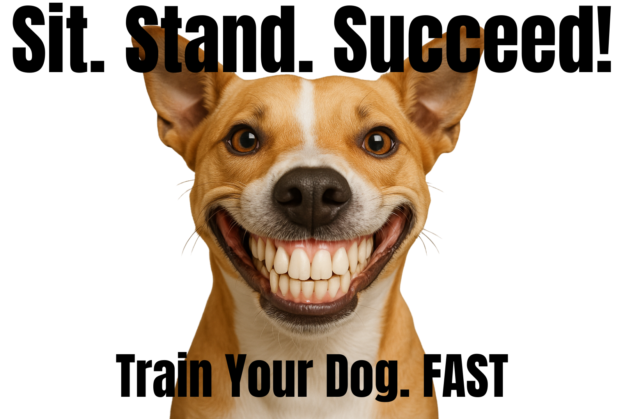
Sit. Stand. Succeed!
Intro
You don’t need to shout.
You don’t need harsh corrections.
And you definitely don’t need to feel embarrassed every time you walk your dog in public.
What you need is clarity — a simple, proven, easy to follow and practical to implement system that shows you how dogs actually learn, and how to guide them calmly, confidently, and consistently.
That’s exactly what this course delivers.
A Complete Training System — From Absolute Beginner to Confident Control
The Complete Dog Training System is a structured, step-by-step easy to follow course designed to take you and your dog from the basics all the way to real-world reliability.
No guesswork.
No dominance myths.
No one-size-fits-all shortcuts.
Instead, you’ll learn:
- How your dog thinks, learns, and communicates
- How to prevent behaviour problems before they start
- How to fix common issues without fear or force
- How to build calm obedience that actually lasts
Whether your dog is a puppy, adolescent, rescue, or adult — this system meets you where you are and moves forward at the right pace.
This Isn’t Just Dog Training — It’s Handler Training
A well-behaved dog isn’t created by commands alone.
It’s created by clear communication, consistency, and trust.
That’s why this course focuses just as much on you as it does on your dog.
By the end, you won’t just have a trained dog —
you’ll be a competent, confident dog owner who understands:
- Why behaviours happen
- How to respond calmly under pressure
- How to adapt training to real-life situations
And once you understand that, everything changes.
Imagine This Instead…
- Walks without pulling or frustration
- A dog that listens — even around distractions
- Calm greetings, polite behaviour, and reliable recall
- Confidence knowing you’re doing the right thing
CONTENTS
- Module 1: Welcome to Dog Training Done Right
- Module 2: Understanding Your Dog’s Mind
- Module 3: Speak Your Dog’s Language
- Module 4: Tools, Rewards & Training Setup
- Module 5: Reward-Based Training That Works
- Module 6: Rules, Boundaries & Daily Structure
- Module 7: Focus, Attention & Engagement
- Module 8: Essential Commands Made Easy
- Module 9: Stay, Self-Control & Patience
- Module 10: Loose Lead Walking Without the Struggle
- Module 11: Recall You Can Rely On
- Module 12: Polite Behaviour Around People & Dogs
- Module 13: Behaviour Problems Explained
- Module 14: Barking, Whining & Attention-Seeking
- Module 15: Chewing, Digging & Destructive Habits
- Module 16: Fear, Anxiety & Reactivity
- Module 17: Creating a Calm, Confident Dog
- Module 18: Stress-Free Handling & Grooming
- Module 19: Making Training Work Everywhere
- Module 20: Off-Leash Skills & Safety
- Module 21: Advanced Impulse Control
- Module 22: Discipline Without Fear or Force
- Module 23: Becoming a Calm, Confident Leader
- Module 24: Training Multiple Dogs
- Module 25: Real-Life Scenarios & Problem Solving
- Module 26: Competent Dog Owner Certification
Module 1: Welcome to Dog Training Done Right
Get a clear overview of the course, how the system works, and what success looks like. You’ll learn what modern dog training really is — and how to avoid the common mistakes that cause confusion and frustration.
How this system works, what you’ll learn, and the key habits that set you up for success.
This module gives you a clear understanding of how the course works, what you can expect from the training process, and — most importantly — how to avoid the common mistakes that cause dogs to become confused, distracted, or uncooperative.
1. What You’ll Achieve by the End of This Course
By the time you finish this program, you and your dog will have:
✔ Calm behaviour at home
Your dog will understand:
- how to settle
- how to wait
- how to be calm around guests
- how to relax without constant attention
✔ Solid obedience in distracting environments
Your dog will respond to:
- Sit, Down, Stand
- Stay and wait
- Come when called
- Walk nicely on lead
✔ Emotional balance and confidence
You’ll learn how to:
- reduce stress
- prevent fear-based behaviours
- build a confident, stable temperament
✔ Real-world reliability
Training won’t just work in the house — it’ll work everywhere:
- parks
- beaches
- busy footpaths
- around people, kids, and other dogs
2. How This System Works (And Why It Works)
This course is built on three proven principles of modern dog training:
1️⃣ Clarity
Dogs thrive when they know exactly what is expected and how to succeed.
You’ll learn to give simple, consistent instructions your dog can follow instantly.
2️⃣ Motivation
Dogs learn FAST when they find training rewarding.
Rewards aren’t bribes — they are communication tools.
You’ll learn how to use:
- food
- toys
- praise
in a way that turns training into a game they want to play.
3️⃣ Structure
Training isn’t about “fixing” bad behaviour — it’s about teaching good habits.
This course gives you daily structure, simple routines, and clear rules that prevent problems before they start.
3. The Most Common Training Mistakes (and How to Avoid Them)
❌ Mistake 1: Repeating Commands
Saying “Sit… sit… SIT!” teaches the dog to ignore the first two repetitions.
Fix:
Say a command once — then guide or reset the dog to succeed.
❌ Mistake 2: Training Too Long
Dogs learn fastest in short, focused sessions.
Fix:
Train for:
- 2–3 minutes for puppies
- 5 minutes for adults
- multiple times per day
Micro-sessions create massive progress.
❌ Mistake 3: Training When the Dog Is Over-Excited
An overstimulated dog can’t think.
Fix:
Use a warm-up routine:
- 30 seconds of calming strokes
- 10 seconds of stillness
- slow eye contact
Then begin training.
❌ Mistake 4: Using Emotion Instead of Technique
Shouting, anger, or frustration shuts learning down.
Fix:
Use:
- calm voice
- consistent signals
- predictable consequences
If you’re calm, your dog becomes calm.
❌ Mistake 5: Forgetting to Reward the Good
Most people only react when the dog does something wrong.
Fix:
Reward the behaviours you want to see more of:
- sitting calmly
- relaxing on the mat
- checking in with you
- walking beside you
Dogs repeat what works.
4. Practical Training Advice to Start TODAY
Below are the essential daily habits that accelerate progress from Day 1.
✔ 1. Keep Treats on You At Home
Dogs learn all the time, not just during “training sessions.”
Carry a few treats in your pocket so you can reward:
- calm behaviour
- checking in
- sitting politely
Every reward teaches a rule.
✔ 2. Begin “Name = Attention” Training
Say your dog’s name once:
“Buddy!” (name)
→ When they look at you, reward immediately.
This becomes the foundation for:
- recall
- loose-lead walking
- engagement
- distraction training
✔ 3. Introduce the Marker Word
Choose a marker such as:
- “Yes!”
- “Good!”
Say it the moment your dog does the correct behaviour —
then reward.
This creates instant clarity.
✔ 4. Use a Training Mat
A mat teaches:
- calmness
- boundaries
- rest
- impulse control
Steps:
- Place the mat down
- When your dog steps on it — mark (“Yes!”)
- Reward
- Repeat until your dog chooses the mat voluntarily
This becomes your “calm zone.”
✔ 5. Add Structure to Meals
Hand-feed 10–20% of meals during training.
This:
- increases engagement
- reinforces manners
- strengthens the relationship
The rest can go in a bowl or enrichment toy.
5. What Success Looks Like
Over the next modules, you’ll quickly notice:
🔹 Your dog becomes more focused
🔹 Training becomes enjoyable
🔹 Daily routines become easier
🔹 Bad behaviours decrease naturally
🔹 Confidence grows — for both of you
This course is not about perfection.
It’s about progress, clarity, and building a calm, connected partnership.
Module 2: Understanding Your Dog’s Mind
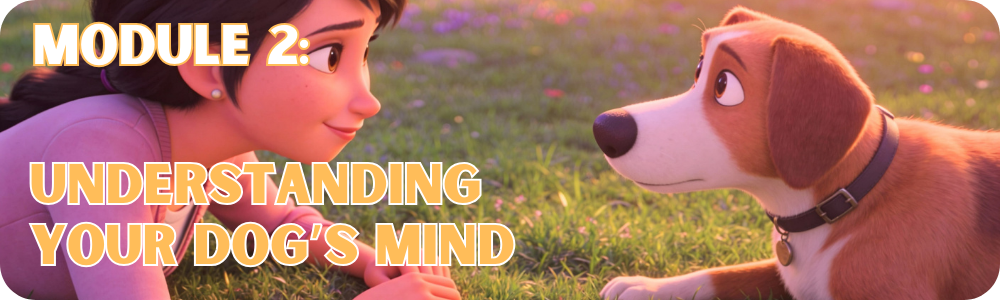
Learn how dogs think, learn, and make decisions. This module gives you the foundation to understand behaviour, motivation, and why your dog does what they do.
This course is built on three proven principles of modern dog training:
1️⃣ Clarity
Dogs thrive when they know exactly what is expected and how to succeed.
You’ll learn to give simple, consistent instructions your dog can follow instantly.
2️⃣ Motivation
Dogs learn FAST when they find training rewarding.
Rewards aren’t bribes — they are communication tools.
You’ll learn how to use:
- food
- toys
- praise
in a way that turns training into a game they want to play.
3️⃣ Structure
Training isn’t about “fixing” bad behaviour — it’s about teaching good habits.
This course gives you daily structure, simple routines, and clear rules that prevent problems before they start.
3. The Most Common Training Mistakes (and How to Avoid Them)
❌ Mistake 1: Repeating Commands
Saying “Sit… sit… SIT!” teaches the dog to ignore the first two repetitions.
Fix:
Say a command once — then guide or reset the dog to succeed.
❌ Mistake 2: Training Too Long
Dogs learn fastest in short, focused sessions.
Fix:
Train for:
- 2–3 minutes for puppies
- 5 minutes for adults
- multiple times per day
Micro-sessions create massive progress.
❌ Mistake 3: Training When the Dog Is Over-Excited
An overstimulated dog can’t think.
Fix:
Use a warm-up routine:
- 30 seconds of calming strokes
- 10 seconds of stillness
- slow eye contact
Then begin training.
❌ Mistake 4: Using Emotion Instead of Technique
Shouting, anger, or frustration shuts learning down.
Fix:
Use:
- calm voice
- consistent signals
- predictable consequences
If you’re calm, your dog becomes calm.
❌ Mistake 5: Forgetting to Reward the Good
Most people only react when the dog does something wrong.
Fix:
Reward the behaviours you want to see more of:
- sitting calmly
- relaxing on the mat
- checking in with you
- walking beside you
Dogs repeat what works.
4. Practical Training Advice to Start TODAY
Below are the essential daily habits that accelerate progress from Day 1.
✔ 1. Keep Treats on You At Home
Dogs learn all the time, not just during “training sessions.”
Carry a few treats in your pocket so you can reward:
- calm behaviour
- checking in
- sitting politely
Every reward teaches a rule.
✔ 2. Begin “Name = Attention” Training
Say your dog’s name once:
“Buddy!” (name)
→ When they look at you, reward immediately.
This becomes the foundation for:
- recall
- loose-lead walking
- engagement
- distraction training
✔ 3. Introduce the Marker Word
Choose a marker such as:
- “Yes!”
- “Good!”
Say it the moment your dog does the correct behaviour —
then reward.
This creates instant clarity.
✔ 4. Use a Training Mat
A mat teaches:
- calmness
- boundaries
- rest
- impulse control
Steps:
- Place the mat down
- When your dog steps on it — mark (“Yes!”)
- Reward
- Repeat until your dog chooses the mat voluntarily
This becomes your “calm zone.”
✔ 5. Add Structure to Meals
Hand-feed 10–20% of meals during training.
This:
- increases engagement
- reinforces manners
- strengthens the relationship
The rest can go in a bowl or enrichment toy.
5. What Success Looks Like
Over the next modules, you’ll quickly notice:
🔹 Your dog becomes more focused
🔹 Training becomes enjoyable
🔹 Daily routines become easier
🔹 Bad behaviours decrease naturally
🔹 Confidence grows — for both of you
This course is not about perfection.
It’s about progress, clarity, and building a calm, connected partnership.
Module 3: Speak Your Dog’s Language
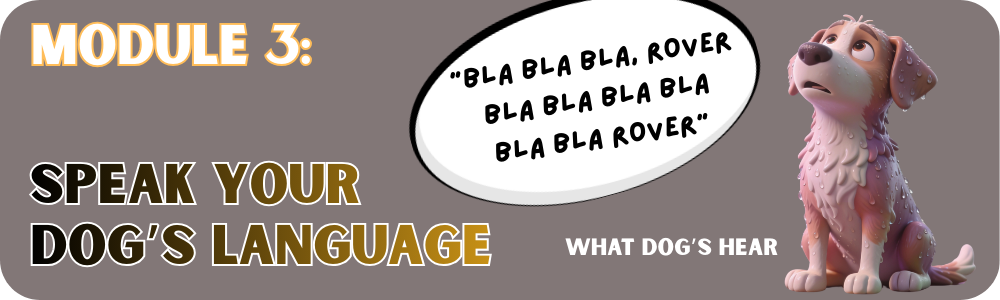
Discover how to read your dog’s body language and emotional signals. You’ll learn to recognise stress, calm, fear, and confidence — and how to adjust your approach accordingly.
This module is extremely powerful — because once an owner can read a dog, everything becomes easier: training, behaviour correction, confidence, calmness, and trust.
Learn to read body language, emotions, and signals so you can train with clarity—not confusion.
Dogs communicate constantly.
They don’t use sentences — they use posture, movement, tension, breathing, facial expressions, and subtle signals that most humans simply never learned to notice.
This module teaches you the real “communication tools” dogs use so you can understand what your dog is feeling before it becomes a behaviour problem.
Once you can read your dog clearly, you will prevent:
- reactivity
- fear
- overstimulation
- pulling
- conflict with other dogs
- training frustration
Communication is a superpower — and after this module, you’ll have it.
🔵 1. Reading Body Language With Confidence
Dogs express their emotions through their entire body.
Here’s how to read the most important signals:
✔ Tail
Loose, sweeping tail:
Happy, relaxed, comfortable.
Low tail, tucked:
Fearful, anxious, unsure.
High, stiff, fast wag:
Over-aroused, overstimulated, may escalate.
Still tail (no wag):
On alert, assessing something carefully.
✔ Eyes
Soft eyes:
Blinking, relaxed, calm.
Whale eye (white showing):
Fear, stress, or warning.
Hard stare:
Intensity, challenge, discomfort, heightened arousal.
✔ Ears
Neutral/relaxed:
Comfortable and at ease.
Forward and stiff:
Alert, stimulated, focused.
Pinned back:
Fear, appeasement, stress.
✔ Mouth
Loose mouth, tongue visible:
Relaxed, calm.
Closed tight mouth:
Concern building.
Panting rapidly (not heat):
Stress, anxiety, excitement.
Lip licking (no food present):
A stress or appeasement signal.
✔ Body posture
Loose, curved body:
Friendly, safe, relaxed.
Leaning forward, stiff:
Tension, defensiveness, potential escalation.
Rolling onto back (loose body):
Trust, comfort, relaxation.
Rolling onto back (stiff body):
Appeasement, uncertainty, “please don’t.”
🔵 2. Recognising Stress, Calm & Emotional Signals
Dogs rarely go from “calm” to “reactive” instantly.
There are early warning signs.
Learning these signs prevents:
- lunging
- barking
- growling
- pulling
- shut-down behaviour
✔ Early Stress Signs
These signals often appear before barking or reacting:
- lip licking
- yawning (out of context)
- sudden freezing
- slow, stiff movement
- turning head away
- sniffing floor suddenly
- paw lift
Trainer tip:
When you see these, increase distance or reduce pressure.
✔ Escalating Stress Signs
These appear when the dog is overwhelmed:
- tail tuck
- ears pinned
- fast shallow panting
- backing away
- refusing food
- whining
- attempting escape
Respond by:
- adding distance
- redirecting calmly
- lowering difficulty
- NOT “pushing through it”
✔ Signs of Calm & Trust
Celebrate these — they mean your training is working:
- soft eye contact
- slow blinking
- relaxed breathing
- tail wagging low and loose
- leaning into you
- offering behaviours voluntarily
- listening even around distractions
🔵 3. How Your Actions Shape Your Dog’s Behaviour
Your dog is reading YOU just as much as you’re reading them.
Your:
- body movement
- tone
- posture
- breathing
- tension
all communicate to your dog, even when you don’t mean them to.
✔ Your posture matters
Leaning over a dog:
Can feel intimidating.
Standing side-on:
Feels safer and more inviting.
Quick movement:
Creates excitement or tension.
✔ Your tone changes behaviour
- high, excited voice = increases energy
- calm, low voice = reduces energy
- sharp tone = stops behaviour
- soft tone = encourages behaviour
Use tone intentionally — it’s one of your strongest tools.
✔ Your timing is communication
Rewarding too late teaches the wrong behaviour.
Example:
If you reward after your dog stands up, they learn:
“Standing gets the reward.”
Timing creates meaning.
✔ Your breathing affects your dog
Dogs read the emotional state of their humans.
If you:
- hold your breath
- tense your shoulders
- tighten the lead
Your dog becomes more alert and tense.
Trainer tip:
Use slow breathing to calm yourself → your dog will mirror it.
🔵 4. Practical Exercises to Build Communication Skills
These are real-world exercises used by professional trainers.
Start today.
Exercise 1: 2-Minute Observation Drill
For two minutes:
- watch your dog
- no talking
- no commands
- no interaction
Write down:
- tail position
- eyes
- ears
- posture
- breathing rate
- how emotions change in different contexts
This trains your “trainer’s eye.”
Exercise 2: Body Language Labeling
Say out loud (or write):
- “soft eyes”
- “stiff tail”
- “relaxed posture”
- “ears forward”
This trains your brain to recognise patterns in real time.
Exercise 3: Watch-and-Respond
Whenever you notice early stress signs:
- increase distance
- lower intensity
- add calm reinforcement
This prevents escalation.
Exercise 4: Mirror Calmness
Practice:
- slow movements
- gentle voice
- loose shoulders
- relaxed breathing
Then observe your dog’s response.
Your dog mirrors your state.
This is your secret advantage.
🔵 5. What Success Looks Like After Module 3
By the end of this module, you will be able to:
✔ Identify stress vs excitement instantly
✔ Spot the early warning signs before behaviour escalates
✔ Respond to emotional changes with confidence
✔ Communicate through posture, tone, and timing
✔ Build a calm, trusting bond with your dog
✔ Prevent 80% of behaviour issues before they even start
This module sets the foundation for all leash training, recall, impulse control, reactivity reduction, and advanced obedience work in later phases.
Module 4: Tools, Rewards & Training Setup
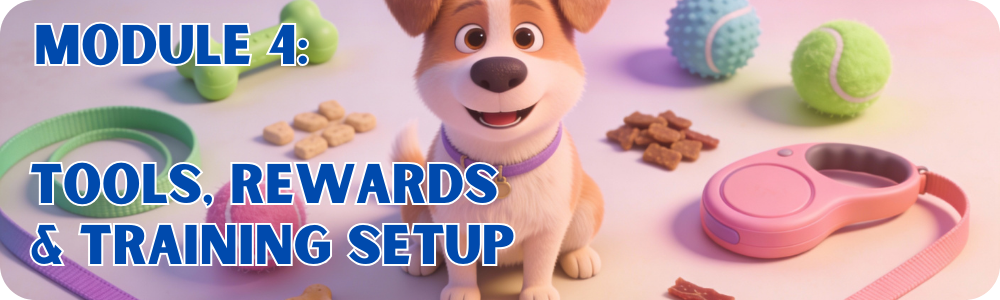
Learn which training tools actually help — and which ones don’t. You’ll set up the right environment, choose effective rewards, and prepare for success before training even begins.
This module is one of the most important in the entire system — because your tools, rewards, and setup determine whether training is clear and effective, or frustrating and confusing.
Choose the right equipment, set up the right environment, and learn how to use rewards that make training fast, fun, and frustration-free.
Training doesn’t begin when you say “Sit.”
It begins with the environment, the equipment, your preparation, and the reward strategy you bring into the session.
This module teaches you how to set up training correctly — so every session is calm, clear, and successful.
🔵 1. Choosing the Right Equipment for Success
The right tools make training easier, safer, and far more effective.
Here’s what works — and what doesn’t.
✔ Flat Collar
Best for:
- ID tags
- safe walking for calm dogs
- everyday use
Avoid using for:
- dogs that pull
- excited adolescents
- training new behaviours
It does NOT help stop pulling — it simply attaches the lead.
✔ Y-Front Harness (Recommended for 90% of dogs)
Allows:
- full shoulder movement
- comfort
- safer control
- reduced pulling pressure
Look for:
- Y-shape (never straight bar across chest)
- two lead points (front + back)
- adjustable straps
Best for:
- puppies
- strong dogs
- training loose-lead walking
✔ Front-Clip Harness (Training Tool)
Helps gently turn the dog toward you during pulling.
Use when:
- teaching loose-leash walking
- training strong or excitable dogs
Avoid:
- pulling harshly — the harness does the work
- relying on it forever
It’s a teaching tool, not a permanent solution.
✔ Long Line (5m–10m)
One of the most powerful training tools.
Used for:
- recall training
- safe outdoor practice
- controlled freedom
Allows:
- distance
- exploration
- safety
- training that works BEFORE off-leash freedom
✔ Treat Pouch
Keeps rewards:
- accessible
- fast to deliver
- consistent
A must-have for effective timing.
❌ Tools to Avoid
These tools create fear, pain, or confusion — and make behaviour worse long-term:
- prong collars
- choke chains
- slip leads used for correction
- spray collars
- shock/e-collars (unless used by certified specialists for severe cases)
This course focuses on clear, humane, effective training only.
🔵 2. Using Food, Toys & Praise Effectively
Rewards are how we communicate success to a dog.
Without rewards, training becomes unclear and frustrating.
Different rewards serve different purposes.
✔ Food Rewards (Primary Training Tool)
Use food for:
- teaching new behaviours
- shaping
- fast learning
- calm behaviours
- precision training
Types of food:
- soft, moist treats
- cheese, chicken, beef
- commercial training treats
- kibble (only for easy tasks)
Rule:
The harder the task, the better the treat.
✔ Toy Rewards
Best for:
- high-energy dogs
- working breeds
- outdoor training
- recall building
Toy types:
- tug toys
- balls
- flirt pole (use sparingly)
Toys build excitement and engagement — but they are not ideal for calm behaviours like “Stay.”
✔ Praise (Social Reward)
Use for:
- reinforcing calm behaviour
- maintaining focus
- building relationship
Praise works best when your dog:
- already enjoys you
- is in a low-arousal state
Never rely on praise alone for new behaviours.
✔ Reward Delivery — Timing Matters
Reward:
- within 1 second of the correct behaviour
- using a marker word (“Yes!”)
- consistently
This creates clarity:
“THIS is the moment you did it right.”
🔵 3. Creating a Training Environment That Works
Where you train determines how well your dog learns.
Dogs do NOT generalise well — meaning:
“Sit in the kitchen” does NOT automatically translate to
“Sit at the park.”
Follow the 3-Stage Environment System:
✔ Stage 1: Low-Distraction Environment (Indoors)
Best for:
- new commands
- shaping behaviour
- early learning
Choose:
- living room
- hallway
- quiet space
- minimal noise
Goal:
Success and clarity.
✔ Stage 2: Medium-Distraction Environment (Yard / Driveway)
Add mild distractions:
- sounds
- smells
- light movement
Perfect for advancing:
- sit, down, stay
- loose-lead basics
- recall with long line
Goal:
Real-world readiness.
✔ Stage 3: High-Distraction Environment (Public Areas)
Use only when:
- behaviour is already reliable
- your dog can succeed at Stage 2
Examples:
- parks
- walking paths
- beaches
- near dogs and people
Goal:
Proofing and reliability.
🔵 4. Practical Step-by-Step Training Setup
Use this before every training session.
✔ 1. Pre-Session Checklist
- Treat pouch filled
- Long line or harness ready
- Distraction level appropriate
- Dog not over-aroused
- YOU calm and patient
If you start wrong, the session fails before it begins.
✔ 2. Warm-Up Routine (30–60 seconds)
- gentle strokes
- slow breathing
- eye contact
- name recognition
- one easy behaviour (“Sit”)
This lowers excitement and opens the learning brain.
✔ 3. Training Flow
A session should look like:
- Ask behaviour
- Mark (“Yes!”)
- Reward
- Reset
- Repeat
Consistency = results.
✔ 4. Session Length
Follow this rule:
- Puppies: 2 minutes
- Teens: 3–5 minutes
- Adult dogs: 5–8 minutes
- Total sessions per day: 3–5 micro sessions
Short. Fun. Clear.
🔵 5. Troubleshooting (Common Problems & Fixes)
❌ Dog ignores food
Cause: too distracted or wrong treat.
Fix:
- lower distraction
- use a higher-value treat
- shorten session
❌ Dog pulls during training
Cause: starting in wrong environment.
Fix:
- begin indoors
- teach focus first
- use front-clip harness
- use long line outdoors
❌ Dog loses interest
Cause: session too long or rewards too predictable.
Fix:
- shorten sessions
- alternate food + toys
- increase difficulty slowly
❌ Dog becomes hyperactive
Cause: tug reward or excitement too early.
Fix:
- switch to calm food rewards
- include mat work
- add structure & pauses
🔵 6. What Success Looks Like After Module 4
You will be able to:
✔ Use the right tools for your dog’s needs
✔ Deliver rewards clearly and effectively
✔ Set up training sessions that lead to success
✔ Control distraction levels like a professional trainer
✔ Prevent 80% of training frustration
This module sets the stage for the real training that begins in Module 5.
Module 5: Reward-Based Training That Works
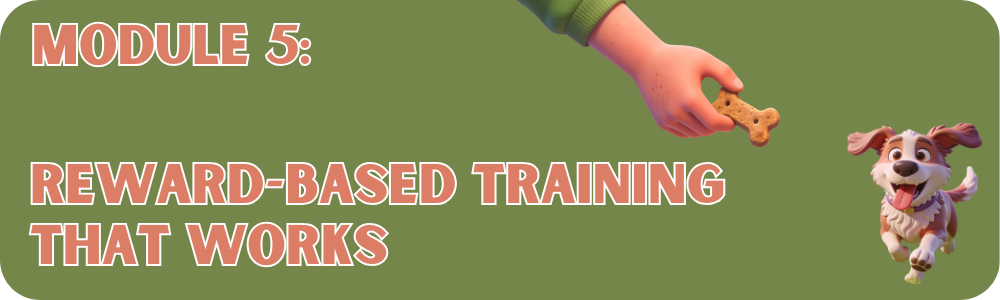
Master the fundamentals of positive reinforcement. You’ll learn how timing, consistency, and clear markers create faster learning and better results.
This is one of the most IMPORTANT modules in the entire course, because reward-based training isn’t about “treats” — it’s about communication.
When owners understand how rewards actually shape behaviour, dog training becomes easy, fast, and enjoyable.
Master the fundamentals of positive reinforcement, perfect timing, clear communication, and consistent results.
Reward-based training is not about spoiling the dog or “bribing” them.
It’s about teaching through clarity:
“THIS is the behaviour I want.
THIS is the moment you did it right.”
Rewards tell the dog exactly what worked — and that clarity creates fast, reliable learning that lasts a lifetime.
This module teaches you world-class reinforcement methods used by professional trainers.
🔵 1. Why Positive Reinforcement Works Faster
Positive reinforcement strengthens the exact behaviours you want to see more of.
Dogs are constantly evaluating:
- What gets me rewarded?
- What gets me attention?
- What gets me closer to what I want?
When you control the reward system, you control behaviour.
Here’s why it works so well:
✔ 1. It creates eager, motivated learners
Dogs work harder when training feels like play.
Reward-based training makes your dog think:
“Training is fun — and I want to keep trying.”
✔ 2. It removes fear and confusion
Punishment shuts learning down.
Rewards open it up.
When a dog knows exactly how to succeed, they relax, think clearly, and learn quickly.
✔ 3. It builds trust and cooperation
Your dog learns that:
- you are predictable
- you are safe
- listening to you makes good things happen
This reduces anxiety, reactivity, and stubborn behaviour.
✔ 4. It prevents problem behaviours before they start
A rewarded dog is a calm dog, and a calm dog:
- pulls less
- barks less
- jumps less
- reacts less
Good behaviour becomes a habit — not a command.
🔵 2. Perfect Timing, Markers & Delivery
Timing is the most important skill in dog training.
If you reward too late, you risk reinforcing the wrong behaviour.
This module teaches you to time rewards correctly using the marker system.
✔ The Marker Word (“Yes!”)
A marker is a precise signal that tells the dog:
“The exact behaviour you did at this moment is correct.”
- Say it once
- Use a normal tone
- Reward immediately afterward
Examples:
- Dog’s bum hits floor → “Yes!” → treat
- Dog looks at you → “Yes!” → treat
- Dog walks beside you → “Yes!” → treat
This creates lightning-fast clarity.
✔ Reward Placement (Where You Deliver the Treat Matters)
Different placements influence behaviour:
Reward at your side
Builds loose-lead walking.
Reward on the ground
Builds calm, low-arousal behaviour.
Reward in front of you
Builds engagement and attention.
Tiny placement changes = big behavioural differences.
✔ Reward Frequency
Use this rule:
- Teaching a new behaviour: reward every success
- Building confidence: high reward rate
- Advancing the skill: reward intermittently
- Proofing the behaviour: use life rewards (movement, environment, freedom)
This creates a smooth transition from “training with treats” to “living with good habits.”
🔵 3. Types of Rewards & When to Use Them
Rewards are communication tools.
Each type sends a different message.
✔ 1. Food Rewards (Most Effective)
Use soft, high-value treats for:
- shaping
- learning new commands
- working in distractions
- building calm behaviours
Examples of high-value rewards:
- cooked chicken
- cheese
- liver treats
- commercial training treats
- roast beef
Low-value rewards (kibble) are best for:
- easy tasks
- indoor training
- warmups
✔ 2. Toy Rewards
Best for:
- high-drive dogs
- outdoor training
- recall
- engagement building
Use:
- tug toys
- balls
- squeakers (sparingly)
Toy rewards build ENERGY — great for engagement, not great for calm behaviours.
✔ 3. Praise & Affection
Great for:
- reinforcing calm
- rewarding polite behaviour at home
- lowering arousal
Praise works best when paired with food early in training.
✔ 4. “Life Rewards”
These are powerful, natural reinforcers:
- going through a door
- being let off leash
- sniffing
- jumping into the car
- playing with another dog
- chasing a ball
Real-world rewards build long-term reliability.
🔵 4. Avoiding the Most Common Training Mistakes
Most training failures come from simple errors that are easy to fix.
❌ Mistake 1: Using food as a bribe
Holding the treat in front of the nose before asking is bribery.
The dog learns:
“I only listen when you show me food.”
Fix:
Ask → dog behaves → then food appears.
❌ Mistake 2: Incorrect timing
Rewarding too late reinforces the wrong behaviour.
Fix:
Use your marker word (“Yes!”) for instant timing.
❌ Mistake 3: Rewarding while dog is excited
If your dog is over-aroused:
- they can’t think
- rewards lose value
- behaviour becomes chaotic
Fix:
Use calm rewards:
- slower delivery
- ground placement
- praise after the behaviour, not before
❌ Mistake 4: Training too long
Long sessions = mental fatigue = slow learning.
Fix:
Use micro-sessions:
- puppies: 2 minutes
- adults: 5 minutes
- multiple times per day
❌ Mistake 5: Skipping steps
If your dog can’t perform a behaviour in a park, it’s because you advanced too fast.
Fix:
Follow the 3-stage environment system:
- indoors
- medium distraction
- public place
Progress only when the behaviour is reliable.
🔵 5. Practical Exercises for Immediate Results
These exercises build lightning-fast learning and strong engagement.
Exercise 1: 10-Reward Focus Drill
- Say your dog’s name
- Dog looks at you
- “Yes!” + reward
- Repeat 10 times
Builds automatic attention.
Exercise 2: Reward on Calm
Reward when your dog:
- takes a breath
- lowers shoulders
- relaxes
- sits quietly
- settles on mat
This builds calm behaviour without commands.
Exercise 3: The “Magic Hand” Game
- Treat in your closed hand
- Dog sniffs/licks → ignore
- Dog backs off or sits → “Yes!” → open hand
Teaches impulse control instantly.
Exercise 4: Fast Teaching (3-Second Rule)
Ask → dog succeeds → “Yes!” + reward → reset → repeat.
Short repetitions = fast learning.
Exercise 5: Reward Placement Shaping
Reward:
- at left side for loose-lead walking
- at your feet for calm
- in front for attention
This shapes behaviour without force.
🔵 6. What Success Looks Like After Module 5
At the end of this module, your dog will:
✔ Learn new behaviours faster
✔ Focus better
✔ Work happily and willingly
✔ Respond to your marker word instantly
✔ Understand exactly what earns rewards
✔ Start building strong, consistent habits
And YOU will:
- have professional-level timing
- use rewards strategically
- know how to motivate your dog effectively
- communicate with clarity and consistency
This paves the way for Module 6: Rules, Boundaries & Daily Structure, where good habits become reliable behaviour.
Module 6: Rules, Boundaries & Daily Structure
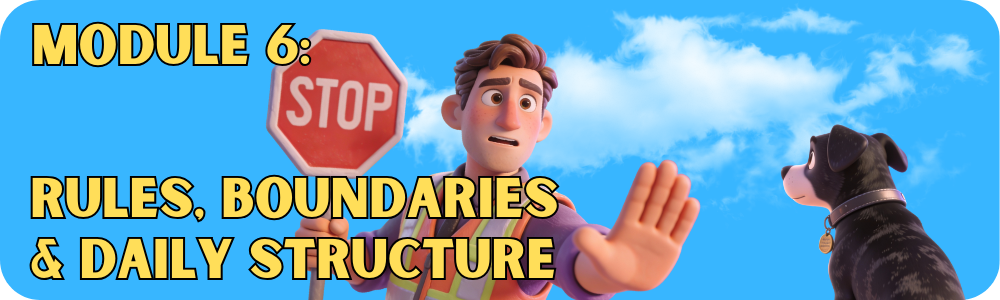
Discover how structure and routine reduce behaviour problems. This module shows you how to set clear rules that create calm, confident dogs.
This is one of the most transformative modules because rules and structure don’t dominate a dog — they free a dog from confusion.
A structured household creates calm, predictable behaviour and eliminates 80% of common issues.
Create a calm, predictable environment that reduces behaviour problems and builds a well-balanced, confident dog.
Dogs thrive when:
- expectations are clear
- routines are predictable
- the environment is consistent
- humans respond the same way every time
Without structure:
- behaviour becomes chaotic
- commands lose meaning
- dogs become anxious or frustrated
- owners become inconsistent
- training progress stalls
This module teaches you how to create simple, healthy rules and household routines that naturally prevent unwanted behaviour — without fear, force, or constant micromanaging.
🔵 1. Why Clear Rules Create Calm Dogs
Most unwanted behaviours happen because the dog doesn’t know the rules, not because they’re misbehaving intentionally.
Dogs ask themselves:
- “Can I jump?”
- “Can I bark now?”
- “Can I rush the door?”
- “Can I pull toward that dog?”
- “Who decides what happens next?”
If the rules change from day to day — or person to person — dogs become confused, excited, unpredictable, or anxious.
Rules create:
✔ predictability
✔ emotional stability
✔ calm behaviour
✔ confidence in the owner
✔ fewer opportunities for bad habits
This module shows you how to build structure without becoming rigid or harsh.
🔵 2. The Three Types of Rules Every Dog Needs
✔ 1. Environmental Rules (Where the Dog Can Be)
These rules help your dog understand:
- which areas are free
- which areas are “calm zones”
- which areas require permission
Examples:
- “Stay out of the kitchen while cooking.”
- “Wait at doorways.”
- “No rushing through gates.”
- “Quiet time in crate or on mat.”
Environmental rules stop:
- counter surfing
- crowding
- door dashing
- chaotic greetings
- overexcitement
✔ 2. Behavioural Rules (What the Dog May Do)
These rules protect your dog, your home, and other people.
Examples:
- no jumping on guests
- no pulling on the lead
- no barking for attention
- no stealing food
- calm behaviour before getting what they want
Behavioural rules stop:
- overwhelm
- overstimulation
- unruly behaviour
- attention-seeking
✔ 3. Permission Rules (When the Dog Gets Something They Want)
This is the calmest, most powerful structure in dog training.
Anything your dog wants becomes an opportunity for training:
They want to go outside? → calm sit
They want attention? → calm behaviour
They want food? → wait calmly
They want the ball thrown? → sit first
They want to greet another dog? → loose lead first
Life rewards build incredible behaviour — without force.
🔵 3. Simple Routines That Reduce Behaviour Issues
Dogs love patterns. These routines teach your dog that calmness makes life easier and more rewarding.
✔ 1. The “Nothing for Free” Routine (but gentle, not harsh)
This doesn’t mean dominance.
It means:
“Show me a calm behaviour, and you get what you want.”
Examples:
- sit before meals
- wait before doors open
- calm body before getting patted
- quiet before receiving attention
This eliminates:
- pushy behaviour
- demand barking
- entitlement
- chaos around excitement triggers
✔ 2. Daily Energy Management Routine
Dogs behave badly when their mental and physical needs aren’t met.
Ideal daily structure:
- morning sniff walk (mental exercise)
- short training session
- rest period
- play session or enrichment
- another short training session
- evening walk or calm outing
Dogs with balanced routine = fewer unwanted habits.
✔ 3. The Calm-Greeting Routine
Chaos at the door creates endless behaviour problems.
Teach:
- sit calmly
- wait on mat
- greet only when released
This reduces:
- jumping
- barking
- anxiety
- door darting
✔ 4. Predictable Sleep & Rest Routine
Most behaviour problems are caused by fatigue, especially in puppies.
Ideal rest:
- puppies: 16–20 hours/day
- teens: 14–18 hours/day
- adults: 12–16 hours/day
Provide:
- crate or playpen
- quiet mat
- predictable rest schedule
A rested dog is a well-behaved dog.
🔵 4. Getting the Whole Household on Board
Inconsistent humans create inconsistent dogs.
Even ONE person breaking the rules creates setbacks.
This module helps you create a Household Training Agreement.
✔ Step 1: Identify the rules
Everyone must agree on:
- no jumping
- no pulling
- where the dog may go
- training words
- boundaries
✔ Step 2: Use the same cues and language
Examples:
- “Off” (get down)
- “Sit” (not “Sit down”)
- “Wait” (not “Stay”)
- “Leave it” (not “No no no no!”)
Consistency = clarity.
✔ Step 3: Agree on reinforcement
Everyone should reward:
- calm behaviour
- polite greetings
- loose-lead walking
- checking in with owner
Reinforcing calmness is how you eliminate chaos.
✔ Step 4: A unified response to unwanted behaviour
If your dog jumps, all humans do the same thing:
- no engagement
- wait for calm
- reward calm
If your dog barks for attention:
- no yelling
- no touching
- no eye contact
- reward quiet
Every unwanted behaviour disappears when the response is consistent.
🔵 5. Practical Exercises for Module 6
These exercises transform household behaviour fast.
Exercise 1: Doorway Waiting Drill
- Approach door
- Dog must wait
- Say “Wait”
- Open door 2–3 cm
- If dog moves: close door
- When dog waits calmly: release & go through
Teaches impulse control.
Exercise 2: Calm Before Freedom
Before:
- opening crate
- letting dog outside
- greeting
- leash on
- throwing ball
Require:
- Sit
- or stand calmly
- or simply stop bouncing
Reward with the thing they wanted.
Exercise 3: Household Cue Consistency Drill
Everyone practices:
- Sit
- Down
- Stay
- Leave it
- Wait
Same words.
Same timing.
Same rewards.
Exercise 4: Mat Training Routine
- Place mat
- Dog steps on it
- “Yes!” + treat
- Build duration
- Add calm rewards
- Release calmly
Mat = calm zone.
This fixes 90% of household chaos.
🔵 6. What Success Looks Like After Module 6
By the end of this module, your dog will:
✔ Be calmer throughout the day
✔ Understand household rules clearly
✔ Show polite behaviour naturally
✔ Be easier to manage around visitors
✔ Show fewer behaviour issues
✔ Be more predictable, confident, and relaxed
And YOU will:
✔ Have a structured routine to reduce chaos
✔ Know exactly how to maintain consistent behaviour
✔ Feel more in control — without ever using force
✔ Have a household that supports your training goals
Module 7 is the turning point where training goes from “managing problems” to “building a reliable dog.”
Module 7: Focus, Attention & Engagement
Teach your dog to pay attention to you — even around distractions. You’ll build engagement and motivation, creating a dog that wants to listen.
Module 7 is one of the MOST important modules in the entire course, because focus is the foundation of ALL training:
- Recall
- Loose-lead walking
- Stay
- Impulse control
- Calm behaviour
- Obedience around distractions
If your dog can’t focus, they can’t learn.
If you teach focus, everything else becomes easy.
Teach your dog to listen, build powerful engagement, and maintain attention even around distractions.
This module gives you the tools professional trainers use to create dogs who want to pay attention — not because they’re forced, but because you become more interesting than the distractions around them.
Once your dog understands focus work, training becomes smoother, calmer, and dramatically more effective.
🔵 1. Teaching Your Dog to Listen
Dogs don’t listen because:
- they’re overstimulated
- the environment is too difficult
- the reward isn’t motivating enough
- you haven’t taught focus intentionally
- your voice blends into background noise
This module teaches you how to build attention from the ground up.
✔ Step 1: Name Recognition (“Name = Attention”)
This is the first layer of all communication.
Exercise:
- Say your dog’s name once.
- The moment they look at you → “Yes!” + reward.
- Repeat until fast and automatic.
Rules:
- Don’t repeat the name.
- Don’t use it when angry.
- Make sure your dog LOVES hearing it.
Goal:
Head turn within 1 second.
✔ Step 2: The Attention Cue (“Watch Me”)
Teach your dog to make eye contact on cue.
Exercise:
- Hold treat between eyes.
- Dog looks at treat → move treat behind your back.
- Dog looks at your eyes → “Yes!” + reward.
- Add verbal cue: “Watch.”
Build up to:
- 1 second
- 3 seconds
- 5 seconds
- distractions
Eye contact = engagement.
✔ Step 3: The Engagement Circle
This powerful exercise teaches your dog:
- to check in automatically
- to stay connected while moving
- to respond quickly to changing direction
Exercise:
- Walk in a small circle.
- When dog checks in → “Yes!” + reward.
- Change direction randomly.
- Reward again when dog turns with you.
Builds a dog that stays with you.
🔵 2. Building Strong Focus Around Distractions
Dogs cannot focus if the environment is too hard.
We raise distraction levels gradually using the Focus Ladder.
🪜 The Focus Ladder (Progression System)
Level 1: Indoors (Low Distraction)
Start with:
- name training
- eye contact
- engagement circle
Goal: automatic focus.
Level 2: Backyard / Quiet Street (Medium Distraction)
Add:
- light sounds
- mild smells
- moving background
Reward generously.
Level 3: Public Area (High Distraction)
Start at a distance from triggers:
- other dogs
- children
- bikes
- smells
- high movement
Reward for:
- looking at you
- choosing calm behaviour
- checking in voluntarily
Level 4: Trigger Proximity Work
This is advanced.
Reward:
- head turns away from triggers
- calm focus
- walking beside you
This builds impulse control AND engagement.
🔵 3. Creating a Willing, Motivated Learner
You cannot force attention.
You build attention by becoming:
✔ predictable
✔ rewarding
✔ calm
✔ consistent
✔ more interesting than the options around you
Here’s how:
✔ Use “Engagement Sessions” (1–2 minutes each)
An engagement session is NOT obedience.
No sit.
No down.
No stay.
It is simply:
- rewarding eye contact
- celebrating check-ins
- turning together
- having fun
Dogs trained this way:
- stay connected
- stay close
- learn faster
- offer behaviours voluntarily
✔ Use Movement to Build Attention
Movement creates:
- focus
- curiosity
- following behaviour
Professional trainer secret:
“If focus drops, move — don’t talk.”
Try:
- walk away
- change direction
- jog 2 steps
- stop suddenly
Reward when your dog follows your movement.
✔ Use the Right Reinforcer for the Right Moment
Use:
- high-value treats for high distraction
- quick treats for rapid repetition
- toys for intense engagement
- praise for calm focus
If your dog loses interest, your reward isn’t high enough for the environment.
✔ Make Yourself the “Source of Good Decisions”
This transforms your relationship.
Reward when your dog:
- looks back during walks
- chooses you over a distraction
- waits calmly
- sits before greeting
- ignores something tempting
Good choices = rewards
Bad choices = no reward
No punishment needed.
🔵 4. Practical Exercises for Module 7
Here are the exact exercises trainers use to build world-class focus.
Exercise 1: The “10 Automatic Check-Ins” Game
Goal: train your dog to check in without being asked.
Steps:
- Stand still
- Reward every time dog looks at you
- Aim for 10 check-ins
If dog gets bored → move around → reset.
Exercise 2: The Choose Me Over That Game
- Walk your dog at a distance from a distraction.
- When your dog glances at distraction → then looks back at you:
“Yes!” + reward
This is the foundation of reducing reactivity.
Exercise 3: The 3-Second Rule
In high distraction:
- If dog looks at you for 3 seconds → reward
- Builds impulse control and patience
Exercise 4: Pattern Games (from Control Unleashed)
Patterns calm the dog and create focus.
Simple patterns:
- 1-2-3 Treat
- Up-Down
- Side-to-Side
Predictability = calm attention.
Exercise 5: The Engagement Walk
- Clip long line.
- Walk in a quiet area.
- Reward every check-in.
- Add sudden turns and stops.
- Celebrate connection.
This builds a dog that pays attention before pulling begins.
🔵 5. What Success Looks Like After Module 7
By the end of this module, your dog will:
✔ Look at you quickly when you say their name
✔ Offer attention voluntarily
✔ Stay engaged on walks
✔ Choose you instead of distractions
✔ Learn new commands faster
✔ Work with excitement AND calmness
✔ Maintain focus around real-world triggers
And YOU will:
✔ Understand how to build attention intentionally
✔ Know how to structure engagement sessions
✔ Be able to raise (or lower) distraction levels
✔ Use reinforcement strategically
✔ Have the foundation for loose-lead walking, recall, and impulse control
Everything in Modules 8–12 becomes dramatically easier once your dog knows how to focus.
Module 8: Essential Commands Made Easy
Learn how to teach sit, down, and stand step by step. This module focuses on clarity, consistency, and turning commands into reliable behaviours.
This module teaches you the essential commands every dog must know — and how to teach them clearly, calmly, and consistently.
The focus is on real-world reliability, not robotic obedience.
Teach sit, down, stand, and other core behaviours using clear steps, proven methods, and calm communication.
Essential commands are the foundation of a well-behaved dog.
But most dogs don’t fail because they’re “stubborn.”
They fail because:
- the cue wasn’t taught correctly
- the environment was too hard
- the owner repeated themselves
- timing was unclear
- rewards were inconsistent
This module removes all the guesswork — and replaces it with simple, repeatable steps that build reliable habits.
🔵 1. How to Teach Commands the Modern Way
Professional trainers use a 3-part teaching system:
✔ 1. Lure
Guide the dog into the position with a treat.
NOT a bribe — a teaching tool.
✔ 2. Reward
Mark the exact moment the dog succeeds.
This builds clarity.
✔ 3. Fade the Lure
Quickly remove visible food so the cue becomes the signal.
This prevents lifelong bribery.
Every command in this module follows that structure.
🔵 2. Teaching the Sit — Calm, Clear & Reliable
Sit is often taught wrong because people push the dog’s bottom or repeat the cue. ❌
Here is the correct method.
✔ Step-by-Step “Sit” Training
Step 1: Lure
- Hold treat close to dog’s nose
- Slowly move treat upward and slightly backward
- As head goes up → bottom goes down
Step 2: Mark the behaviour
The second the bum touches the ground:
“Yes!” → reward
Step 3: Add the cue
Say “Sit” before you lure.
Timing rule:
Cue → lure → sit → “Yes!” → reward
Step 4: Fade the lure
Move your hand in the same motion without food.
Then reward from other hand.
✔ Common Sit Problems & Fixes
❌ Dog jumps or paws
Fix: Raise treat slower.
❌ Dog backs up
Fix: Train against a wall or sofa.
❌ Dog won’t sit outside
Fix: Lower distractions.
Return to Module 7’s Focus Ladder.
🔵 3. Teaching the Down — Calm, Relaxing & Controlled
Down is a calming behaviour — but many dogs resist it if taught incorrectly.
Here’s the correct method.
✔ Step-by-Step “Down” Training
Step 1: Lure
- Start in sit position
- Bring treat down to the floor
- Slide treat slowly toward dog’s chest
- Then pull treat slightly forward
- Dog should follow treat into a down
Step 2: Mark
The moment belly or elbows touch the floor:
“Yes!” → reward
Step 3: Add cue
Say “Down” just before luring.
Step 4: Fade lure
Move hand without treat → reward from other hand.
✔ Problems & Fixes
❌ Dog keeps standing
Fix: Start from sit, not stand.
❌ Dog follows treat but won’t lie down
Fix: Move treat slowly — don’t rush.
Or use a mat (more inviting).
❌ Dog pops up quickly
Fix: Deliver reward low to the ground to keep them down.
🔵 4. Teaching the Stand — Useful, Often Overlooked
Stand is important for:
- grooming
- vet exams
- polite greetings
- preventing sitting in some contexts
- agility and advanced work
✔ Step-by-Step “Stand”
Step 1: Lure
- Start in sit or down
- Move treat gently forward (parallel to floor)
- Dog rises into stand position
Step 2: Mark
“Yes!” + reward while standing
Step 3: Add cue
Say “Stand” before luring.
Step 4: Fade lure
Move empty hand → reward with other.
✔ Problems & Fixes
❌ Dog walks forward
Fix: Lure slower; reward directly in front of nose.
❌ Dog pops back into sit
Fix: Reward multiple times while standing.
🔵 5. Teaching “Sit–Down–Stand” as a Sequence
This builds:
- body awareness
- impulse control
- flexibility in training
- fast responses
Exercise:
- Sit → reward
- Down → reward
- Sit → reward
- Stand → reward
This teaches your dog to respond to cues separately and in combination.
🔵 6. Turning Commands into Reliable Habits
A dog doesn’t truly “know” a command until they can perform it:
- in 10+ environments
- with moderate distractions
- 10 times in a row
- with variable rewards
- on one cue only
- without a lure
- without hand motion
- around people and other dogs
- when excited
- when calm
- when tired
This module teaches you how to reach that level.
✔ Stage 1: Fluency (Fast, Automatic Response)
Reward every repetition.
Goal:
Dog responds instantly, indoors.
✔ Stage 2: Generalisation (Different Environments)
Practice in:
- kitchen
- garden
- driveway
- pathway
- park (at a distance)
Goal:
Dog responds anywhere.
✔ Stage 3: Distraction training
Add:
- movement
- toys
- smells
- light noises
Goal:
Dog stays focused even when tempted.
✔ Stage 4: Delay Rewards (Intermittent Reinforcement)
Reward:
- every second rep
- then randomised
Goal:
Dog works without predictable treats.
✔ Stage 5: Real Life Integration
Use commands during:
- walks
- greetings
- feeding
- car entry/exit
- doorways
Goal:
Commands become natural habits.
🔵 7. The No-Nonsense Cue Rules
To avoid confusion:
✔ Say each cue once
Repeat = noise.
✔ Only cue when you can help the dog succeed
If the dog is:
- distracted
- anxious
- excited
-they won’t succeed
Set them up correctly first.
✔ Reward the FIRST move toward the behaviour
Success builds success.
🔵 8. Practical Training Exercises for Module 8
Exercise 1: The 3-Position Drill
- Sit
- Down
- Stand
Repeat 5–10 times.
Builds body control and calm repetition.
Exercise 2: Distraction Sit
Wave a toy slowly
→ dog sits
→ “Yes!” + reward
Builds real-world focus.
Exercise 3: The Duration Down
Ask for down →
Count to 1 → reward
Count to 3 → reward
Count to 5 → reward
Build duration slowly.
Exercise 4: “Sit” Anywhere Challenge
Teach your dog to sit:
- on grass
- on concrete
- in kitchen
- at park
- near a dog (at distance)
This builds generalisation.
Exercise 5: Calm Stand
Reward multiple times while standing
→ prevents dog from sitting automatically.
Useful for grooming and vet visits.
🔵 9. What Success Looks Like After Module 8
By the end of this module, your dog will:
✔ Sit, down, and stand on a single cue
✔ Respond consistently indoors and outdoors
✔ Hold positions with increasing duration
✔ Listen even around reasonable distractions
✔ Understand your cues without lures
✔ Feel calm, confident, and clear about expectations
And YOU will:
✔ Teach commands quickly and effectively
✔ Know how to fade treats without losing behaviour
✔ Understand how to generalise cues to the real world
✔ Have a dog ready for the advanced work in Module 9
Module 9: Stay, Self-Control & Patience
Build impulse control and calm behaviour. You’ll teach your dog to stay reliably while increasing distance, duration, and distractions.
This module is one of the most transformative in dog training because self-control is not natural for dogs — it’s taught.
When you teach patience and impulse control, EVERYTHING improves:
- greeting manners
- door behaviours
- loose-lead walking
- barking
- jumping
- food manners
- reactivity
- general calmness
This module gives you the exact system trainers use to create calm, reliable dogs who can think instead of react.
Teach your dog to remain in position, regulate their impulses, and stay calm even around distractions.
A reliable “Stay” isn’t just a trick — it’s a life skill.
It teaches your dog that:
- calmness works
- waiting pays off
- not all excitement requires a reaction
- patience leads to good things
Self-control is the foundation of real-world obedience.
🔵 1. Why Teaching “Stay” Is About the Mind, Not the Body
Many owners think Stay is about keeping the dog physically still.
Professionals know it’s about something far deeper:
teaching the dog to regulate their emotional state.
A dog that can stay:
- has control over impulses
- can remain calm under pressure
- has good focus
- understands boundaries
- is safer in real-life situations
🔵 2. The Three Pillars of a Reliable Stay
A perfect Stay depends on three elements:
✔ 1. Duration
How long the dog can hold the position.
✔ 2. Distance
How far you can move from your dog.
✔ 3. Distraction
What your dog can ignore while staying.
You train them in this order:
Duration → Distance → Distraction
Never the other way around.
🔵 3. Teaching the “Stay” Step-by-Step
✔ Step 1: Start with Duration Indoors
Exercise:
- Ask your dog to sit or down.
- Wait 1 second.
- “Yes!” → reward → release dog.
- Repeat and gradually increase duration.
Goal: dog holds position calmly, without guessing.
✔ Step 2: Add the Cue “Stay”
When your dog can hold a sit/down for 3–5 seconds:
- Ask for sit/down
- Pause
- Say “Stay” (soft voice)
- Wait 2–3 seconds
- Mark and reward
This teaches:
“Stay means don’t move until I release you.”
✔ Step 3: Add a Release Cue
The release cue ends the behaviour.
Choose one:
- “Free!”
- “Okay!”
- “Release!”
The dog learns:
“I stay until I hear the release word.”
✔ Step 4: Increase Duration Slowly
Use this progression:
1 → 2 → 3 → 5 → 8 → 10 → 12 → 15 → 20 seconds
Reward heavily as duration increases.
🔵 4. Adding Distance (Move Away From Your Dog)
Only add distance when duration is solid.
✔ Distance Progression
- Step back 1 step → return → reward.
- Step back 2 steps → return → reward.
- Walk in a half circle → return → reward.
- Walk around your dog → reward.
Important:
Always return to your dog to reward.
Don’t call them out of the stay — that teaches breaking.
🔵 5. Adding Distractions (This Builds Real Self-Control)
Start small:
Low-level distractions
- touch a chair
- clap once
- walk around them
- jingle keys
- pick up a toy
Medium-level distractions
- walk to door
- knock lightly
- toss low-value toy
- bounce ball once
Higher-level distractions
- people walking by
- food on table
- dog in distance
- birds, bikes, kids
Only increase distractions when success is consistent.
🔵 6. Self-Control Training Beyond “Stay”
Impulse control must be trained in MANY areas of daily life.
Below are the core self-control skills your dog will develop.
✔ Skill 1: Food Bowl Patience
- Place bowl on counter
- Ask for sit
- Lower bowl 10 cm
- If dog moves → bowl goes up
- If dog stays → lower bowl more
Reward with the bowl.
Builds calmness around food.
✔ Skill 2: Doorway Self-Control
- Ask dog to sit
- Touch door handle
- If dog moves → let go of handle
- When calm → open 2 cm
- Gradually increase door opening
Teaches your dog not to bolt out of doors.
✔ Skill 3: Controlled Greetings
- Ask for sit
- Approach person slowly
- If dog stands/jumps → walk away
- Try again
Reward calm greetings.
✔ Skill 4: Toy & Play Restraint (Impulse Control Around Excitement)
- Hold toy still
- Wait for calm behaviour
- “Yes!” → begin play
- Pause game
- Dog must sit or relax
- Resume playing
This teaches LIFELONG emotional control.
🔵 7. The Calmness Formula (Professional Trainer Method)
A dog becomes calm when three things are true:
✔ the environment is predictable
✔ rewards reinforce calm behaviour
✔ arousal is lowered intentionally
Use this formula:
- Slow movements
- Slow voice
- Deliver treats low to the ground
- Reward calmness, not excitement
- End sessions while the dog is still succeeding
This dramatically increases patience.
🔵 8. Troubleshooting Common Stay Problems
❌ Dog keeps breaking the stay
Fix:
- reduce difficulty
- shorten duration
- decrease distance
- remove distraction
- reward more frequently
❌ Dog lies down when supposed to sit
Fix:
Reward earlier for sitting.
Build strength in sit before long duration.
❌ Dog whines or fidgets
Fix:
- drop criteria (make it easier)
- use calm rewards
- practice relaxation exercises in Module 17
❌ Dog becomes too excited when released
Fix:
- use calm rewards
- ask for “sit” before releasing
- reward calm behaviour AFTER release
🔵 9. Real-World Applications (Where This Module Changes Everything)
A solid stay and calm self-control help with:
✔ waiting at doors
✔ sitting politely for grooming
✔ calm behaviour at the vet
✔ not jumping on strangers
✔ loose-lead walking
✔ recall (better impulse control = better recall)
✔ car safety
✔ greeting other dogs
✔ managing excitement around children
This is why Module 9 is life-changing for most owners.
🔵 10. Practical Training Exercises
Exercise A: The 30-Second Sit
Build calmness and patience.
Exercise B: Step-Away Drill
1 step → reward
2 steps → reward
3 steps → reward
Builds distance gradually.
Exercise C: The “Leave That Alone” Game
Reward *
calm choices*
around temptations.
Exercise D: Distraction Ladder
Practice stays while adding:
- sound
- movement
- food
- toys
- people
Slow, controlled progression.
Exercise E: Release Cue Practice
- Ask for sit
- Wait
- “Free!”
- Reward after cue
- Repeat until release cue is clear
A clear release cue makes a strong stay.
🔵 11. What Success Looks Like After Module 9
By the end of this module, your dog will:
✔ stay in position with confidence
✔ hold sits/downs with duration, distance & distractions
✔ wait calmly at doors, meals, toys, visitors
✔ think before reacting
✔ have much better impulse control
✔ be calmer in everyday life
✔ respond reliably to commands even in busy environments
And YOU will:
✔ know how to structure self-control exercises
✔ know exactly when to reward (and when not to)
✔ understand how to raise and lower difficulty
✔ build calm behaviour without force
✔ prevent 80% of behaviour issues naturally
Module 10: Loose Lead Walking Without the Struggle
Say goodbye to pulling and frustration. Learn how to teach calm, controlled walking so walks become enjoyable again.
This is one of the most important modules in the entire course, because pulling on the leash is the #1 frustration for dog owners worldwide.
Most dogs don’t pull because they’re “dominant” or “disobedient” —
they pull because:
- pulling WORKS
- humans walk too slowly
- the world is exciting
- they were never taught loose-lead skills
- tension on the leash has become normal
- they don’t understand what “loose lead” means
This module fixes that.
Teach your dog to walk calmly by your side — without pulling, dragging, frustration, or pain.
You’ll learn how to transform walks from chaotic to calm using humane, science-based methods that build connection instead of conflict.
🔵 1. Why Dogs Pull — The Real Reasons
Dogs pull because…
✔ Reason 1: Pulling Works Perfectly For Them
Every single time your dog pulls and moves forward, they learn:
“Pulling = Success.”
This is the primary driver of leash pulling.
✔ Reason 2: Humans Reward Pulling Accidentally
Most owners:
- follow the dog
- keep walking while leash is tight
- allow zig-zagging
- move forward during lunging
Every step forward rewards pulling.
✔ Reason 3: Walks Are Overstimulating
Smells
Movement
Birds
Dogs
People
Sounds
Too much arousal = no focus.
✔ Reason 4: Dogs Walk Faster Than Humans
Human pace = boring
Dog pace = exciting
We must teach the skill of matching pace.
✔ Reason 5: No One Ever Taught Loose-Lead Walking Properly
It is a TRAINED behaviour — not an instinct.
🔵 2. What Loose Lead Walking Actually Means
A loose lead is:
- a soft J shape in the leash
- slack between you and the dog
- no tension
- dog moving in the same general direction
- calm, steady pace
It does NOT mean:
- perfect heel
- staring at you nonstop
- glued to your side
- robotic obedience
Loose lead walking is a partnership, not a drill.
🔵 3. Tools That Make Loose Lead Walking Easier
The right equipment prevents frustration and helps your dog succeed.
✔ Best Choices
- Y-front harness
- Front-clip harness (especially for strong pullers)
- Long line for training in open areas
✔ Avoid
- choke chains
- prong collars
- slip leads used for correction
- retractable leashes (reward pulling automatically)
These tools increase pulling, stress, and reactivity.
🔵 4. Before You Walk — The Pre-Walk Calm Routine
Loose-lead walking starts BEFORE you leave the house.
✔ Step 1: Calm Out the Door
Sit → wait → door opens slowly → release cue.
If your dog rushes:
- close door calmly
- reset
- try again
✔ Step 2: Warm-Up Engagement (30 seconds)
Reward:
- eye contact
- check-ins
- calm behaviour
This puts your dog in “learning mode,” not “zoom mode.”
✔ Step 3: Smell Break Before Training
Let your dog sniff for 1 minute.
This reduces arousal and helps them settle.
🔵 5. Step-by-Step Loose Lead Walking Training
⚡ Exercise 1: The Stop & Reset Method (The Foundation)
The rule:
If the leash tightens, you stop.
If the leash loosens, you walk.
Simple. Clear. Effective.
Steps:
- Start walking.
- Leash tightens → stop immediately.
- Wait.
- Dog turns back or loosens leash → “Yes!” → walk forward.
WHY THIS WORKS:
You remove the reward (movement) whenever the dog pulls.
⚡ Exercise 2: The Change Direction Method
This teaches your dog to pay attention.
Steps:
- Start walking forward.
- Dog pulls → say nothing.
- Turn 180 degrees.
- Dog follows → “Yes!” + reward.
This builds engagement and prevents mindless pulling.
⚡ Exercise 3: Reward at Your Side (The Position Reward)
Rewarding the correct walking position teaches your dog where you want them.
Steps:
- Walk slowly.
- When your dog is by your side → “Yes!” → reward near your leg.
- Keep moving.
Rewarding at the leg builds the habit of staying close.
⚡ Exercise 4: The Engagement Walk
Transform your dog from reactive to connected.
Steps:
- Walk in a quiet area.
- Reward every check-in.
- Add turns, circles, stops.
- Celebrate engagement.
This makes YOU more interesting than the environment.
🔵 6. Using Sniffing as a Reward (Powerful!)
Dogs are sniffing animals.
Sniffing is relaxing.
It also reduces pulling.
Use sniffing as a life reward:
If dog walks nicely for 5–10 seconds:
→ “Go sniff!”
This teaches your dog:
Good walking = freedom.
🔵 7. What to Do When Your Dog Pulls Toward Something
✔ If dog pulls to a smell:
Stop → wait → return to loose leash → THEN release to sniff.
✔ If dog pulls toward another dog:
Increase distance → do engagement exercises → reward check-ins.
✔ If dog pulls toward people:
Practice sit + calm greeting routines from Module 6.
✔ If dog lunges:
Use long line, increase distance, lower arousal, reward for calm choices.
🔵 8. Handling High-Excitement & High-Distraction Areas
Different difficulty levels require different strategies.
✔ Low Distraction (Indoors, backyard)
Teach mechanics
Build success
Reward often
✔ Medium Distraction (quiet street)
Use change-direction drill
Add random stops
Increase duration between rewards
✔ High Distraction (parks, beaches)
Stand still
Reward check-ins
Keep sessions short
Use high-value treats
Move away from triggers calmly
🔵 9. Common Mistakes & How to Fix Them
❌ Mistake: Pulling the dog back
Dogs pull MORE when pulled against.
Fix: stop pulling instantly instead.
❌ Mistake: Talking too much
Commands become noise.
Fix: focus on movement, not chatter.
❌ Mistake: Expecting immediate perfection outdoors
Outdoors is the final exam.
Fix: train gradually (Focus Ladder from Module 7).
❌ Mistake: Long walks with terrible pulling
Rehearsing pulling makes it worse.
Fix: Short, focused training walks.
❌ Mistake: Being inconsistent
If your dog pulls even sometimes, the behaviour survives.
Fix: stop every time leash tightens.
🔵 10. Real-World Walking Structure
Here’s how a perfect walk looks:
- Exit calmly
- Engagement warm-up
- Short burst of loose-lead walking
- “Go sniff!” reward
- Short burst of walking
- “Go sniff!”
- Real-life practice in medium distraction
- Calm return home
- Sit → release to house
This creates calm, confident, enjoyable walks for both of you.
🔵 11. Practical Daily Training Plan
✔ Day 1–3:
Indoors + backyard
Stop & Reset + Engagement Walks
✔ Day 4–7:
Quiet street
Change Direction + Side Rewards
✔ Week 2:
Medium distractions
Sniff breaks + pattern walking
✔ Week 3+:
Parks, pathways
Distance management
High-value rewards
Short training bursts
🔵 12. What Success Looks Like After Module 10
By the end of this module, your dog will:
✔ walk without pulling most of the time
✔ check in with you regularly
✔ respond to your movement and direction changes
✔ understand that loose lead = forward movement
✔ be calmer and more focused on walks
✔ have reduced reactivity and excitability
And YOU will:
✔ enjoy walking your dog again
✔ know exactly what to do when pulling starts
✔ understand how to use rewards and sniffing correctly
✔ be confident handling distractions
✔ have the skills to maintain calm, consistent walks for life
Module 11: Recall You Can Rely On
Teach your dog to come when called — even in real-life situations. This module focuses on building a recall that’s fast, reliable, and safe.
This module is CRITICAL because recall is the one cue that can literally save a dog’s life.
A reliable recall gives your dog:
- more freedom
- more off-leash exploration
- more confidence
- more safety
- a stronger bond with you
And it gives you:
- peace of mind
- control in emergencies
- enjoyable adventures
- a dog you can trust anywhere
This isn’t “just teaching come.”
This is building a dog who runs to you with joy — no matter what the distraction is.
Teach your dog to come when called — reliably, happily, and even around distractions.
Most recall problems come from:
- calling the dog too often
- calling when the dog is distracted
- calling only to end fun
- calling with an annoyed voice
- calling in situations the dog isn’t ready for
- inconsistently reinforcing coming back
This module builds a recall that is:
✔ fast
✔ joyful
✔ automatic
✔ reliable in the real world
🔵 1. The Golden Rules of Recall
Follow these rules and recall becomes much easier.
✔ Rule 1: “Come” must ALWAYS be positive.
Never call your dog to:
- punish
- scold
- end play
- take something away
- put them inside
- stop their fun without rewarding
Recall must be a party, every single time.
✔ Rule 2: Use a cheerful, friendly tone.
Dogs come faster to:
- higher pitch
- excited tone
- inviting energy
Tone matters more than the word.
✔ Rule 3: Always reward recall generously.
Great recalls = great rewards.
Use:
- chicken
- cheese
- tug toy
- ball
- freedom (sniffing!)
Low-value rewards create slow recall.
✔ Rule 4: Never chase your dog.
If you chase them:
They learn running away = fun.
Instead:
- run backwards
- crouch
- act playful
Draw the dog toward you.
✔ Rule 5: Use a long line until recall is reliable.
A long line:
- prevents failure
- keeps dog safe
- reinforces lessons
- allows freedom
Never practice recall off-leash too early.
🔵 2. Foundation Recall Training (Indoors First)
You do NOT start recall in the yard or park.
You start where the dog can win.
✔ Exercise 1: The “Charging the Cue” Game
Teach your dog that the recall cue = amazing things.
Steps:
- Say “Come!”
- Immediately give a treat (don’t wait for behaviour).
- Repeat 20 times.
Your dog learns:
“That word means something awesome is coming.”
This builds emotional power behind the cue.
✔ Exercise 2: The “Treat & Retreat” Game
Perfect for nervous, distracted, or unsure dogs.
- Toss treat away.
- Dog goes to get treat.
- Say “Come!” as dog lifts head.
- Dog turns → “Yes!” → treat from you.
This builds a natural return pattern.
✔ Exercise 3: The Two-Person Recall Game
If you have two people available:
- Sit opposite each other.
- Call the dog back and forth.
- Reward heavily for each return.
Builds repetition and speed.
🔵 3. Intermediate Recall — Adding Movement & Excitement
Once the dog is responding indoors:
✔ Exercise 4: “Run Away Recall”
Movement builds engagement.
- Say “Come!”
- Immediately jog backwards.
- Dog chases you → reward.
Chasing YOU is more fun than chasing distractions.
✔ Exercise 5: Hide & Seek Recall
- Hide behind a door or sofa.
- Call the dog.
- Dog finds you → huge celebration + reward.
This creates enthusiastic, natural recall.
✔ Exercise 6: Long Line Recall
Use a 5–10m long line.
- Let dog explore.
- Call once.
- If dog hesitates → gentle reel-in (no yanking).
- Reward the MOMENT they move toward you.
Long line prevents failure and builds reliability.
🔵 4. Advanced Recall — Distraction Proofing
You’ll now add controlled distractions using the Recall Ladder.
🪜 The Recall Ladder
Level 1
Mild distractions indoors
- toys on floor
- soft noise
- someone walking by
Level 2
Backyard distractions
- birds
- smells
- leaves
- sounds
Level 3
Medium outdoor distractions
- dog at a distance
- children playing nearby
- people walking past
- bicycles
Level 4
High-intensity distractions
- dogs running
- off-leash areas
- wildlife
- beaches
- crowded parks
You only move up when your dog succeeds at least 80% of the time.
🔵 5. The Emergency Recall — A Lifesaving Cue
This is a special cue reserved for true emergencies:
- gate left open
- dog heading toward road
- off-leash dog approaches
- wildlife appears
- dog bolts unexpectedly
Choose a cue different from “Come”:
- “Here!”
- “To me!”
- A whistle
- “Let’s go!”
- “Party time!”
✔ How to train the Emergency Recall Cue
- Say the emergency cue.
- Immediately deliver jackpot rewards:
- 10 tiny treats
- tug session
- favourite toy
- rapid-fire rewards
- Use only 2–3 times per week for training.
- NEVER use this cue casually.
Your dog will come running like it’s the best event in their life.
🔵 6. Real-Life Recall Strategies
These tips separate average recall from bulletproof recall.
✔ Strategy 1: Use “Surprise Rewards”
When your dog returns without being called:
- reward
- praise
- release again
This massively increases voluntary check-ins.
✔ Strategy 2: Reward With Freedom
One of the strongest rewards is:
“Go play!”
or
“Go sniff!”
This teaches:
Returning = more freedom.
✔ Strategy 3: Don’t Overuse the Cue
Call your dog:
- intentionally
- sparingly
- only when you can reward
Never “nag” the cue.
✔ Strategy 4: Recall from Low to High Distraction Gradually
You cannot jump from:
living room → park
Success requires:
living room → backyard → quiet oval → quiet park → busy park
This protects your dog’s confidence.
✔ Strategy 5: Build a Habit of Checking In
Use rewards when your dog:
- glances at you
- returns naturally
- walks near you
- chooses you over distractions
This builds an automatic habit of staying connected outdoors.
🔵 7. Common Recall Problems & Fixes
❌ Dog runs away from you
Fix: run backwards or crouch → become more fun.
❌ Dog ignores you outdoors
Fix:
- lower distraction
- add value to rewards
- use long line
- use “run away recall”
❌ Dog comes slowly
Fix: reward faster arrivals more generously.
❌ Dog stops short
Fix: toss treat between your legs to teach full return.
❌ Dog only comes inside
Fix: make outdoors rewarding
→ treats
→ toys
→ sniff breaks
→ freedom
❌ Dog won’t come away from other dogs
Fix:
- increase distance
- use higher value rewards
- practice with calm dogs from distance first
- build engagement before greeting
🔵 8. Daily Recall Training Plan
✔ Day 1–3: Indoors
Charging the cue
Treat & Retreat
Two-Person Recall
✔ Day 4–7: Backyard
Long-line recall
Hide & Seek recall
Run away recall
✔ Week 2: Quiet street or oval
Distraction ladder
Movement-based recall
✔ Week 3+: Real-world
Controlled dog distraction
Sniff rewards
Emergency recall practice
🔵 9. What Success Looks Like After Module 11
By the end of this module, your dog will:
✔ come when called — without hesitation
✔ respond reliably in low, medium, and high distraction
✔ understand that “Come” = huge reward
✔ check in with you naturally
✔ follow you joyfully when you run backwards
✔ come off smells, people, and other dogs
✔ have a powerful emergency recall cue
And YOU will:
✔ know how to train recall step-by-step
✔ prevent failure using a long line
✔ reward effectively and strategically
✔ use the Recall Ladder correctly
✔ trust your dog with increasing freedom
✔ be confident in real-life off-leash situations
Module 12: Polite Behaviour Around People & Dogs
End jumping, over-excitement, and chaotic greetings. You’ll teach calm, polite behaviour at home and out in the world.
This module is extremely valuable because most “bad manners” aren’t disobedience — they’re emotional overflow, confusion, or instinct.
When dogs learn HOW to behave politely around people and other dogs, life becomes calmer, safer, and much more enjoyable.
Teach your dog calm greetings, controlled behaviour in social settings, and better manners at home and outdoors.
Most dogs aren’t naturally polite.
They:
- jump
- rush forward
- bark with excitement
- get overwhelmed
- pull toward people or dogs
- greet too intensely
- react when frustrated
This module teaches your dog:
- calm approaches
- controlled greetings
- healthy social skills
- emotional stability
- positive interactions
Let’s turn chaotic greetings into calm, confident behaviour.
🔵 1. Why Dogs Struggle With Social Manners
Dogs often misbehave around people/dogs because:
✔ they are overstimulated
✔ they lack clear routines and boundaries
✔ humans reinforce unwanted behaviours
✔ they don’t understand what we expect
✔ greetings happen too fast
✔ they’ve never practiced calm behaviour
This module corrects these problems with structure, practice, and controlled exposure.
🔵 2. Polite Greetings with People
Jumping, pawing, barking, pulling — these aren’t dominance behaviours.
They’re excitement behaviours.
✔ The Calm Greeting Formula
(Used by professional trainers)
Excitement = no greeting
Calmness = greeting
Simple, powerful, effective.
✔ Step-by-Step Training for Calm Greetings
Step 1: Pre-Greeting Calm
Before approaching a person:
- ask for sit (or stand if dog prefers)
- reward calm body language
If dog cannot sit from excitement —
move away, reset, try again.
Step 2: Approach Using the 3-Step Rule
- Take 2–3 steps toward person
- If dog stays calm → keep moving
- If dog becomes excited → step back
This teaches the dog:
“Calm gets you closer.
Excitement makes the greeting go away.”
Step 3: The Greeting Moment
When within 1–2 yards/metres:
- dog must be calm AND have four paws on the ground
- person must ignore the dog until calm
Then person may:
- offer a hand
- speak softly
- give a gentle pat
Only praise when dog remains calm.
Step 4: Release Cue
Greeting ends with:
- “All done”
- “Free!”
- or your release word
This prevents lingering excitement.
✔ Training the Polite Greeting Indoors First
Practice with:
- family
- friends
- visitors invited for training
You teach:
- sit for greeting
- stay calm when someone enters
- mat training (dog stays on mat while person enters)
Mat training works brilliantly:
Door opens → dog stays on mat → gets rewarded → greeting happens calmly.
🔵 3. Stopping Jumping on People
Jumping is usually caused by:
- excitement
- seeking attention
- humans accidentally rewarding it
Here’s how to eliminate it.
✔ Set a Clear Rule
Jumping NEVER gets attention.
When dog jumps:
- turn away
- no talking
- no touching
- no eye contact
When dog stops jumping:
- “Yes!” → reward calm behaviour
- offer greeting
Dogs learn FAST with this clarity.
✔ Replace Jumping With a Functional Behaviour
Teach:
- sit
- hand target (“touch”)
- calm stand
Give them something TO DO instead of jumping.
🔵 4. Polite Behaviour Around Other Dogs
Social behaviour with other dogs must be taught —
it does not happen automatically.
Dogs often:
- pull toward other dogs
- become overexcited
- bark with frustration
- rush into greetings
- greet too intensely
- ignore warning signals
This module fixes all of these issues.
✔ Step 1: Controlled Distance (Critical for Success)
Start at a distance where your dog:
- can look at a dog
- remain calm
- respond to cues
- check in with you
This is called the Awareness Zone, not the Explosion Zone.
✔ Step 2: Reward Calmness on Approach
As you walk toward another dog:
- reward check-ins
- reward calm body behaviour
- reduce pace
- speak softly
If your dog becomes excited:
- increase distance
- reset
Distance = control.
✔ Step 3: Side-by-Side Walking Before Greeting
Before dogs actually meet:
- Walk parallel to the other dog
- Dogs face the same direction
- Humans remain calm
- Reward calm walking
This reduces frontal pressure (which causes tension).
✔ Step 4: The “3-Second Dog Greeting Rule”
This prevents:
- tension
- intimidation
- escalation
- over-arousal
The Rule:
- Dogs sniff briefly (3 seconds)
- Humans gently call dogs away
- Reward both dogs
Short, controlled greetings = success.
✔ Step 5: Call Away & Release
Teach your dog to return to you after greeting:
- Call your dog back
- Reward generously
- Release with “Go say hi” for a second greeting
This reinforces control + social opportunities.
🔵 5. Preventing & Fixing Overexcited Greeting Behaviours
✔ Problem: Dog pulls toward people/dogs
Fix:
- increase distance
- use 3-step approach
- reward check-ins
- teach loose-lead walking (Module 10)
✔ Problem: Dog barks in excitement
Fix:
- increase distance
- use engagement games
- reward quiet moments
- avoid high-pressure greetings
✔ Problem: Dog becomes mouthy or jumpy
Fix:
- use sit or hand-target as alternative
- reward calm behaviour
- keep greetings short
✔ Problem: Dog ignores owner when others are around
Fix:
Go back to Module 7 — strengthen focus and engagement first.
🔵 6. Teaching Calm Behaviour Around Visitors at Home
Visitors are one of the top triggers for overexcitement.
Here’s the professional routine:
✔ Routine: The Visitor Protocol
Step 1: Dog goes to mat
Step 2: Visitor enters quietly
Step 3: Dog stays on mat until release
Step 4: Calm greeting allowed only when dog is settled
Reward heavily for staying calm.
This prevents:
- barking
- jumping
- rushing door
- overwhelm
🔵 7. Reading Dog Body Language During Social Interactions
Knowing what dogs are saying during greetings stops problems early.
✔ Signs of Calm, Polite Interaction
- loose body
- soft tail wag
- curved body approach
- brief sniffing
- turning away afterwards
✔ Signs of Over-Arousal
- stiff body
- high tail
- intense pulling
- whining or barking
- weight shifted forward
Increase distance immediately.
✔ Signs of Discomfort or Stress
- lip licking
- yawning
- looking away
- tucking tail
- moving behind you
End the greeting calmly.
🔵 8. Practical Exercises for Module 12
Exercise A: Step-In, Step-Out Greeting Drill
Move toward person 2 steps → reward calm
Move back 2 steps → reset
Repeat until calm behaviour increases.
Exercise B: Hand Target Greeting
Teach dog to “Touch” person’s hand instead of jumping.
Exercise C: Visitor Mat Routine
Train calmness on a mat before greeting.
Exercise D: Parallel Walking with Another Dog
Side-by-side walking → calm → controlled greeting.
Exercise E: The 3-Second Rule Practice
Short sniff → recall → reward → optional second greeting.
🔵 9. What Success Looks Like After Module 12
By the end of this module, your dog will:
✔ greet people without jumping or pulling
✔ stay calm when visitors arrive
✔ approach dogs politely and confidently
✔ disengage on cue after greetings
✔ control excitement in social settings
✔ walk calmly around dogs and people
✔ show better emotional stability overall
And YOU will:
✔ understand social body language
✔ know exactly how to structure greetings
✔ prevent over-arousal before it starts
✔ confidently manage interactions
✔ give your dog safe, positive social experiences
✔ know when to step in and when to step back
Module 12 turns chaos into calm, and confusion into confident, polite behaviour.
Module 13: Behaviour Problems Explained
Understand why problem behaviours occur and how to address them effectively. Learn to identify training gaps versus emotional issues.
This module is a major turning point because once owners understand WHY behaviour problems happen, the solutions become clear, simple, and effective.
Most behaviour issues are NOT:
- dominance
- stubbornness
- defiance
- “bad dogs”
They are either training gaps, emotional responses, or normal dog behaviours expressed in the wrong context.
This module shows you the difference and gives you the blueprint for fixing problems at the root — not just treating symptoms.
Understand why behaviour issues happen, how to diagnose the true cause, and how to choose the right solution every time.
If a behaviour feels confusing, frustrating, or random, this module removes that confusion.
All behaviour has a reason — and once you understand the reason, you know how to fix it.
🔵 1. The Three Root Causes of Behaviour Problems
Every behaviour issue falls into ONE of these categories:
✔ 1. Training Gaps
Your dog does not know what to do, or has not learned the behaviour in enough environments.
Examples:
- pulling on lead
- ignoring commands outdoors
- slow or inconsistent recall
- jumping on people
- grabbing objects
Training gaps are solved by:
- clearer teaching
- better timing
- more repetition
- improved reinforcement
- practicing in multiple environments
This is the simplest category to fix.
✔ 2. Emotional Issues
The dog KNOWS what to do…
but cannot do it because of emotion.
Emotional behaviour includes:
- fear
- anxiety
- over-arousal
- frustration
- stress
- excitement overload
- reactivity
These dogs are not being naughty — they are overwhelmed.
Emotional issues require:
- calming routines
- confidence work
- desensitisation
- counterconditioning
- reducing pressure
- building safety and trust
Punishment always makes emotional issues worse.
✔ 3. Instinct-Driven Behaviours
These are natural dog behaviours done at the wrong time or place.
Examples:
- barking
- digging
- chewing
- chasing
- sniffing
- guarding
- herding
- hunting
- mouthing
You cannot “turn off” instincts —
but you CAN redirect them, fulfil them in healthy ways, and prevent them from happening destructively.
🔵 2. How to Diagnose Which Category Your Dog Falls Into
Use this simple diagnostic question:
“Is the dog able to perform the correct behaviour in an easy environment?”
✔ If YES → this is an emotional issue or instinct
✔ If NO → this is a training gap
Examples:
Dog sits indoors but not outdoors → training gap (generalisation needed)
Dog refuses to go near strangers → emotional issue
Dog jumps on guests → training gap + over-arousal
Dog chases cars → instinct + excitement
Dog growls when guarding food → instinct + fear + emotional issue
This module teaches you to correctly identify the true cause — so you don’t waste time on the wrong solution.
🔵 3. Why “Dominance Theory” Is Outdated and Wrong
Many behaviour issues are incorrectly blamed on:
- “dominance”
- “alpha behaviour”
- “trying to take over the house”
Science shows dogs behave based on:
- reinforcement history
- emotional state
- environment
- genetics
- stress
- learned patterns
Your dog is not trying to dominate you —
they’re making the best decisions they can with the information they have.
Understanding this frees you from:
- guilt
- shame
- confusion
- force-based methods
🔵 4. Training Gaps vs Emotional Issues — Key Differences
✔ Training Gaps Look Like:
- dog looks confused
- dog offers wrong behaviours
- dog is distracted
- dog does behaviour in some places but not others
- dog responds slowly or inconsistently
- dog improves rapidly with better rewards
Solution: teach clearer, practice more, reduce distractions.
✔ Emotional Issues Look Like:
- dog refuses to take food
- dog cannot focus
- dog appears tense or hypervigilant
- dog shuts down or avoids
- dog reacts explosively (barking/growling)
- dog panics, trembles, hides
- dog becomes overly excited or frantic
Solution: build calmness, confidence, gradual exposure, safety.
🔵 5. The 5 Most Common Behaviour Issues — Explained
This module introduces the core causes and the foundation for solving them (details in Modules 14 & 15).
✔ 1. Barking (At Home or Outdoors)
Barking is communication.
Dogs bark because of:
- alerting
- fear
- excitement
- frustration
- boredom
- attention seeking
Each type has a different solution.
✔ 2. Jumping on People
Jumping is:
- excitement
- greeting behaviour
- seeking attention
- habit reinforced by humans
Solution: calm greeting structure (Module 12).
✔ 3. Pulling on Lead
Caused by:
- pulling working in the past
- overstimulation
- excitement
- lack of training in progressively harder environments
Solution: loose-lead program (Module 10).
✔ 4. Destructiveness (Chewing/Digging)
Often caused by:
- boredom
- under-stimulation
- teething
- normal dog instinct
- stress relief
Solution: management + redirection + enrichment (Module 15).
✔ 5. Reactivity
Barking/lunging at dogs, people, cars, etc.
Always caused by:
- fear
- frustration
- anxiety
- over-arousal
- past negative experiences
Solution: distance, calmness, counterconditioning (Module 16).
🔵 6. The Behaviour Triangle (Professional Assessment Tool)
Every behaviour is shaped by THREE factors:
✔ 1. Antecedents (What triggers the behaviour)( a thing that existed before)
Examples:
- doorbell
- approaching dogs
- strangers
- noise
- movement
- being alone
✔ 2. Behaviour (What the dog does)
bark, jump, lunge, hide, freeze, pace, etc.
✔ 3. Consequences (What the dog gains from the behaviour)
attention, distance, relief, access, freedom, reward.
If you change ANY point of the triangle, behaviour changes.
This is the foundation of behaviour modification.
🔵 7. Behaviour Change Roadmap (Your Step-by-Step Guide)
Step 1: Identify the behaviour (clear description)
No guessing — be specific.
Step 2: Identify the trigger
What starts the behaviour?
Step 3: Identify the dog’s emotional state
Fear? Excitement? Frustration? Confusion?
Step 4: Remove or reduce the trigger temporarily
Reduce pressure so dog can learn.
Step 5: Teach alternative behaviour
Sit, look at you, go to mat, etc.
Step 6: Reinforce calmness heavily
Calm behaviour MUST pay well.
Step 7: Slowly reintroduce the trigger
In tiny, manageable increments.
Step 8: Build real-life reliability
Practice in different places, intensities, and contexts.
This roadmap works for every problem behaviour.
🔵 8. Practical Exercises for Module 13
Exercise A: Trigger Diary
Write down:
- what happened
- what triggered behaviour
- how dog reacted
- intensity level
- distance from trigger
- recovery time
You will see patterns quickly.
Exercise B: The Calmness Capture Drill
Reward calm behaviour ANY time your dog offers it naturally.
This teaches:
“Calm is your default.”
Exercise C: Antecedent-Behaviour-Consequence Chart
For each behaviour, write:
- Before
- During
- After
This reveals what drives the behaviour.
Exercise D: 80% Rule Check
Ask:
“Is my dog successful 80% of the time?”
If no → make training easier.
🔵 9. What Success Looks Like After Module 13
By the end of this module, you will be able to:
✔ identify the true root cause of any behaviour
✔ distinguish training gaps from emotional problems
✔ prevent issues instead of reacting to them
✔ understand your dog with clarity (not frustration)
✔ choose the RIGHT solution quickly and confidently
✔ avoid outdated, harmful advice
✔ build training plans with accuracy
And YOUR DOG will:
✔ feel understood
✔ experience less confusion
✔ begin to show calmer, more predictable behaviour
✔ respond better to training
✔ trust you more deeply
Module 14: Barking, Whining & Attention-Seeking
Reduce excessive noise by addressing the root cause. You’ll learn how to teach calm alternatives without punishment or stress.
This is one of the most important modules in the entire course because barking, whining, and attention-seeking are the behaviours owners struggle with the most — and also misunderstand the most.
This module finally gives you a clear, simple framework for reducing noise, preventing emotional overflow, and teaching calm behaviour without yelling, punishing, or worsening anxiety.
Understand the cause behind your dog’s vocal behaviour, fix the root issue, and build calm alternatives without stress or punishment.
Barking and whining are normal dog communication, but when they’re constant or inappropriate, they become stressful for both dog and owner.
The key is to identify WHY your dog is vocalising — because each type of barking requires a different solution.
This module breaks it all down.
🔵 1. The 6 Types of Barking (and What They Mean)
Almost all barking falls into one of these categories:
✔ 1. Alert Barking (“Something is there!”)
Triggered by:
- noises
- people walking past
- knocking
- delivery drivers
Purpose: alert the household.
Solution:
- acknowledge the alert
- reward quiet
- reduce window access
- teach calm routines
✔ 2. Excitement Barking (“I’m so excited!”)
Triggered by:
- play
- visitors
- seeing dogs
- anticipation
Purpose: emotional overflow.
Solution:
- reduce arousal
- build impulse control
- use calm rewards
✔ 3. Frustration Barking (“I want that!”)
Triggered by:
- being on leash
- blocked access
- waiting for something
Purpose: release emotional tension.
Solution:
- reward calmness
- reduce frustration triggers
- teach alternate behaviours
✔ 4. Fear/Anxiety Barking (“I’m scared!”)
Triggered by:
- strangers
- sudden noises
- new situations
- previous trauma
Purpose: increase distance or safety.
Solution:
- increase distance
- remove pressure
- counterconditioning
- calm handling
✔ 5. Attention-Seeking Barking (“Look at me!”)
Triggered by:
- boredom
- habit
- owner accidentally reinforcing it
Purpose: get attention, play, touch, food, anything.
Solution:
- stop rewarding the behaviour
- reward quiet
- add mental enrichment
✔ 6. Boredom / Under-Stimulation Barking
Triggered by:
- lack of exercise
- lack of mental work
- long periods alone
- unmet instincts
Purpose: self-entertainment.
Solution:
- enrichment
- exercise
- structured routines
🔵 2. The 4 Types of Whining (and How to Decode Them)
Whining is softer than barking but usually more emotional.
✔ 1. Excitement Whining
Dog cannot regulate emotions.
Fix:
- slow movement
- calm rewards
- impulse control exercises
✔ 2. Anxiety Whining
Dog is scared or uncertain.
Fix:
- reduce pressure
- build confidence
- desensitisation
✔ 3. Demand Whining
Dog wants something now.
Fix:
- stop responding to the whining
- reward quiet moments
- add structure
✔ 4. Frustration Whining
Dog is stuck or confused.
Fix:
- simplify training
- reduce difficulty
- use clearer cues
🔵 3. The 3 Rules of Fixing Barking & Whining
These three rules make everything easier and prevent mistakes.
✔ Rule 1: Do NOT punish vocal behaviour.
Punishment:
- increases fear
- increases anxiety
- suppresses communication
- makes behaviours worse later
Instead: guide, redirect, and reinforce calmness.
✔ Rule 2: Identify the trigger before trying to fix the behaviour.
Each trigger = different solution.
✔ Rule 3: Reward calm behaviour, not quiet by force.
A dog forced into silence is stressed.
A dog that chooses calmness is learning.
🔵 4. Step-by-Step Solutions — Based on the Type of Barking
Below are the exact professional protocols for each type of barking.
✔ A. Fixing Alert Barking
Alert barking is normal but controllable.
Step 1: Acknowledge the alert
Say:
“Thank you.”
This tells your dog you heard them.
Step 2: Move dog away from trigger
Close curtains
Create distance
Call them to another room
Step 3: Reward quiet
Dog stops barking → “Yes!” → reward
Repeat until calm.
Step 4: Teach “Quiet on cue”
- Say “Quiet”
- Reward FIRST moment of silence
- Gradually increase duration
Step 5: Manage environment
If possible, find a quiet environment with minimal distractions
✔ B. Fixing Excitement Barking
Dog is not misbehaving — they’re overstimulated.
Step 1: Reduce excitement before greeting
Module 12 routines.
Step 2: Slow everything down
Move slowly
Speak softly
Use low-value treats
Step 3: Teach calmness on cue
Mat training
Settling routines
Breathing alongside dog
Step 4: Reward calm behaviour consistently
ANY calm moment → reward.
✔ C. Fixing Frustration Barking
Often seen on walks.
Step 1: Increase distance
More space = less frustration.
Step 2: Teach alternate behaviours
Focus
Sit
Hand target
Step 3: Reduce leash tension
Tension increases frustration.
Step 4: Reward calm choices
ANY disengagement → reward.
✔ D. Fixing Fear or Anxiety Barking
Treat like an emotional problem, not disobedience.
Step 1: Increase distance immediately
Relief = learning.
Step 2: Pair scary thing with reward
Trigger appears → treat rain
Trigger disappears → stop treats
This is counterconditioning.
Step 3: Build confidence gradually
Easy exposures → tiny increments
Never flood or overwhelm.
Step 4: Reward calm curiosity
Dog looks at trigger calmly → reward.
✔ E. Fixing Attention-Seeking Barking
This is simple but requires consistency.
Step 1: IGNORE barking completely
No eye contact
No touch
No voice
No movement
Step 2: Reward FIRST moment of quiet
Quiet → “Yes!” → reward
This teaches your dog what to do instead.
Step 3: Add mental enrichment
Dogs bark more when bored.
Step 4: Increase structure
A structured day = less attention-seeking.
✔ F. Fixing Boredom Barking
Barking is self-entertainment.
Step 1: Add mental stimulation
Puzzle toys
Scent games
Training sessions
Step 2: Add physical exercise
Walks
Play
Sniffing sessions
Step 3: Give independent activities
Kongs
Chews
Enrichment
🔵 5. Teaching the “Quiet Cue” (The Right Way)
Step 1: Capture quiet
Dog stops barking → “Yes!” → treat
Step 2: Add cue
Dog is quiet → say “Quiet” → treat
Step 3: Increase duration
1 second
2 seconds
3 seconds
5 seconds
Step 4: Use cue BEFORE barking starts
Preventative cue stops barking early.
🔵 6. Solving Whining Step-by-Step
✔ 1. Excitement Whining Fix
- slow movement
- reward calmness
- stop reinforcing hyper behaviour
✔ 2. Anxiety Whining Fix
- increase distance from stressor
- build confidence
- use enrichment
- avoid pressure
✔ 3. Demand Whining Fix
- ignore whining
- reward quiet
- schedule attention, not spontaneous
✔ 4. Frustration Whining Fix
- simplify training
- reduce difficulty
- break tasks into smaller steps
🔵 7. Preventing Barking & Whining Before They Start
These are the professional-level prevention strategies.
✔ Daily Mental Enrichment
A tired brain = a quiet dog.
✔ Predictable Routine
Dogs bark less when life is structured.
✔ Clear Rules
Reduce confusion → reduce vocal behaviour.
✔ Confidence Building
Less anxiety = less barking.
✔ Physical Exercise
Not overexcitement — balanced exercise.
✔ Self-Soothing Skills
Mat training
Settle cue
Calm reinforcement
🔵 8. Practical Training Exercises (High-Impact)
Exercise A: Calmness Capture
Catch and reward calm moments all day.
Exercise B: Quiet Marker Training
Mark quiet behaviour with “Yes!”
Reward instantly.
Exercise C: Trigger Distance Game
Trigger appears → reward calmness
Move closer gradually.
Exercise D: “Do This Instead” Training
Replace barking with sit, down, or hand target.
Exercise E: Enrichment Rotation
Rotate 3–5 activities daily:
- Kong
- snuffle mat
- puzzle toy
- training session
- chew item
🔵 9. What Success Looks Like After Module 14
By the end of this module, your dog will:
✔ bark less and settle faster
✔ whine less and communicate more appropriately
✔ show calmer behaviour during triggers
✔ rely less on attention-seeking
✔ feel more confident and less anxious
✔ know what behaviours you want instead
And YOU will:
✔ understand WHY your dog vocalises
✔ know EXACTLY how to respond to each type of barking
✔ use reinforcement strategically to reduce noise
✔ avoid the mistakes that make barking worse
✔ build a calmer, quieter home environment
Module 15: Chewing, Digging & Destructive Habits
Manage natural dog behaviours in healthy ways. Learn redirection strategies and prevention techniques that protect your home and your dog.
This module tackles some of the most common, misunderstood, and often frustrating behaviours.
But here’s the truth:
👉 Chewing, digging, shredding, and stealing are NOT “bad behaviours”…
They’re normal dog behaviours expressed in the wrong context.
Once owners learn why they happen and how to redirect them, these issues can be dramatically reduced — often within days.
Understand why dogs destroy things, redirect natural instincts into appropriate outlets, and prevent damage before it starts.
Destructive behaviour is almost always caused by:
- boredom
- excess energy
- teething
- stress
- unmet instincts
- lack of structure
- unclear boundaries
- anxiety or frustration
- lack of supervision
This module teaches you how to prevent, redirect, and replace destructive habits with healthy, calm behaviours.
🔵 1. Why Dogs Chew, Dig & Destroy Things
Before you fix these behaviours, you must understand what drives them.
✔ 1. Chewing
Dogs chew because:
- it relieves stress
- it soothes teething pain (puppies)
- it releases pleasure chemicals
- it prevents boredom
- it is instinctive
Chewing is necessary for dogs — our job is to provide the right outlets.
✔ 2. Digging
Dogs dig because:
- they’re genetically wired to (terriers, hounds, working breeds)
- it cools them down
- it provides entertainment
- it relieves frustration
- prey scent stimulates instinct
Digging cannot be punished away — it must be redirected or managed.
✔ 3. Destroying Objects
Dogs tear up items because:
- destruction releases energy
- shredding is extremely satisfying
- it relieves anxiety
- it’s self-rewarding (feels good)
- the human accidentally reinforced it once
Destruction is rarely “naughty.”
It’s an outlet.
🔵 2. The Three-Phase Fix for Destructive Behaviour
Professional trainers use a structured approach:
✔ Phase 1: Management (Preventing Rehearsal)
You must stop the dog from practicing unwanted behaviours because:
What is practiced becomes stronger.
What is prevented becomes weaker.
Tools for management:
- baby gates
- crates/playpens
- closed doors
- putting tempting objects away
- chew-proof bins
- supervision
Management is NOT punishment —
it’s setting your dog up to succeed.
✔ Phase 2: Redirection (Replace Bad Habits With Good Ones)
Instead of “NO!”
We teach:
“This instead.”
You give the dog an outlet for the same instinct:
- chew → give chew toys
- dig → create dig zones
- shred → offer shreddable toys
- steal → offer tug toys
- carry objects → give safe items to carry
Redirection is powerful because it works with your dog’s instincts, not against them.
✔ Phase 3: Fulfilment (Meet the Dog’s Needs)
Most destructive behaviour disappears once needs are met:
Mental needs:
puzzle toys
scent work
training
foraging
Physical needs:
walks
play
structured exercise
Emotional needs:
calm routines
predictable structure
self-soothing skills
A fulfilled dog = a calm dog.
🔵 3. Solving Chewing Problems — Step-by-Step
✔ Step 1: Give Appropriate Chewing Options
Recommended chews:
- stuffed Kongs
- long-lasting chews
- raw bones (if appropriate)
- bully sticks
- antlers (soft ones for gentle chewers)
- rope toys
- rubber toys
- food-dispensing toys
Rotate options — novelty increases interest.
✔ Step 2: Remove or Manage Forbidden Items
Dogs don’t automatically know “don’t chew that.”
Put away:
- shoes
- remotes
- kids’ toys
- glasses
- socks
- loose items
This reduces failure.
✔ Step 3: Teach “Trade” Instead of Correction
If dog is chewing something wrong:
- Do NOT yell or chase.
- Say cheerful “Trade?”
- Offer a high-value treat or toy.
- Take inappropriate item calmly.
- Reward when dog drops it.
This builds trust and improves cooperation.
✔ Step 4: Increase Enrichment
Chewing is often a symptom of under-stimulation.
Increase:
- sniffing
- puzzle meals
- training
- scent games
✔ Step 5: Supervise Until Trustworthy
If your dog rehearses chewing behaviour:
- use gates
- use crate
- use tether training
Build freedom slowly.
🔵 4. Solving Digging Problems — Step-by-Step
Digging can be one of the hardest behaviours to change —
unless you work WITH the dog’s instinct.
✔ Step 1: Identify the Reason for Digging
Ask yourself:
- Is dog bored?
- Is dog hot?
- Is dog anxious?
- Is dog hunting prey?
- Is dog left alone too long?
- Is dog under-exercised?
Each reason = different solution.
✔ Solution for Boredom Digging
- add enrichment
- more exercise
- scent work
- rotate yard toys
- short training sessions
✔ Solution for Cooling Digging
Dogs dig cool spots.
Provide:
- shaded resting area
- cooling mat
- access indoors
✔ Solution for Hunting/Prey Digging
If the yard smells like prey:
- block access
- supervise
- scent-redirection games
- provide digging alternatives
✔ Solution for Stress Digging
If dog digs to release tension:
- add calm routines
- increase predictability
- reduce alone time
- provide enrichment chews
✔ Create a “Legal Digging Zone” (Powerful!)
Instead of “stop digging”…
Give your dog a place to dig.
Steps:
- Pick a corner of the yard.
- Fill with sand, soil, or safe substrate.
- Bury toys or treats.
- Encourage dog to dig there.
- Reward digging in correct zone.
Dogs quickly learn:
“Dig here = yes.
Dig lawn = no reward.”
🔵 5. Solving Destructive Habits
Destruction is often:
- self-rewarding
- emotional release
- boredom behaviour
Here’s how to fix it.
✔ 1. Increase Supervision
Destruction happens when dog is unwatched.
Use:
- gate
- crate
- pen
- tether
✔ 2. Add Daily Mental Enrichment
Scent work reduces destructive behaviour dramatically.
Examples:
- snuffle mats
- hide-and-seek treats
- scatter feeding
- puzzle toys
- muffin tin game
✔ 3. Add Physical Exercise — But Not Overstimulation
Balanced exercise improves behaviour.
Examples:
- sniff-walks
- structured tug
- fetch (limited time)
- agility-style play
✔ 4. Fulfil Instincts
If dog needs:
- to chew → provide chews
- to shred → provide cardboard boxes
- to dig → provide dig zone
- to chase → use flirt pole safely
- to carry → provide carry toys
Meet the need → behaviour reduces.
✔ 5. Teach Calmness
Calm routines reduce destruction by lowering arousal.
Use:
- mat training
- settle cues
- breathing exercises
- quiet time
🔵 6. Teaching Dogs What NOT To Chew — The Gentle Way
Never punish.
Instead:
- Interrupt calmly
- Redirect to chew toy
- Reward for choosing correctly
- Rotate toy selection
- Reinforce calm engagement
Punishment teaches fear — not good habits.
🔵 7. Preventing Repeat Offences (The “No-Rehearsal Rule”)
If your dog destroys something once, it may happen again unless prevented.
Use:
- management
- supervision
- clear redirection
- environmental changes
Break the cycle → behaviour disappears.
🔵 8. Special Situations: Puppies vs Adults
✔ Puppies
Chew because:
- teething
- exploration
- boredom
- lack of impulse control
They need:
- frozen teething toys
- supervision
- chew cycle rotation
- training short bursts
✔ Adolescent Dogs
Peak destruction age: 6–18 months
Because:
- high energy
- high curiosity
- low impulse control
- surplus hormones
They need:
- structured days
- impulse-control training (Module 9)
- exercise + enrichment
✔ Adult Dogs
Often destroy due to:
- boredom
- lack of mental stimulation
- lack of routine
- separation anxiety
They need:
- structure
- routine
- calmness practices (Module 17)
🔵 9. Practical Exercises for Module 15
Exercise A: Trade Game
Builds cooperation and prevents guarding.
Exercise B: Chew Station Setup
Set up a chew corner with:
- chews
- toys
- food puzzles
Reward dog for using it.
Exercise C: Digging Zone Training
Bury treats → encourage digging → reward.
Exercise D: Redirect & Reward Cycle
Interrupt inappropriate chewing → offer toy → reward.
Exercise E: Daily Enrichment Rotation
Choose:
1 toy
1 chew
1 puzzle
1 scent activity
Rotate daily.
🔵 10. What Success Looks Like After Module 15
By the end of this module, your dog will:
✔ chew the right things instead of your belongings
✔ dig less (or only in the allowed zone)
✔ shred toys instead of household items
✔ settle more easily and quickly
✔ show fewer signs of boredom or frustration
✔ become calmer and more balanced in daily life
And YOU will:
✔ know EXACTLY why destructive behaviour happens
✔ be able to redirect instincts rather than fight them
✔ prevent destruction before it starts
✔ fulfil your dog’s mental, physical, and emotional needs
✔ confidently manage both puppies & adolescent dogs
Module 16: Fear, Anxiety & Reactivity
Learn how to help fearful or reactive dogs feel safer. This module introduces calm, gradual techniques to reduce anxiety and build trust.
This is one of the most important modules in the entire course, because fear, anxiety, and reactivity are among the most misunderstood behaviour issues in dogs.
Most owners interpret reactive behaviour as:
- “aggressive”
- “dominant”
- “stubborn”
- “defiant”
But in reality:
👉 Reactive dogs are overwhelmed dogs.
👉 Anxious dogs are trying to feel safe.
👉 Fearful dogs are not giving you a hard time — they’re having a hard time.
This module is designed to give owners clarity, compassion, confidence, and a proven roadmap for transforming their dog’s emotional wellbeing.
Understand emotional-driven behaviour, help your dog feel safe, and build confident responses through calm, structured training.
Fear and anxiety are NOT training problems —
they are emotional problems that must be addressed gently, strategically, and gradually.
Reactivity (barking, lunging, growling) is usually:
- fear
- frustration
- insecurity
- over-arousal
- lack of coping skills
- traumatic past experiences
This module shows you how to reduce emotional overload, give your dog safer coping strategies, and change their behaviour at the root.
🔵 1. Understanding the Emotional System of Dogs
To fix fear-based behaviour, you need to understand what’s happening inside the dog’s brain.
✔ The Three Emotional States That Drive Behaviour
1. Fight
Triggered by:
- fear
- insecurity
- threat perception
Appears as:
- barking
- lunging
- growling
- snapping
This is NOT aggression — it’s self-protection.
2. Flight
Triggered by fear of danger.
Appears as:
- running away
- hiding
- freezing
- avoiding situations
3. Freeze
When fight or flight are not available.
Appears as:
- shutting down
- refusing to move
- becoming still or stiff
- withdrawing
Many owners mistake freeze for obedience — but it’s stress.
🔵 2. Why Punishment Makes Fear Worse
Punishing fear-based behaviour:
- suppresses warning signals
- increases panic
- damages trust
- escalates future reactions
- teaches the dog the world is unsafe
A punished fearful dog becomes:
- more unpredictable
- more anxious
- more reactive
Fear cannot be punished out of a dog.
It must be replaced with safety, trust, and confidence.
🔵 3. The Three-Step Formula for Emotional Change
Professional behaviourists use this simple but powerful process:
✔ Step 1: Reduce Pressure
Distance
Space
Predictability
Controlled environments
A dog cannot learn when in panic.
✔ Step 2: Create Positive Associations
By pairing the scary trigger with good experiences:
- treats
- play
- distance
- praise
This is called counterconditioning.
✔ Step 3: Teach Alternative Behaviours
Instead of barking/lunging, we teach:
- look at me
- calm movement
- disengage on cue
- turn away
- settle
This is called desensitisation + replacement behaviour.
🔵 4. Identifying Triggers and Thresholds
Understanding thresholds prevents setbacks.
✔ Trigger
Anything that causes fear or reactivity:
- dogs
- people
- loud noises
- vehicles
- fast movement
- unfamiliar environments
- being touched
✔ Threshold
The point where the dog becomes overwhelmed.
Below threshold:
- dog can think
- dog can take treats
- dog can follow cues
Above threshold:
- barking
- lunging
- shutting down
- refusal to take treats
- tunnel vision
Your #1 job:
Train below threshold.
This is where progress happens.
🔵 5. The Reactivity Ladder (Important)
Behaviours escalate in predictable ways:
- Looks away
- Freezes
- Hard stares
- Stiffening
- Whining
- Lip licking
- Barking
- Lunging
- Snapping
You must intervene BEFORE the dog reaches high levels.
🔵 6. Building a Safety Plan — The Foundation for ALL Progress
Every reactive/anxious dog needs a Safety Plan:
✔ 1. Increased Distance
Distance = safety
Distance = calmness
Distance = learning
Never force a dog into a scary situation.
✔ 2. Predictable Routines
Anxious dogs thrive on structure:
- waking times
- feeding times
- walking routes
- training sessions
Predictability reduces anxiety.
✔ 3. Safe Spaces at Home
Create a spot where the dog can retreat:
- crate
- bed
- mat
- quiet corner
No children or other pets may disturb them there.
✔ 4. Calm, Slow Movements
Quick movements overwhelm anxious dogs.
Move:
- slowly
- quietly
- deliberately
✔ 5. Reduce Environmental Stress
Examples:
- close blinds
- reduce noise
- avoid crowded areas
- use white noise
- controlled exposure
🔵 7. Practical Training Techniques to Reduce Reactivity
These are core professional techniques used worldwide.
✔ A. LAT Training (Look At That)
This teaches the dog to observe the trigger calmly.
Steps:
- Dog sees trigger
- Dog looks → “Yes!” → treat
- Dog begins to automatically look at you instead of reacting
LAT is one of the fastest ways to reduce reactivity.
✔ B. Disengagement Training (“Look Away”)
Teaches your dog to break attention from the trigger.
- Dog glances at trigger
- You say “Look” or “Turn”
- Dog turns head → reward
Builds control & calmness.
✔ C. U-Turn Training
A lifesaving behaviour for reactive dogs.
- Say cheerful “This way!”
- Turn 180°
- Move away happily
- Reward generously
This prevents escalation.
✔ D. Pattern Games (Powerful for Anxiety)
Patterns give stressed dogs predictability.
Examples:
- 1-2-3 Treat
- Up-Down
- Middle Position (dog between legs)
These reduce reactivity by lowering emotional volatility.
✔ E. Movement-Based Calming
Slow, arcing movements help dogs feel safe.
Avoid:
- direct approaches
- fast movements
- tight spaces
Use:
- curves
- distance
- gentle pacing
✔ F. Treat Scatter (Instant De-escalation)
Throw treats onto the ground → dog sniffs → brain shifts into calm mode.
🔵 8. Special Focus: Noise Sensitivity & Sound Anxiety
Dogs fearful of:
- fireworks
- thunderstorms
- vacuum cleaners
- traffic
- loud bangs
Need:
- safe retreat space
- white noise
- low-intensity sound desensitisation
- gentle reassurance
- calming enrichment
- body wraps (e.g., Thundershirt)
- vet consultation for severe cases
Never force a dog to “face their fears.”
🔵 9. Special Focus: Social Reactivity (Reactive to Dogs or People)
This is usually fear or frustration.
Fix:
- increase distance
- LAT training
- parallel walking
- controlled setups
- avoid greetings until calm
- reward disengagement
- predictable routines
Social reactivity often improves dramatically with structure.
🔵 10. Special Focus: Separation Anxiety
This is a deep emotional issue —
NOT disobedience.
Symptoms:
- barking
- destruction
- pacing
- drooling
- panic when alone
Fix requires:
- desensitisation to departure cues
- extremely gradual alone-time training
- no punishment
- professional help for severe cases
🔵 11. Daily Emotional Balance Routine (Core Program)
Every anxious or reactive dog should follow this routine:
✔ 1. Morning Sniff Walk
Sniffing lowers anxiety and releases dopamine.
✔ 2. Short Training Session (5–8 minutes)
Engagement
Focus
Calm cues
✔ 3. Midday Enrichment
Puzzle toy
Kong
Scent game
✔ 4. Calm Rest Time
No overstimulation.
✔ 5. Predictable Evening Routine
Walk
Training
Settle
This structure alone dramatically reduces anxiety.
🔵 12. Practical Exercises for Module 16
Exercise A: Threshold Test
Determine the distance where dog becomes reactive.
Exercise B: LAT Training (Look At That)
Trigger → Look → Reward → Calm.
Exercise C: Treat Scatter Calm-Down
Used during unexpected triggers.
Exercise D: 1-2-3 Pattern Game
Count “1, 2, 3” → treat on 3.
Creates predictability & calm.
Exercise E: U-Turn Safety Cue
Practice indoors → yard → street → real world.
Exercise F: Confidence Walks
Slow-paced, sniff-heavy, low-pressure walks.
🔵 13. What Success Looks Like After Module 16
By the end of this module, your dog will:
✔ show fewer signs of fear or overwhelm
✔ display calmer behaviour around triggers
✔ disengage from stressful situations voluntarily
✔ look to you for guidance
✔ recover faster after reactions
✔ feel safer and more confident in daily life
And YOU will:
✔ understand the emotional root of behaviour
✔ know exactly how to reduce reactivity step-by-step
✔ know how to prevent meltdowns before they occur
✔ feel confident handling unexpected triggers
✔ build a deeper bond based on trust, not fear
✔ become your dog’s emotional anchor and safe leader
Module 17: Creating a Calm, Confident Dog
Build emotional balance and confidence. You’ll learn exercises that promote calmness, independence, and resilience.
This module is one of the most transformative in the course because it teaches owners how to build a dog who is calm by default and confident in all situations — not just during training.
A confident dog:
- thinks clearly
- handles stress well
- recovers from surprises
- behaves reliably
- is safer and happier
- is easier to train
A calm dog:
- listens more easily
- makes better decisions
- avoids reactivity
- learns faster
- feels secure
This module teaches you how to build BOTH.
Teach your dog emotional balance, build internal stability, and create confidence through structured everyday routines.
Most behaviour problems disappear — or never appear — when a dog is calm and confident.
Confidence is not taught through force or “getting used to it”; it is built through predictable success, structured exposure, and emotional safety.
This module shows you exactly how.
🔵 1. The Three Pillars of Calm, Confident Behaviour
A dog becomes calm and confident when these three needs are consistently met:
✔ 1. Predictability
Dogs thrive when the world makes sense.
Predictable:
- routines
- training
- rules
- environments
Predictability reduces:
- anxiety
- reactivity
- impulsiveness
- frustration
✔ 2. Fulfilment
A fulfilled dog is a calm dog.
Fulfilment comes from:
- mental work
- sniffing
- problem-solving
- play
- rest
- structure
Meeting instinctual needs prevents:
- digging
- chewing
- barking
- destructive habits
✔ 3. Success-Based Experiences
Confidence grows when:
- the dog overcomes small challenges
- training is rewarding
- new experiences are safe
- boundaries are clear
Success builds a resilient, emotionally stable dog.
🔵 2. The Calm Dog Formula (Used by Behaviour Experts)
Calmness is not created during excitement —
it is created between exciting moments.
The formula is:
✔ Exercise + Enrichment + Rest + Structure = Calmness
Most dogs lack one or more of these components.
This module shows you how to balance them properly.
🔵 3. Teaching Calmness as a Skill
Calmness isn’t something dogs are “born with” — it is a trained behaviour.
Below are the foundational calmness practices used in professional behaviour modification.
✔ A. Mat Training (“Go to Bed”)
This is one of the most powerful calmness tools.
Steps:
- Lead dog to mat
- Reward for standing or sitting
- Gradually reward lower-energy behaviours (lying down, sighing)
- Increase duration slowly
- Use mat during meals, visitors, downtime
Result:
Dog relaxes on cue anywhere.
✔ B. Capturing Calmness
Reward calm moments throughout the day.
Examples:
- lying down
- sighing
- quiet watching
- choosing rest over excitement
This teaches the dog:
“Calm is valuable.”
✔ C. Slow Movement & Soft Voice
Dogs mirror your energy.
If you want a calm dog:
- move slowly
- speak softly
- breathe deeply
- lower excitement
Calm handler = calm dog.
✔ D. Settle Cue
Teach your dog to relax on cue.
- Place dog in comfortable position
- Reward soft eyes, relaxed muscles
- Pair with cue “settle”
- Extend the quiet time gradually
Becomes extremely useful in public or stimulating environments.
🔵 4. Building Confidence Through Gradual Exposure
Fearful or nervous dogs must be exposed to new things slowly and safely, not forced.
Here is the correct method.
✔ 1. Start Below Threshold
Your dog must:
- be able to eat
- be able to respond
- not show tension
If not, the setup is too hard.
✔ 2. Pair New Experiences With Rewards
The formula:
See something new → feel good → build confidence
Use:
- treats
- praise
- play
- distance
- calm energy
✔ 3. Increase Difficulty in Tiny Steps
Never jump from:
quiet street → busy café
or
distance → close proximity
Confidence is built through:
- repetition
- gentle progression
- measured success
✔ 4. Encourage Curiosity (Not Forcing)
Dog should choose to explore.
Let them:
- sniff
- look
- approach slowly
If they hesitate:
- praise calmness
- increase distance
- wait
Confidence blooms when dogs are supported, not pushed.
🔵 5. Confidence-Building Exercises (High-Impact)
These are core exercises used by trainers to build emotional resilience.
✔ A. Balance & Body Awareness Training
Helps dogs feel more physically secure, which increases emotional confidence.
Use:
- low wobble boards
- small platforms
- walking over objects
- gentle climbs
- stepping onto cushions
Never scary — always safe.
✔ B. Problem-Solving Games
Puzzle toys
Scent trails
Find-the-treat games
Toy hiding
Simple obedience puzzles
A dog who solves problems becomes more confident.
✔ C. Novel Object Exploration
Introduce harmless objects:
- boxes
- cones
- umbrellas
- tarps
Let the dog:
- sniff
- circle
- interact voluntarily
Reward curiosity.
✔ D. Independence Building
Teach your dog to be okay without constant reassurance.
Use:
- short alone-time practice
- scatter feeding in another room
- resting on mat while you move around the house
✔ E. Resilience Walks
Calm, sniff-heavy walks build confidence.
Avoid:
- busy areas
- high-pressure situations
- overwhelming encounters
Use:
- nature tracks
- quiet streets
- calm ovals
Sniffing lowers anxiety and boosts brain chemistry.
🔵 6. Preventing Over-Arousal (Key to Calmness)
Over-arousal leads to:
- jumping
- barking
- reactivity
- inability to listen
- destructive behaviour
Tools to prevent over-arousal:
✔ 1. Lower excitement BEFORE events
Visitors, walks, new environments → slow movement + mat training first.
✔ 2. Control the environment
Reduce:
- sudden access to stimuli
- window viewing
- unpredictable greetings
✔ 3. Reward calm behaviour ONLY
Excited behaviour = no reward
Calm behaviour = reward
This changes everything.
✔ 4. Predictable transitions
Teach predictable routines:
- before walks
- before meals
- before greeting people
- before playing
Calm before activity.
🔵 7. Creating Independence (Without Anxiety)
Confident dogs are comfortable being alone briefly.
Tools:
✔ 1. Teach “Relax While I Move”
Practice dog staying calm while you:
- walk around
- open doors
- leave room briefly
Reward dog for staying relaxed.
✔ 2. Short Alone-Time Training
Start with:
- 10 seconds
- 30 seconds
- 1 minute
- 2 minutes
Increase slowly and calmly.
✔ 3. Self-Soothing Activities
Offer:
- chews
- puzzle feeders
- snuffle mats
- stuffed Kongs
These help dogs relax independently.
🔵 8. The Daily Calmness Routine (Builds Automatic Calm)
Use this simple daily structure:
✔ Morning
Sniff walk → calm training → enrichment
✔ Midday
Chew time → rest → predictable quiet time
✔ Evening
Training → short walk → mat settle → family time
Consistency creates calmness.
🔵 9. Practical Exercises for Module 17
Exercise A: Calmness Capture Log
Track calm moments you reinforce daily.
Exercise B: Curious Explorer Game
Introduce a new safe object → reward any curiosity.
Exercise C: Mat Training Progression
Build from 10 seconds → 30 → 1 minute → 5 → 10 → 20+.
Exercise D: Sniff Walk (Confidence Version)
Let dog choose pace and direction.
Reward curiosity.
Exercise E: Pattern Game (Confidence Builder)
1-2-3 Treat
Middle Position
Up-Down Game
Predictability builds confidence.
🔵 10. What Success Looks Like After Module 17
By the end of this module, your dog will:
✔ have stronger emotional resilience
✔ be more comfortable in new situations
✔ settle more quickly in daily life
✔ show fewer signs of fear or worry
✔ handle stress more gracefully
✔ show natural curiosity instead of avoidance
✔ become calmer inside and outside the home
And YOU will:
✔ know how to create a calm household
✔ confidently expose your dog to new experiences
✔ reinforce the behaviours that build emotional stability
✔ avoid the mistakes that damage confidence
✔ understand how to balance stimulation and rest
✔ become the steady, predictable leader your dog needs
Module 18: Stress-Free Handling & Grooming
Teach your dog to cooperate during handling, grooming, and vet visits. Reduce stress and build trust through consent-based training.
This module is especially important because grooming and handling are areas where many dogs become fearful, resistant, or reactive — not because they are “difficult,” but because they were never taught HOW to feel safe during handling.
This module transforms grooming and physical care from a stressful chore into a calm, cooperative experience that strengthens trust.
Teach your dog to accept handling calmly, build trust through cooperative care, and prepare them for grooming and vet visits without fear.
Handling and grooming problems are NOT disobedience issues.
They stem from:
- fear
- discomfort
- lack of early exposure
- negative past experiences
- unpredictability
- loss of control
A confident, well-trained dog still needs specific teaching to tolerate:
- nail trims
- brushing
- ear checks
- grooming tools
- baths
- vet examinations
- being lifted
- being touched in sensitive areas
This module provides a complete roadmap for building trust, cooperation, and calm behaviour.
🔵 1. The Three Big Reasons Dogs Resist Handling
Understanding the why prevents frustration and sets the foundation for success.
✔ 1. Loss of Control (Most Common)
When a dog feels:
- restrained
- trapped
- held still
- unable to move
They instinctively panic or resist.
This is biological — not behavioural.
✔ 2. Sensitivity or Physical Discomfort
Dogs may react because:
- knots in fur hurt
- nails are too long
- skin is tender
- ears are inflamed
- teeth or gums are sore
- previous injuries
Always rule out pain when behaviour escalates.
✔ 3. Negative or Unpredictable Experiences
A few unpleasant handling events can teach dogs:
“Grooming is scary.”
“Touch means discomfort.”
“Humans grab me suddenly.”
This module teaches positive, predictable experiences instead.
🔵 2. The Cooperative Care Philosophy (Fear-Free Approach)
Cooperative care means:
- the dog participates willingly
- the dog has choices
- the dog can opt out
- you move at the dog’s pace
- force is avoided
This results in calmer animals and safer handlers.
Cooperative Care Uses These Principles:
✔ Predictability
Dog always knows what to expect.
✔ Permission
Dog learns “consent cues” to participate.
✔ Choice
Dog can back away, reposition, or pause.
✔ Positive Associations
Every step is paired with calmness and reward.
✔ Slow, Step-by-Step Progress
Never rush — smaller steps build faster results.
🔵 3. Foundation Skills for Stress-Free Handling
Before grooming begins, dogs need certain emotional and behavioural skills.
✔ A. Touch Conditioning (“Yes, Touch is Good”)
Start with low-intensity touches:
- Touch shoulder → treat
- Touch chest → treat
- Touch paw → treat
- Touch ear → treat
- Touch tail → treat
- Touch collar → treat
Build a map of positive associations.
✔ B. Consent Cue (“Are You Ready?”)
Teach a simple cue that invites participation:
- Present hand or grooming tool
- Dog moves toward it → reward
- Dog chooses not to → pause
This creates trust.
✔ C. Calm Handling Position
Teach your dog to relax in:
- sit
- down
- on your lap
- on a mat
- between your legs (for small dogs)
- leaning gently against your chest
Stability reduces stress.
✔ D. Chin Rest (Powerful Cooperative Care Behaviour)
Dog rests chin on your hand or knee.
Benefits:
- reduces movement
- builds trust
- indicates participation
- calms the nervous system
🔵 4. Step-by-Step Training for Handling Sensitive Body Areas
Each section below includes a safe, progressive training method.
✔ 1. Paws & Nails (Most Dogs’ Least Favourite)
Step 1: Touch paw → reward
Step 2: Hold paw lightly → reward
Step 3: Touch each toe → reward
Step 4: Introduce nail clipper or Dremel (show only) → reward
Step 5: Touch clipper to nail (no pressure) → reward
Step 6: Clip one nail only → reward heavily
Step 7: Build to more nails gradually
Never force or restrain tightly.
Keep sessions short and positive.
✔ 2. Brushing & Fur Maintenance
Step 1: Show brush → treat
Step 2: Brush one stroke → reward
Step 3: Brush small area → reward
Step 4: Gradually increase duration
Step 5: Work on sensitive areas last (tail, legs, belly)
Tip: Use detangling spray or conditioning spray for long coats.
✔ 3. Ears (Cleaning & Exam Prep)
Step 1: Touch outer ear → reward
Step 2: Lift ear flap → reward
Step 3: Touch inside lightly → reward
Step 4: Introduce ear cleaner (show bottle) → reward
Step 5: Touch cotton pad to ear → reward
Step 6: Add gentle cleaning movement
If dog shakes head afterward — normal.
✔ 4. Teeth & Mouth (Dental Health Training)
Step 1: Lift lip for one second → reward
Step 2: Touch teeth with finger → reward
Step 3: Introduce toothbrush → reward
Step 4: One or two brush strokes → reward
Step 5: Build slowly to full brushing
Use dog toothpaste (never human toothpaste).
✔ 5. Bathing (Reducing Stress)
Step 1: Enter bathroom → reward
Step 2: Stand in empty tub → reward
Step 3: Introduce small amount of water → reward
Step 4: Wet paws → reward
Step 5: Gradually wet rest of body
Step 6: Keep water warm, pressure low
Fear comes from unfamiliar sensation — go slowly.
🔵 5. Handling at the Vet — Confidence, Not Panic
Vet visits are overwhelming for many dogs.
This module builds veterinary-handling confidence.
✔ The “Mock Vet Exam” Routine
Do this at home:
- Examine ears
- Check paws
- Touch under tail
- Check teeth
- Feel chest & ribs
- Lift each leg
- Hold collar gently
Reward after each step.
Dogs become desensitised and confident.
✔ Teaching the “Still” Cue
Dog learns to stay still briefly without fear.
- Place a hand on dog
- Count “1” → treat
- Repeat
- Build to “1, 2” → treat
- Increase to 3–5 seconds
Never exceed the dog’s comfort zone.
✔ Creating a Positive Vet Bag
Store special treats in a bag used ONLY at the vet.
Dog associates vet visits with high-value rewards.
🔵 6. Grooming Salon Preparation (For Dogs Who Fear Groomers)
If your dog has ever had:
- a rushed groom
- pain from knots
- a frightening experience
- loud clippers near them
They need gentle retraining.
✔ Salon-Preparation Training Plan
Step 1: Clip Sessions
Turn on clippers across the room → reward
Gradually move closer over sessions.
Step 2: Table Confidence
Teach your dog to stand on low platforms → reward.
Step 3: Blow Dryer Training
Turn dryer on low → reward
Aim away from dog
Gradually move airflow toward dog.
Step 4: Groomer Handling Simulation
Touch legs gently
Lift paws
Hold muzzle briefly (softly)
Reward frequently
Confidence builds with repetition.
🔵 7. Reducing Stress During Grooming Sessions
Tools that help:
✔ 1. Lick Mats
Spread with peanut butter or yogurt.
Keeps dog focused and calm.
✔ 2. Slow Treat Delivery
Treats delivered every few seconds reduce anxiety.
✔ 3. Frequent Breaks
Short sessions prevent overwhelm.
✔ 4. Calm Energy From Handler
Your tone, breathing, and movement matter.
✔ 5. Safe Surfaces
Non-slip mats help dogs feel stable.
🔵 8. Common Mistakes Owners Make (And How to Avoid Them)
Most handling problems come from:
✘ Going too fast
Fear increases.
✘ Restraining tightly
Triggers panic.
✘ Ignoring early warning signals
Growls, lip licking, stiffening.
✘ Punishing fear
Destroys trust.
✘ Forcing grooming tasks
Creates long-term aversion.
✘ Not using rewards
Removes motivation and comfort.
🔵 9. Practical Exercises for Module 18
Exercise A: Touch Ladder
Touch → treat
Hold → treat
Lift → treat
Extend → treat
Build duration gradually.
Exercise B: Chin Rest Training
Teach dog to rest chin on hand → reward calm.
Exercise C: Grooming Tool Desensitisation
Introduce tool → reward
Touch with tool → reward
Use tool briefly → reward
Exercise D: Handling Bingo
Practice touching every body part lightly once a day.
Exercise E: Vet Exam Simulation
Run through 5–10 vet-style checks calmly.
🔵 10. What Success Looks Like After Module 18
By the end of this module, your dog will:
✔ tolerate grooming calmly
✔ allow handling without fear
✔ show more trust during exams
✔ adapt better at vets and groomers
✔ show reduced panic or resistance
✔ feel safer and more in control
✔ participate willingly in cooperative care tasks
And YOU will:
✔ understand how to handle your dog safely and gently
✔ avoid triggers that increase fear
✔ prepare your dog for real grooming and vet visits
✔ know how to build confidence step by step
✔ strengthen the bond through trust and cooperation
Module 19: Making Training Work Everywhere
Take your training beyond the living room. Learn how to proof behaviours around distractions and in new environments.
This module is a major turning point in the course because it teaches owners how to take all the skills their dog has learned at home and make them work in real-life environments — parks, streets, beaches, vet clinics, outdoor cafés, busy footpaths, and anywhere else your lifestyle takes you.
This is where good dogs become reliable dogs.
Teach your dog to listen in new places, around distractions, and in real-life situations — not just at home.
Many owners say:
“My dog listens perfectly at home… but not outside.”
This is normal.
It’s not stubbornness — it’s lack of generalisation.
Dogs do not automatically understand that:
“Sit” indoors = “Sit” at the park.
“Come” in kitchen = “Come” around birds.
This module teaches you how to make behaviours reliable everywhere by following specific, simple training steps.
🔵 1. Why Dogs Forget Behaviours in New Places
Dogs are context-based learners.
At home:
- smells are familiar
- distractions are low
- environment is predictable
- your voice is clear
- your dog feels safe
Outside:
- new smells
- new sounds
- dogs
- people
- movement
- birds, bikes, balls
- unpredictable events
Your dog is not ignoring you…
They are overwhelmed with new sensory information.
This module solves that by teaching generalisation and distraction-proofing.
🔵 2. The Four Levels of Real-Life Reliability
Every behaviour (sit, stay, down, recall, loose lead walking) goes through these stages:
✔ Level 1: Known Environment
(Home, backyard, quiet indoor spaces)
Your dog learns the behaviour with minimal distractions.
✔ Level 2: New but Easy Environment
(Quiet street, driveway, small park, empty oval)
Your dog begins learning the behaviour in slightly more stimulating places.
✔ Level 3: Moderate Distractions
(Busy footpaths, parks with people, dogs at a distance)
You add controlled distractions safely.
✔ Level 4: High Distraction / Real-Life
(Dog parks, beaches, markets, busy cafés, sports fields)
Dog applies behaviours under pressure with confidence.
You cannot skip levels.
Behaviour breaks down when owners jump from Level 1 → Level 4 too soon.
🔵 3. How to Generalise Any Behaviour (Professional Formula)
Follow this formula for ANY cue (sit, stay, come, heel, leave it):
✔ Step 1: Change the Location
Move training to:
- backyard
- front yard
- carport
- quiet street
- empty park
Reward even MORE generously initially.
✔ Step 2: Add Movement
Movement is distracting.
Practice cues while:
- you move
- your dog moves
- people walk past
- birds fly overhead
✔ Step 3: Add Distance
Increase the space between:
- you and your dog
- your dog and distractions
Distance teaches self-control.
✔ Step 4: Add Duration
Build calm endurance.
1 second → 3 → 5 → 10 → 20 → 30 → 1 minute → 3 minutes
✔ Step 5: Add Distractions Slowly
Start with “easy” distractions:
- toy on ground
- person walking far away
- dog at 100m
- noise recordings
Increase realism gradually.
✔ Step 6: Add Real-World Pressure
When your dog is ready, introduce:
- cafés
- markets
- parks
- beaches
Stay below threshold and set up for success.
🔵 4. The Three D’s of Real-Life Reliability
Every behaviour has to be strengthened against:
✔ 1. Duration
How long the dog holds the behaviour.
✔ 2. Distance
How far you can move away while the dog stays in position.
✔ 3. Distraction
What’s going on around the dog.
Most behaviour failures happen because owners increase D2 or D3 too early.
🔵 5. The Distraction Ladder (Used by Professional Trainers)
Your dog progresses from low to high distraction:
✓ Level 1 — No distractions
Kitchen, living room.
✓ Level 2 — Mild distractions
Backyard, toy on floor, gentle movement.
✓ Level 3 — Moderate distractions
Front yard, quiet oval, person nearby.
✓ Level 4 — High distractions
Dogs at a distance, cyclists, birds.
✓ Level 5 — Extreme distractions
Beach, dog park perimeter, busy markets.
Each level must be mastered before progressing.
🔵 6. The “Real-Life Engagement” Training System
Engagement means your dog:
- chooses to look at you
- checks in regularly
- responds quickly to cues
- stays mentally connected
This is the single most powerful skill for real-world reliability.
✔ A. Engagement Building Game
Outdoors, reward every time your dog voluntarily looks at you.
Dog looks → “Yes!” → treat.
✔ B. Name Recognition Game
Say dog’s name once.
Dog looks → reward.
Never repeat the name.
✔ C. Pattern Games for Focus
Use 1-2-3 Treat or Up-Down Game to maintain mental connection in distracting places.
✔ D. Movement Engagement
When dog looks at you → move backward → dog follows → reward.
This teaches:
“Following you is fun.”
🔵 7. Real-Life Situations & How to Train for Them
Below are 10 of the most common “real-world scenarios” and how to build readiness for each.
✔ 1. Walking past another dog
Use:
- distance
- curved approach
- reward calm behaviour
- LAT training (“Look At That”)
Never use tight leashes — tension increases reactivity.
✔ 2. Outdoor cafés
Start from 20–30m away → reward calmness
Gradually decrease distance
Bring mat → practice settle
Reward quiet watching
✔ 3. Parks & ovals
Alternate:
- sniffing
- training bursts
- recall practice
- engagement games
Sniffing reduces anxiety and builds focus.
✔ 4. Beaches
Practice recalls at:
- low distraction times
- far away from other dogs
- long line for safety
Use high-value rewards.
✔ 5. Passing joggers, cyclists, scooters
Step off to the side
Ask for sit or hand target
Reward calm watching
Return to path
✔ 6. Vet waiting rooms
Practice:
- chin rest
- settle
- calm focus
- LAT with dogs/people
Bring extra-high value treats.
✔ 7. Farmers markets or festivals
Start in quiet perimeter areas
Reward heavily for engagement
Keep duration short
Leave before dog becomes overwhelmed
✔ 8. Greeting people politely outdoors
Use Module 12 greeting structure:
- approach slowly
- reward calm
- retreat if excited
- greet only when polite
✔ 9. Off-leash exercise
Use:
- long line until reliable recall
- emergency recall cue
- regular engagement games
- reward voluntary check-ins
✔ 10. Car parks
Teach:
- sit before exiting car
- leash on before door opens
- follow-me cue
- calm walking between cars
Safety first.
🔵 8. Troubleshooting Real-World Training Problems
❌ Problem: Dog listens at home but not outdoors
Fix: Lower the difficulty level. Go back to Level 1–2 environments.
❌ Dog becomes overstimulated quickly
Fix: Add sniffing breaks, increase distance, shorten sessions.
❌ Dog ignores treats outside
Fix: Use higher-value rewards (chicken, cheese, liver, tug toys).
❌ Dog becomes reactive
Fix: Use LAT, increase distance, practice threshold awareness.
❌ Dog pulls strongly
Fix: Return to structured loose lead training (Module 10).
❌ Owner gets frustrated
Fix: Lower expectations temporarily and reset.
Outdoor learning takes time.
🔵 9. Practical Exercises for Module 19
Exercise A: 5 Environment Challenge
Practice sit, down, and recall in:
- Living room
- Backyard
- Front yard
- Quiet street
- Park
Reward generously at each new environment.
Exercise B: 10 Distraction Levels (7. Real-Life Situations & How to Train for Them)
Introduce distractions:
- toys
- noises
- movement
- dogs at distance
- people nearby
Increase only after success.
Exercise C: Engagement Walk
Dog checks in → reward
Dog disengages → reset
Repeat for 5 minutes.
Exercise D: Mat at the Café Drill
Start far from café
Practice settle on mat
Move closer gradually
Reward calm behaviour
Exercise E: The “50-Rep Recall Builder”
Perform 50 small recalls over a week in different environments.
Short, fun, positive.
🔵 10. What Success Looks Like After Module 19
By the end of this module, your dog will:
✔ listen reliably in new environments
✔ respond despite distractions
✔ check in with you voluntarily
✔ maintain focus under moderate pressure
✔ stay calm in busy real-life situations
✔ recall from greater distances
✔ generalise cues across multiple locations
And YOU will:
✔ understand how dogs learn in different environments
✔ know how to structure real-life training sessions
✔ prevent “overwhelm” and reactivity
✔ build reliability step-by-step
✔ feel confident training anywhere — not just at home
Module 20: Off-Leash Skills & Safety
Learn when — and when not — to allow off-leash freedom. This module focuses on safety, control, and responsible decision-making.
This is one of the most critical modules in the entire program, because off-leash freedom is both the dream and the danger zone for many dog owners.
A reliable off-leash dog is:
- calm
- connected
- safe
- responsive
- confident
- predictable
But off-leash reliability doesn’t happen by chance — it happens by deliberate, structured, safety-focused training.
This module teaches you exactly how to develop that reliability step by step, without shortcuts or risk.
Teach your dog safe, controlled freedom through structured training, strong recalls, and real-world awareness.
Off-leash freedom is only safe when:
- your dog can recall reliably
- your dog can disengage from triggers
- your dog stays connected to you
- your dog remains calm under excitement
- YOU understand environmental risks
- you build freedom gradually and responsibly
This module ensures you and your dog earn that freedom the right way.
🔵 1. The Three Requirements for Off-Leash Training
Before a dog is ever allowed off-leash, they must demonstrate these 3 core skills:
✔ 1. Reliable Recall (10/10 indoors, 8/10 outdoors on long line)
Your dog MUST come when called — even around:
- smells
- sounds
- wildlife
- other dogs
- distractions
If recall is weaker than this → dog is not ready yet.
✔ 2. Disengagement Ability
Your dog must be able to:
- look at a distraction
- think
- turn away
- come back to you
Disengagement = safety.
✔ 3. Environmental Awareness (Your Responsibility)
Owners need to know how to assess:
- terrain
- dogs nearby
- wildlife
- escape routes
- hazards
- legal off-leash zones
Off-leash training is as much about YOU as your dog.
🔵 2. The Off-Leash Readiness Checklist
Your dog is almost ready for controlled freedom if they can:
✔ Respond to their name instantly
✔ Recall from 10–15 metres on long line
✔ Come away from other dogs on cue
✔ Return even when sniffing
✔ Walk past distractions calmly
✔ Stay engaged voluntarily outdoors
✔ Check in with you without being asked
✔ Handle unexpected events with calmness
If 80% of this list is true → you can begin controlled off-leash training.
🔵 3. The Long-Line Training System (The Professional Method)
A long-line (5–15 metres) is the bridge between on-leash and off-leash reliability.
Never skip this step.
✔ Stage 1: Drag-Line Training
Attach a 3–5 metre line but let it drag behind the dog.
Dog feels free
BUT you still have emergency control.
Practice:
- recalls
- engagement checks
- disengagement
- leave-it
- mini distance stays
✔ Stage 2: Long-Line Freedom (10–15 metres)
Here, you practice real-world freedom while staying safe.
Training includes:
- calling dog out of play
- calling dog off smells
- calling dog away from movement
- rewarding heavily for rapid response
This is where you proof behaviours under mild distractions.
✔ Stage 3: Long-Line Under Heavy Distraction
Dogs, birds, people, new environments.
You’re still practicing:
- disengage
- focus
- recall
- check-ins
Only when your dog succeeds HERE is off-leash safe.
🔵 4. The Critical Skills Every Off-Leash Dog Must Know
These are non-negotiable.
✔ A. Super Recall (“Emergency Recall”)
A special cue used ONLY in emergencies:
- different word (“Here!”, “NOW!”, “Party!”, “To Me!”)
- always rewarded with best treats
- practiced frequently but never overused
This recall must pay the jackpot every time.
✔ B. Auto Check-Ins
Your dog looks back at you voluntarily every few seconds.
This shows:
- emotional connection
- situational awareness
- readiness for freedom
Reward these heavily.
✔ C. Stop Cue (“Wait” / “Stop”)
Allows you to halt your dog immediately.
Used when approaching:
- cliffs
- roads
- unknown dogs
- hazards
Teach indoors → outdoors → long-line → off-leash.
✔ D. Leave-It
Your dog must disengage instantly from:
- rubbish
- food
- dead animals
- wildlife
- other dogs’ toys
Strong leave-it = huge safety.
✔ E. Follow Cue (“This Way”)
Instead of yelling or chasing your dog:
- cheerful cue
- turn your body
- dog follows
- reward
This creates voluntary movement toward you.
✔ F. Staying Near You
Teach your dog to stay within a “working radius” (5–10 metres).
Reward:
- staying close
- slowing down
- checking in
Most dogs naturally widen their distance unless trained.
🔵 5. Controlled Off-Leash Training Environments
You must choose appropriate training locations.
✔ Best Starter Locations
- fenced ovals
- empty parks
- quiet beaches
- tennis courts
- school grounds (when allowed)
Your dog gets space
without real-world danger.
✔ Intermediate-Level Locations
- dog parks during quiet hours
- open fields
- calm walking trails
- bush paths with visibility
Still low risk, but more distractions.
✔ Advanced Locations
Only when dog is 100% safe:
- busy parks
- off-leash beaches
- open forest trails
- rural fields
- social dog areas
Never attempt advanced environments too early.
🔵 6. What NOT to Do During Off-Leash Training
These mistakes cause most failures.
❌ Overusing the recall cue
Soon the dog stops responding.
❌ Recalling only to end fun
Dog learns “recall = fun ends.”
Fix: recall → treat → release back to play.
❌ Shouting or panicking
Dogs avoid fearful or angry tones.
❌ Chasing the dog
Turns it into a game you cannot win.
❌ Allowing off-leash play too early
Rewards disconnection instead of engagement.
❌ Practicing in unsafe environments
Roads, cliffs, livestock, or crowded dog areas.
❌ Forgetting to reward check-ins
These are GOLD — reward every time.
🔵 7. Building Off-Leash Confidence Through Structured Games
These games massively strengthen reliability.
✔ Game 1: The Boomerang Recall
Let dog walk ahead → call → reward → release.
Builds speed + enthusiasm.
✔ Game 2: Hide & Seek
Hide behind a tree → dog finds you → huge reward.
Teaches dog YOU disappear when they don’t check in.
✔ Game 3: Two-Person Recall Relay
Great for families.
Dog runs joyfully between handlers → reinforcement explosion.
✔ Game 4: Freedom → Check-In → Release
Dog gets freedom when checking in — not randomly.
✔ Game 5: Changing Directions Walk
Dog learns to:
- track you
- follow movement
- pay attention
Increases off-leash awareness.
🔵 8. Wildlife, Livestock & High-Risk Scenarios
Many dogs lose reliability around:
- kangaroos
- birds
- rabbits
- livestock
- scents
- fast movement
Use:
- long line
- emergency recall
- distance
- arcing movement
- structured disengagement
NEVER allow off-leash freedom where wildlife or livestock are present unless your dog is fully reliable.
🔵 9. Practical Exercises for Module 20
Exercise A: 5-Level Recall Progression
Practice recall in 5 environments of increasing difficulty.
Exercise B: 20 Rep Check-In Drill
Reward 20 spontaneous check-ins per walk.
Exercise C: Drag-Line Freedom Training
Use short line indoors → yard → quiet park.
Exercise D: Emergency Recall Conditioning
1 cue → 1 huge reward → release → no repetition.
Exercise E: Stay Within Radius Game
Reward staying within 5–8m of you.
Exercise F: Controlled Greetings Practice
Recall away from friendly dogs → reward → release to play.
🔵 10. What Success Looks Like After Module 20
By the end of this module, your dog will:
✔ recall reliably in many environments
✔ disengage from distractions quickly
✔ maintain voluntary check-ins
✔ stay within safe distance naturally
✔ respond to emergency recall instantly
✔ behave predictably around dogs and people
✔ explore with confidence but stay connected to you
And YOU will:
✔ know when off-leash freedom is safe
✔ use long-line training like a professional
✔ prevent dangerous situations before they occur
✔ read your dog’s emotional state accurately
✔ feel confident allowing controlled off-leash time
✔ understand safety laws and environmental risk
Module 21: Advanced Impulse Control
Teach calm behaviour in exciting or high-energy situations. Build reliable self-control you can trust in everyday life.
This is one of the most powerful modules in the entire training system because impulse control is the foundation of:
- polite greetings
- reliable recall
- calm behaviour
- loose-lead walking
- settling at cafés
- reducing reactivity
- safety around roads, wildlife, and other dogs
A dog that can control their impulses is a dog who can think before reacting — even in high-energy situations.
This module teaches you how to build that ability step-by-step.
Teach your dog to stay calm, think clearly, and make good decisions — even during excitement, distraction, or high-pressure situations.
Impulse control is not about dominance or force.
It’s about teaching your dog how to regulate their emotions and make choices calmly, even when their instincts push them toward action.
A dog with strong impulse control can:
- ignore distractions
- resist the urge to chase
- stay calm around food
- remain steady when excited
- pause before reacting
- listen during high arousal
This module transforms dogs from reactive → thoughtful, impulsive → controlled, excitable → composed.
🔵 1. Understanding What Impulse Control Really Is
Impulse control is:
- A trained skill, not a personality trait
- A brain process, not obedience
- A choice your dog learns to make, not something they “should know”
There are two types of impulse control:
✔ 1. Self-Control (Emotional Regulation)
Your dog learns to:
- slow down
- think
- breathe
- choose stillness
- resist urges
This is emotional intelligence for dogs.
✔ 2. Environmental Control (Responding Despite Distractions)
Your dog learns to:
- stay steady around movement
- ignore exciting triggers
- remain calm when highly stimulated
- focus on you instead of the environment
This is “real-world obedience” — the kind you can trust.
🔵 2. Why Impulse Control Fails (And How to Fix It)
Dogs lose impulse control because of:
- overwhelming environmental stimulation
- high arousal (excitement/stress)
- frustration
- lack of structure
- inconsistency from humans
- under-exposure to manageable distractions
This module rebuilds impulse control through:
- teaching calm
- adding structure
- using repetition
- creating predictable routines
- rewarding thoughtful choices
🔵 3. The 5 Pillars of Advanced Impulse Control
Professional trainers build impulse control around these five pillars:
✔ 1. Wait
Dog pauses instead of rushing.
Used for:
- doorways
- car doors
- gates
- food bowls
✔ 2. Leave It
Dog disengages from anything, including:
- food
- rubbish
- animals
- toys
- smells
- other dogs
✔ 3. Stay with Distractions
Calmness + patience in:
- high-energy environments
- busy areas
- around dogs
- around movement
✔ 4. Release Control
Dog learns the difference between:
- staying calm
- and breaking position when released
Release cues are CRITICAL for impulse control.
✔ 5. Calm Response to Excitement
Dog maintains composure around:
- visitors
- children
- wildlife
- play
- sudden sounds
- balls or toys
This takes your dog from excitable → composed.
🔵 4. Training Impulse Control (Professional Step-by-Step System)
Below are the exact methods behaviour experts use to build real, lasting impulse control.
✔ A. Food Bowl Control (“Wait to Eat”)
Step 1: Hold bowl
Dog sits → treat
Step 2: Lower bowl halfway
If dog moves → raise bowl → reset
If dog stays → reward
Step 3: Place bowl on floor
Release cue (“Okay!”)
Step 4: Increase difficulty
Add movement or distractions gradually.
This routine alone improves impulse control dramatically.
✔ B. Doorway Control (“Wait at Thresholds”)
Teach dog to pause at:
- house doors
- car doors
- garden gates
- crate doors
Steps:
- Dog sits at closed door
- Open door 1 inch
- If dog moves → close door
- If dog waits → open slightly more
- Release cue only when dog holds position
This prevents:
- bolting
- unsafe exits
- impulsive behaviour
✔ C. Leave It (Advanced Version)
Step 1: Dog looks at object
Step 2: “Leave it”
Step 3: Dog disengages → reward
Step 4: Increase difficulty with:
- moving toys
- food on ground
- wildlife at a safe distance
The goal:
Dog CHOOSES to disengage.
✔ D. Stay Around Movement
Practice with:
- toys rolling
- people walking
- children playing (controlled distance)
- dogs moving
Steps:
- Begin far away
- Ask for sit or down
- Add mild movement
- Increase intensity gradually
- Reward calmness
This teaches “stillness in chaos.”
✔ E. The “It’s Your Choice” Game (Powerful)
Dog learns:
Impulse control earns rewards.
Steps:
- Hold treats in open hand
- Dog tries to grab → close hand
- Dog backs off or looks away → reward
Dog learns:
“Calm behaviour makes good things happen.”
✔ F. Calmness in High Arousal Situations
Use structured exposure:
- fetch → pause → sit → throw
- tug → drop → calm → resume
- play → stop → settle → restart
This teaches dogs how to regulate energy in real time.
🔵 5. Advanced Impulse Control in Real-Life Scenarios
✔ 1. Around Wildlife & Fast Movement
Use:
- long line
- leave-it
- emergency recall
- distance
- curved movement
Build reliability BEFORE freedom.
✔ 2. Around Other Dogs
Teach:
- calm watching
- engagement checks
- parallel walking
- polite greetings
- impulse-controlled play (start/stop cues)
✔ 3. With Toys & Balls
Dogs who obsess over toys need structured rules.
Rules:
- sit before throw
- wait before chase
- drop on cue
- end game calmly
- This prevents over-arousal and frustration.
✔ 4. With Visitors
Train:
- sit before greeting
- calm behaviour earns attention
- overexcitement pauses the greeting
Use:
- mat training
- controlled approach
- consistent rules
✔ 5. During Walks
Impulse control outdoors prevents:
- lunging
- pulling
- chasing
- jumping
Use:
- random sits
- check-in rewards
- emergency U-turn
- leave-it drills
🔵 6. Teaching Emotional Regulation (The Deep Work)
This is what separates basic obedience from advanced training.
✔ 1. Teach Slow Thinking
Reward:
- pauses
- calm choices
- slower movement
- deliberate behaviour
Your dog learns to think, not react.
✔ 2. Build Tolerance to Frustration
Dogs need to learn:
- waiting
- pausing
- trying again
- being patient
Reward persistence and calm.
✔ 3. Break the Arousal Cycle
If dog becomes overstimulated:
- stop activity
- introduce calm breathing
- use mat training
- lower intensity
Arousal is the enemy of impulse control.
🔵 7. Practical Exercises for Module 21
Exercise A: Doorway Drill
Several reps daily.
Calmness at doors = calmness everywhere.
Exercise B: Food Bowl Control
Practice with different environments and distractions.
Exercise C: Toy Release Pattern
Tug → drop → sit → resume.
Exercise D: Distraction Stay Challenge
Start with mild distractions → increase slowly.
Exercise E: Wildlife Simulation
Use controlled movement like flirt poles (at low intensity).
Teach disengagement + leave-it.
Exercise F: Real-Life Impulse Test
Dog sits calmly while:
- person walks by
- ball rolls past
- other dog moves
- cyclist passes
- children play
Reward success generously.
🔵 8. What Success Looks Like After Module 21
By the end of this module, your dog will:
✔ think before reacting
✔ control their excitement more easily
✔ remain calm during high-energy situations
✔ stay focused around distractions
✔ disengage from temptations
✔ behave predictably in public
✔ show greater emotional maturity
✔ learn faster and respond more reliably
And YOU will:
✔ understand how to shape emotional regulation
✔ know how to reduce over-arousal
✔ prevent reactivity through impulse control
✔ use structured, effective training methods
✔ feel confident handling challenging environments
✔ teach your dog to make great decisions — independently
Module 22: Discipline Without Fear or Force
Learn what healthy discipline really means. This module shows how to guide behaviour clearly without intimidation or punishment.
This is one of the most important lessons in the entire course because it teaches owners what real discipline actually is — and what it is not.
Most owners believe discipline means:
- punishment
- correction
- scolding
- dominance
- “showing who’s boss”
But modern behavioural science is crystal clear:
👉 True discipline does NOT create fear.
👉 True discipline does NOT hurt the relationship.
👉 True discipline helps dogs succeed — not feel scared.
This module teaches you how to guide behaviour fairly, calmly, and clearly, so your dog understands expectations and trusts you completely.
Learn what healthy discipline looks like, how to teach consequences fairly, and how to guide your dog’s behaviour without intimidation, fear, or conflict.
Your dog doesn’t need dominance or physical force.
They need:
- clarity
- structure
- boundaries
- consistency
- calm leadership
This module gives you the tools to create a well-behaved dog without ever damaging trust.
🔵 1. What Discipline REALLY Means (The Modern Definition)
Discipline = teaching your dog how to behave by showing them what works and what doesn’t — calmly, consistently, and without fear.
Healthy discipline:
- is predictable
- is unemotional
- is structured
- is fair
- is focused on learning
- guides behaviour instead of suppressing it
Unhealthy discipline:
- shocks
- scares
- intimidates
- punishes
- confuses
- harms the bond
This module builds healthy discipline in a way your dog understands and respects.
🔵 2. The Four Pillars of Force-Free Discipline
These are the same principles used by behaviourists, veterinary trainers, and top-tier dog professionals.
✔ 1. Management
Prevent mistakes before they happen.
Examples:
- blocking access to unsafe areas
- using baby gates
- keeping shoes out of reach
- avoiding overwhelming situations
Management reduces behaviour problems instantly.
✔ 2. Teaching Alternative Behaviours
Dogs need to know what TO do — not just what NOT to do.
Instead of:
- “Don’t jump” → teach sit
- “Don’t bark” → teach quiet + settle
- “Don’t pull” → teach loose-lead walking
- “Don’t steal food” → teach mat stay
Clear alternatives reduce frustration and confusion.
✔ 3. Consistent Rules & Boundaries
Dogs thrive on predictability.
Boundaries like:
- no rushing through doors
- no jumping on visitors
- no stealing food from counters
- waiting politely for meals
These boundaries create a calm, stable dog.
✔ 4. Fair Consequences
Consequences that are:
- calm
- non-scary
- instantly understandable
- linked directly to the behaviour
Examples:
- lose access to attention
- lose access to play
- reset the situation
- brief time-out from reinforcement
No pain.
No fear.
Just information:
“That behaviour doesn’t work.”
🔵 3. What NOT to Do (Obsolete “Training” That Harms Dogs)
These methods damage trust, increase aggression, and make behaviour problems worse:
❌ yelling
❌ growling at the dog
❌ alpha rolls
❌ leash jerks
❌ hitting or tapping
❌ shock collars
❌ fear-based dominance
❌ spraying water in the face
❌ forcing dogs to “submit”
❌ rubbing nose in accidents
These techniques:
- create anxiety
- suppress warning signals (dangerous)
- reduce learning
- erode trust
- increase stress hormones
- make behaviour worse long-term
This course uses ethical, modern, science-based training instead.
🔵 4. The Calm Consequence System (Used by Professionals)
Here’s how trainers enforce rules without fear.
✔ Step 1: Interrupt the Behaviour (Calmly)
Use:
- “Uh-uh” (neutral sound)
- “Not that”
- “Try again”
- gentle body block
- stop reinforcement
You’re NOT yelling.
You’re NOT scaring.
You’re simply interrupting the pattern.
✔ Step 2: Redirect to an Approved Behaviour
Dog jumps → ask for sit
Dog barks → ask for mat settle
Dog pulls → reset walk
Dog steals food → redirect to chew toy
Redirection teaches the dog what WILL work.
✔ Step 3: Reward the Correct Choice
Reinforcement is ALWAYS for the behaviour you WANT.
This builds habits fast.
✔ Step 4: Remove Reward for Unwanted Behaviour
This is NOT punishment — it’s simply “no payoff.”
Examples:
- jumping → no patting
- barking for attention → ignore
- mouthing → end play
- pulling → stop walking
- grabbing items → no chase game
The dog learns:
Calm behaviour = reward
Unwanted behaviour = nothing happens
🔵 5. Healthy Consequences That Build Better Behaviour
These consequences are effective, fair, and safe.
✔ 1. Loss of Attention
If dog jumps, whines, paws, barks for attention…
You simply turn away or step back.
Attention returns when behaviour improves.
✔ 2. Reset the Environment
If dog pulls → stop walking
If dog rushes door → door closes
If dog jumps at food → food stays still
The world becomes predictable.
✔ 3. Removal of Opportunity
Dog wants to:
- greet
- play
- chase
- sniff
- explore
They only earn access when calm.
✔ 4. Time-Out From Rewarding Activity
Time-out does NOT mean isolation or punishment.
It simply means:
- “Pause the fun”
- “Try again when calm”
1–5 seconds is enough.
✔ 5. Redirection to Chew, Play, or Settle
Instead of suppressing natural behaviours, we meet the dog’s need in a healthy way.
Examples:
- chewing → offer chew toy
- excitement → play tug with rules
- barking → settle on mat
🔵 6. Teaching Dogs to Handle Frustration (Emotional Discipline)
Impulse control is part of discipline.
Dogs must learn:
- waiting
- pausing
- trying alternative behaviours
- being patient
Use:
- “wait” at doors
- delayed food bowl release
- structured play (start/stop)
- calm greetings
- pattern games
Frustration tolerance = emotional maturity.
🔵 7. Creating Clear Household Rules (Consistency Is Key)
Decide the rules and stick to them.
Examples:
✔ No jumping
Ask for sit before greeting.
✔ No rushing through doors
Use wait cue.
✔ No barking for attention
Reward quiet behaviour.
✔ No counter surfing
Keep counters clean + teach mat stay.
✔ No pulling on walks
Loose-lead walking rules always apply.
Dogs adapt quickly when rules are predictable.
🔵 8. Real-Life Discipline Examples (Exactly What to Do)
Here are common household issues and the force-free discipline approach.
❌ Jumping on people
Discipline:
Turn away → ask for sit → reward sit → greet calmly.
❌ Pulling on leash
Discipline:
Stop walking → wait → restart only on loose lead.
❌ Demand barking
Discipline:
Ignore barking → reward silence → continue interaction.
❌ Nipping during play
Discipline:
Pause game → encourage calm → resume play when gentle.
❌ Stealing objects
Discipline:
Trade for treat → reward calm → offer appropriate toy.
❌ Counter surfing
Discipline:
Prevent access + train mat stay + reward staying away.
❌ Bolting out door
Discipline:
Close door immediately → reset → wait cue → release cue.
❌ Ignoring commands outdoors
Discipline:
Reduce distractions → reward attention → work below threshold.
🔵 9. The “Calm Parent Rule” (Essential)
Discipline ONLY works when the human:
- stays quiet
- stays calm
- stays patient
- avoids emotional reactions
Your energy sets the dog’s emotional tone.
If you get angry → dog becomes anxious or excited.
If you stay composed → dog mirrors your calmness.
🔵 10. Practical Exercises for Module 22
Exercise A: The Reset Routine
Interrupt → redirect → reward.
Exercise B: Calm Greeting Protocol
Visitors → ignore jumping → reward sit.
Exercise C: Doorway Discipline Drill
Dog waits → door opens → release when calm.
Exercise D: 10-Second Rule
If behaviour breaks down, pause for 10 seconds, reset, try again.
Exercise E: Start/Stop Play Game
Teaches impulse control + fair boundaries.
Exercise F: Attention Removal Exercise
Turn away for unwanted behaviour → reward return to calm.
🔵 11. What Success Looks Like After Module 22
By the end of this module, your dog will:
✔ understand your boundaries clearly
✔ respond to consequences without fear
✔ respect rules because they make sense
✔ behave more predictably and calmly
✔ understand which behaviours earn rewards
✔ recover from frustration more easily
✔ trust you even more deeply
And YOU will:
✔ know how to discipline fairly without force
✔ understand what consequences actually teach
✔ avoid harmful, outdated techniques
✔ guide behaviour calmly and confidently
✔ become a leader your dog feels safe with
✔ build a relationship based on trust, not intimidation
Module 23: Becoming a Calm, Confident Leader
Develop leadership based on trust and consistency. Learn how your behaviour influences your dog’s choices and confidence.
This module is crucial because your dog’s behaviour is directly influenced by your behaviour.
A calm, confident owner creates a calm, confident dog.
This is NOT about dominance.
This is NOT about “alpha” theory.
This is NOT about intimidation or force.
Modern canine science shows:
👉 Dogs don’t need a dominant boss —
they need a predictable, emotionally stable leader.
And YOU can become that leader through clear communication, calm energy, and consistent guidance.
Develop the mindset, behaviours, and routines that help your dog feel secure, guided, and confident — without intimidation or force.
Leadership is not domination.
Leadership is influence.
It’s the ability to guide your dog through the world in a way that makes them feel:
- safe
- understood
- protected
- supported
- confident
- calm
This module teaches you how to become the rock your dog can depend on — no matter the situation.
🔵 1. What Calm, Confident Leadership Really Means
Leadership is not:
- yelling
- forcing
- punishing
- overpowering
- intimidating
- controlling every movement
Leadership is:
- predictability
- emotional control
- clarity
- boundaries
- guidance
- consistency
- empathy
A dog follows calm leadership naturally.
🔵 2. Why Dogs Need a Human Leader
Dogs feel insecure when:
- rules change from day to day
- humans react emotionally
- expectations are unclear
- environment is chaotic
- rewards are inconsistent
- routine is unpredictable
Insecurity leads to:
- reactivity
- barking
- anxiety
- pulling
- jumping
- poor impulse control
A confident leader creates a stable world.
🔵 3. The Three Pillars of Calm Leadership
Professional trainers build leadership around these three pillars:
✔ 1. Emotional Stability (You Stay Calm)
Your dog mirrors your emotions.
If you become:
- stressed
- angry
- frustrated
- chaotic
Your dog becomes:
- anxious
- excitable
- reactive
When YOU breathe and stay calm, your dog relaxes instantly.
✔ 2. Predictable Structure (Consistent Rules)
Dogs thrive when expectations are the same every day.
Leadership means:
- you communicate clearly
- you follow through consistently
- you guide behaviours patiently
Predictability = safety.
✔ 3. Clear Communication (Simple, Consistent Cues)
Dogs need:
- short cues
- consistent signals
- body language they can read
- timing that makes sense
When cues are clear, dogs feel confident and avoid confusion.
🔵 4. Common Mistakes That Undermine Leadership
Many well-meaning owners unintentionally create insecurity:
❌ repeating cues
❌ raising the voice
❌ mixing rules
❌ emotional reactions
❌ inconsistency
❌ stopping training too quickly
❌ apologising to the dog
❌ feeling guilty for boundaries
This module teaches you how to avoid these pitfalls gracefully.
🔵 5. How to Become a Calm, Confident Leader (The Behaviour Template)
Follow these principles daily.
Your dog will follow your energy effortlessly.
✔ A. Slow Everything Down
Move slowly
Speak softly
Pause before acting
Slowness signals confidence.
✔ B. Respond Instead of React
Reacting = emotional
Responding = thoughtful
When something happens:
- take a breath
- assess
- make a clear, calm choice
Your dog immediately feels your stability.
✔ C. Keep Commands Simple & Consistent
One word per cue:
- “Sit”
- “Down”
- “Come”
- “Wait”
Don’t add chatter.
Clarity builds confidence.
✔ D. Maintain Neutral Body Language
Avoid:
- tense shoulders
- leaning over the dog
- grabbing suddenly
Use:
- calm posture
- soft eyes
- gentle gestures
Neutrality = safety.
✔ E. Reward What You Want — Ignore or Redirect What You Don’t
This creates predictable patterns dogs can trust.
✔ F. Use Calm “Consequences,” Not Emotion
If behaviour breaks:
- pause
- reset
- redirect
- reinforce the correct behaviour
Never escalate emotionally.
✔ G. Follow the “Lead, Don’t Push” Principle
Leadership is an invitation, not a demand.
Guide the dog — don’t force.
🔵 6. The Leadership Ladder (Daily Leadership Habits)
Here is the step-by-step progression that builds leadership naturally.
Step 1: Calm Start to the Day
Gentle voice, slow movement, predictable routine.
Step 2: Structured Walks
You choose direction and pace.
Your dog follows confidently.
Step 3: Intentional Training Moments
Short, positive sessions multiple times daily.
Step 4: Clear Expectations in the Home
Ask for:
- sit before meals
- wait at doors
- calm greetings
- settle on mat
Step 5: Controlled Exposure to New Situations
YOU set the pace.
YOU choose safe distances.
YOU guide curiosity.
Step 6: Emotional Consistency
Your dog sees you:
- calm
- steady
- predictable
Every day.
Step 7: Maintaining Boundaries
Rules do not change based on your mood.
This creates deep trust.
🔵 7. How Calm Leadership Solves Behaviour Problems
Strong, calm leadership naturally reduces:
✔ barking
✔ jumping
✔ reactivity
✔ pulling
✔ fear-based behaviours
✔ over-arousal
✔ separation anxiety
✔ difficulty listening
Because the dog looks to YOU for guidance instead of reacting impulsively.
🔵 8. Top Leadership Mistakes — and How to Fix Them
❌ Inconsistency
Rules change day to day.
Fix: establish household rules chart.
❌ Emotional Escalation
Humans react loudly or angrily.
Fix: pause, breathe, reset.
❌ Letting the Dog Make All Decisions
Example: dog chooses route, pace, greeting strangers.
Fix: gently take back control.
❌ Overuse of Freedom
Too much freedom too early creates chaos.
Fix: earn freedom through calm behaviour.
❌ Confusion in Cues
Different cues for same behaviour.
Fix: simplify commands.
🔵 9. Leadership in Real-Life Situations
Here’s how a calm, confident leader behaves in everyday scenarios:
✔ Around other dogs
Calm voice
Smooth movement
Keep distance until dog is ready
Reward disengagement
✔ At the park
Prioritise connection over activity
Stay aware of other dogs
Recall regularly
Reward check-ins
✔ When visitors arrive
You lead the greeting
Dog waits on mat
Release when calm
Predictable routine every time
✔ During stressful events
Speak softly
Remove pressure
Use pattern games
Stay predictable
Offer reassurance calmly, without fuss
🔵 10. Practical Exercises for Module 23
Exercise A: The Calm Pause
Stop for 2 seconds before giving a cue.
Slow down → dog slows down.
Exercise B: Follow Me Walk
You change direction often
Dog learns YOU are the leader
Reward following
Exercise C: Controlled Greeting Protocol
Visitor arrives → calm behaviour → reward → release.
Exercise D: Neutral Body Language Drill
Practice:
- relaxed shoulders
- slow movements
- soft eyes
- minimal talking
Exercise E: Decision-Maker Game
On walk:
YOU decide
- direction
- speed
- when to sniff
- when to greet
- when to stop
Dog learns you’re in charge — safely and kindly.
Exercise F: Calm Response Conditioning
Trigger appears → you exhale → soften voice → slow movement
Dog mirrors your energy.
🔵 11. What Success Looks Like After Module 23
By the end of this module, your dog will:
✔ look to you for guidance
✔ handle stress more calmly
✔ react less and think more
✔ follow your lead naturally
✔ behave more predictably
✔ feel secure and emotionally supported
And YOU will:
✔ feel confident leading your dog in any situation
✔ communicate more clearly and effectively
✔ establish consistent boundaries without conflict
✔ guide behaviour using calm, steady influence
✔ become your dog’s emotional anchor and safe base
✔ build a deeper, more trusting bond
Module 24: Training Multiple Dogs
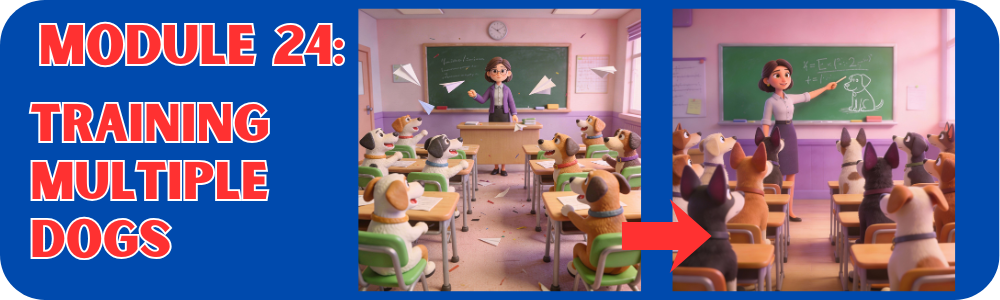
Manage multi-dog households effectively. Learn how to balance individual training while maintaining harmony and structure.
This module is especially important because multi-dog households often experience:
- competition
- jealousy
- resource guarding
- chaotic play
- inconsistent rules
- overstimulation
- uneven training results
- conflict between dogs
When managed well, a multi-dog home becomes harmonious, calm, and deeply rewarding.
When managed poorly, it becomes unpredictable and stressful — for the dogs AND the humans.
This module gives you the full system to train, manage, and build a peaceful, structured multi-dog household.
Learn how to train, manage, and create harmony between multiple dogs by using structure, individual attention, fair routines, and clear leadership.
Training more than one dog is NOT simply “training one dog but twice.”
It requires:
- twice the structure
- twice the clarity
- individual training
- group management
- controlled interactions
- fair access to resources
- well-designed routines
This module teaches you how to build the exact environment multi-dog homes need to thrive.
🔵 1. Why Multi-Dog Households Need Special Training
Dogs in multi-dog homes often struggle with:
- impulse control
- competition for attention
- resource guarding
- copying each other’s bad behaviours
- overstimulation
- jealousy
- selective obedience
They develop group behaviour patterns — good or bad.
Your job:
Shape the group, support the individuals.
🔵 2. The Golden Rule of Multi-Dog Training
👉 Train each dog separately BEFORE training them together.
Group training fails when:
- dogs distract each other
- one dog does all the thinking
- shy dogs get overshadowed
- excitable dogs set the tone
- bad habits “spread” across the dogs
Success depends on individual competence first.
🔵 3. The Three-Phase Multi-Dog Training System
Trainers follow these phases:
✔ Phase 1: Train Each Dog Individually
Teach every dog:
- sit
- down
- stay
- recall
- mat training
- name recognition
- impulse control
- leash skills
- calmness exercises
Individual training prevents dependency and creates clarity.
✔ Phase 2: Parallel Training (Dogs Working Side-by-Side, Not Interacting)
Dogs remain:
- on leash
- on mats
- focused on you
- rewarded for ignoring each other
This teaches calm coexistence.
✔ Phase 3: Group Training (Controlled Interactions)
Gradually introduce:
- group sits
- group stays
- group recalls (one at a time)
- calm greetings
- structured play
Now dogs learn to behave even in shared environments.
🔵 4. Managing the Household (Critical for Peace & Safety)
Multi-dog homes need structure to prevent conflict.
✔ A. Individual Spaces
Each dog should have:
- their own bed
- their own crate (highly recommended)
- their own feeding area
- access to personal rest time
Reduces competition and overstimulation.
✔ B. Separate Feeding (Non-Negotiable)
Even calm dogs can develop food guarding.
Feed dogs:
- in crates
- behind baby gates
- in separate rooms
This prevents conflict, anxiety, and competition.
✔ C. Controlled Access to High-Value Items
Bones, chews, stuffed Kongs, and toys can trigger conflict.
Rules:
- give these items separately
- supervise always
- remove items after use
- reward calm behaviour
✔ D. Rotational Attention System
Give:
- one-on-one training
- one-on-one affection
- one-on-one walks
This prevents:
- jealousy
- attention guarding
- clinginess
- insecurity
Every dog gets individual, meaningful connection.
🔵 5. Managing Competition & Preventing Conflicts
Dogs in a group compete for:
- your attention
- food
- toys
- doorways
- space
- positions on furniture
Here’s how to prevent issues:
✔ 1. Use Structured Greetings
When you arrive home:
- no crowding
- one dog greets at a time
- reward calm behaviour
- redirect overexcited dogs to mats
✔ 2. Enforce “Wait Your Turn” Rules
Teach dogs:
- sit before doors
- sit before treats
- one dog moves at a time
This prevents chaotic pushing and tension.
✔ 3. Manage Play Sessions
Rules:
- supervise
- interrupt if arousal skyrockets
- teach dogs to pause
- separate if play becomes one-sided
Healthy play is:
- loose
- bouncy
- reciprocal
- relaxed
✔ 4. Use Gates & Barriers Wisely
Gates create:
- calm transitions
- safe feeding
- controlled excitement
- stress-free training sessions
Gates are a multi-dog household’s best friend.
✔ 5. Identify Early Warning Signs of Tension
Watch for:
- freezing
- lip licking
- hard stares
- standing tall
- blocking access
- hovering around resources
- sudden silence
Intervene early with redirection.
🔵 6. Training Behaviours That Are Essential for Multi-Dog Homes
✔ Name recognition
Dogs respond when THEIR name is called.
✔ Individual recall
Never recall all dogs at once unless trained.
✔ Place/mat training
Each dog learns to settle independently.
✔ Wait cues
Stops crowding and competition.
✔ Polite greetings
Prevents chaos when people arrive.
✔ Leave it
Vital around shared environments.
✔ Release cues
Dogs learn that only the dog released moves.
🔵 7. Group Training Exercises (Professional Techniques)
✔ Exercise 1: One Dog Works, One Dog Waits
One dog trains with you
The other stays on mat
Switch roles
Builds patience & impulse control.
✔ Exercise 2: Group Sit & Stay
Start with short duration
Increase gradually
Reward individually
End before dogs break position.
✔ Exercise 3: Controlled Group Doorway Exit
Dogs sit
One name called
That dog exits
Rotate
Prevents pushing or conflict.
✔ Exercise 4: Sequential Recall
Call:
- “Bella, come!”
- reward
- release
- “Max, come!”
- reward
Teaches dogs NOT to rush when another dog is called.
✔ Exercise 5: “Calm Together” Mat Practice
Each dog on its own mat
Reward for calmness
Practice during:
- meals
- TV time
- visitors
- excitement
🔵 8. Handling Problem Scenarios in Multi-Dog Homes
❌ Resource Guarding
Solution:
separate feeding, teach trade-up, reward calm, remove triggers.
❌ One dog bullies another
Solution:
interrupt early, separate play, reward balanced interactions, create safe spaces.
❌ Dogs copy each other’s unwanted behaviour
Solution:
train individually, prevent rehearsal, reinforce calm behaviour.
❌ Jealousy over attention
Solution:
rotational one-on-one time, boundary training, predictable routines.
❌ Play becomes chaotic
Solution:
structured play, stop/start cues, calm breaks.
❌ Dogs rush the door when guests arrive
Solution:
assign mats, reward calm, greet one dog at a time, practice desensitisation.
🔵 9. The Multi-Dog Harmony Formula
To create peace and structure in a multi-dog household:
✔ Individual training
✔ Structured group training
✔ Separate feeding & resources
✔ Clear routines
✔ Fair rules
✔ Calm leadership
✔ Supervised play
✔ Consistent boundaries
✔ Emotional neutrality
✔ Predictable interactions
When all of this is in place, multi-dog homes become easy, calm, and joyful.
🔵 10. What Success Looks Like After Module 24
By the end of this module, your dogs will:
✔ cooperate calmly with each other
✔ follow individual cues reliably
✔ work side-by-side without tension
✔ share space respectfully
✔ play safely
✔ wait their turn
✔ settle on mats peacefully
✔ obey rules without conflict
✔ trust each other and you
And YOU will:
✔ feel fully in control of the household
✔ understand how to prevent conflict
✔ manage resources safely
✔ train each dog effectively
✔ balance individual and group needs
✔ maintain harmony with confidence
✔ lead the group with calm, fair authority
Module 25: Real-Life Scenarios & Problem Solving
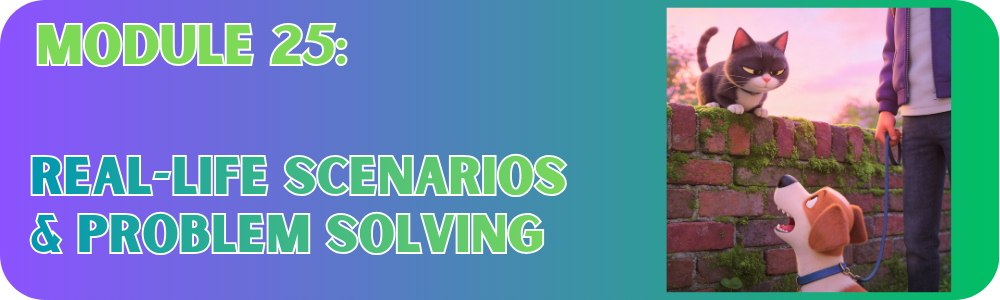
Prepare for the unexpected. Learn how to adapt training, handle setbacks, and maintain progress long-term.
This module is a big one because it brings everything together:
skills → confidence → real-life behaviour → calm problem-solving.
The goal is to prepare owners for the unpredictable nature of everyday life — and teach them how to respond calmly, confidently, and effectively when things don’t go to plan.
Learn how to handle unexpected challenges, adapt training on the fly, and guide your dog through everyday situations with clarity, structure, and calm leadership.
Real life isn’t a controlled training session.
It’s:
- dropped leashes
- off-leash dogs
- loud noises
- children running
- wildlife bolting
- surprise visitors
- stressful vet trips
- unexpected setbacks
This module teaches you how to respond to these challenges without fear or frustration — and how to help your dog feel secure no matter what’s happening.
You’ll learn:
- scenario-based training
- critical thinking
- environmental awareness
- calm crisis handling
- adaptive problem-solving
- how to reset a training plan when things go wrong
This is the module that truly turns owners into competent handlers.
🔵 1. Why Real-Life Problem Solving Matters
Many dogs can perform beautifully:
- at home
- in the backyard
- in a quiet park
But real life throws surprises.
A competent handler:
- predicts issues before they happen
- stays calm under pressure
- adapts cues to new environments
- protects the dog from danger
- communicates clearly
- resets calmly after setbacks
This module builds those skills.
🔵 2. The Three Components of Real-Life Dog Handling
Every real-world scenario requires:
✔ 1. Environmental Awareness
Know what’s around you:
- dogs
- bicycles
- children
- wildlife
- noises
- escape points
- triggers
- traffic
Good handlers scan the environment like lifeguards.
✔ 2. Emotional Control
Your dog reads your:
- breathing
- tone
- movements
- energy
If you remain calm, your dog has a chance to stay calm.
✔ 3. Behavioural Strategy
You choose:
- what cue to use
- whether to increase distance
- how to redirect
- whether to avoid or approach
- when to leave the situation
This is how you turn training into instinctive, confident action.
🔵 3. The Handler’s Decision Framework (Used by Professionals)
Here is the exact 4-step method behaviourists use in real-life scenarios:
✔ Step 1: Assess
What’s happening?
Where is the risk?
What does your dog need right now?
✔ Step 2: Adjust
Increase distance
Change direction
Lower criteria
Remove pressure
✔ Step 3: Act
Use:
- focus cues
- pattern games
- recall
- leave it
- mat behaviour
OR simply walk away calmly.
✔ Step 4: Anchor
Reward calm
End session on success
Reset emotionally
Move on
This stops you from panicking or reacting emotionally.
🔵 4. Real-Life Scenario Training (10 Practical Situations)
Below are examples of real-world scenarios and step-by-step instructions on what to do.
🟧 A. Off-Leash Dog Approaching Your Dog
This is one of the most stressful real-life situations for owners.
What to Do:
- Step calmly in front of your dog (body block)
- Say firmly to the other dog: “Stop!” or “Go home!”
- Toss a handful of treats behind the approaching dog
(redirects them away) - Quickly leave with your dog in the opposite direction
- Avoid tension on the leash
- Reward your dog for following calmly
What Not to Do:
❌ pick your dog up
❌ panic
❌ tighten leash (triggers fight response)
🟧 B. Dog SUDDENLY Pulls Toward Something (bird, smell, dog)
What to Do:
- Stop
- Wait for slack in leash
- Ask for eye contact
- Reward
- Continue walking calmly
This resets the moment and prevents escalation.
🟧 C. Visitor Arrives at the Door Unexpectedly
Steps:
- Cue: “Go to your mat”
- Reward calmness
- Open door only when dog is still
- Allow greeting only if calm
- If excited → quick reset back to mat
🟧 D. Dog Refuses to Come When Called Outdoors
Steps:
- Move AWAY from dog (never toward)
- Get low and inviting
- Use happy voice
- Reward massively
- Reduce distraction level next session
Recall failure = training issue, not disobedience.
🟧 E. Children Running Toward Your Dog
Steps:
- Step between children and dog
- Ask children to stop
- Put dog behind your leg
- Cue “sit” or “watch”
- Reward calm
- Allow quiet greeting only if safe
You are your dog’s advocate.
🟧 F. Loud Noise Frightens Your Dog (fireworks, motorbikes, storms)
Steps:
- Get distance
- Soften your tone
- Use pattern game (1-2-3 treat, up-down)
- Reward calm
- Avoid forcing the dog toward the noise
🟧 G. Dog Reacts (barks, lunges) at Another Dog
Steps:
- Increase distance immediately
- Turn sideways (less threatening)
- Cue “watch” or “touch”
- Reward ANY small moment of calm
- Exit the situation
This is NOT the time for discipline — it’s fear.
🟧 H. Dog Growls or Guards a Resource
Steps:
- DO NOT punish (dangerous)
- Freeze
- Toss high-value treat to create distance
- Remove resource once dog moves
- Begin resource-guard training later
- Protect the dog’s sense of safety
Never take things by force.
🟧 I. Meeting Another Dog on Footpath
Steps:
- Move to side
- Create space
- Walk in soft arc (not straight line)
- Reward focus on you
- Pass calmly
Arc movement prevents frontal pressure.
🟧 J. Dog Overexcited in the Car or Jumping Out
Steps:
- Ask for “wait”
- Open car door slightly
- Close if dog moves
- Only open fully when calm
- Release cue to exit
Car control = calm travel.
🔵 5. How to Handle Setbacks (The Reset System)
Training setbacks are normal and predictable.
Dogs regress when:
- stressed
- overstimulated
- in new environments
- during teenage phase
- sick or uncomfortable
Here is how to reset correctly:
✔ Step 1: Lower the difficulty
Go back to a simpler environment.
✔ Step 2: Reduce distraction
Remove competing stimuli.
✔ Step 3: Increase rewards
Rebuild confidence.
✔ Step 4: Shorten sessions
End on success.
✔ Step 5: Go back one module
Often solves the issue instantly.
🔵 6. The “One-Metre Rule” for Instant Behaviour Improvement
If something goes wrong:
Move one metre away from the trigger.
One metre can turn:
- reactivity → calm
- fear → curiosity
- confusion → clarity
Distance = safety.
🔵 7. Pattern Games for Crisis Management
Pattern games help dogs stay calm when situations escalate.
✔ Up-Down
Dog looks at environment → then at you → reward.
✔ 1-2-3 Treat
You say “1…2…3!” → treat on 3 → dog stays engaged.
✔ Side-by-Side Walking
Dog matches your movement → builds connection.
✔ Look at That (LAT)
Dog looks calmly at trigger → reward → confidence grows.
🔵 8. Common Real-Life Mistakes & Corrections
❌ tightening leash
✔ increase distance calmly
❌ yelling
✔ quiet voice, breathing
❌ forcing dog toward fear
✔ allow distance and observation
❌ punishing reactive behaviour
✔ manage emotions + reward calm
❌ letting situations escalate
✔ intervene early with space and direction
🔵 9. Practical Exercises for Module 25
Exercise A: Surprise Recall Drill
Call your dog randomly in safe areas.
Reward enthusiastically.
Builds responsiveness.
Exercise B: Emergency U-Turn Practice
Teach dog to turn with you instantly.
Great for avoiding triggers.
Exercise C: Threshold Training for Visitors
Mat → settle → greet calmly.
Exercise D: Sudden Distraction Rehearsal
Drop items or make mild noises.
Reward calm.
Exercise E: Real-Life Walk Simulation
Practice:
- passing dogs
- stopping
- sitting for calm
- arc walking
Exercise F: Controlled Surprise Exposure
Introduce mild surprises (new objects, sounds)
Reward curiosity and calm.
🔵 10. What Success Looks Like After Module 25
By the end of this module, your dog will:
✔ handle surprises with confidence
✔ recover from stress more quickly
✔ respond to cues even under pressure
✔ look to you for direction
✔ remain calmer in unpredictable environments
✔ improve behaviour through experience
✔ stay emotionally balanced
✔ build resilience and adaptability
And YOU will:
✔ know how to handle ANY real-life scenario
✔ stay calm under pressure
✔ apply training instantly and effectively
✔ make smart, safe decisions
✔ intervene early to prevent problems
✔ adapt your dog’s training on the fly
✔ feel confident in unpredictable situations✔ become a truly competent, real-world handler
Module 26: Competent Dog Owner Certification
Review everything you’ve learned and assess your skills. Finish the course with clarity, confidence, and a long-term training plan.
This is the final chapter of the entire program — the graduation step where everything comes together.
This module transforms the dog owner from a learner into a calm, confident, capable handler who can train, guide, and support their dog in any situation.
It includes:
✓ skill assessment
✓ behavioural competence checklists
✓ practical tests
✓ mindset and leadership evaluation
✓ a long-term roadmap
✓ graduation framework
Let’s build the final cornerstone of your course.
Review your skills, assess your dog’s progress, and complete the practical and mindset criteria that demonstrate true competence as a calm, confident dog handler.
This module is not a test of perfection — it is a test of readiness.
A competent dog owner is not someone whose dog never makes mistakes.
It is someone who can:
- understand why a behaviour happens
- respond calmly
- guide their dog clearly
- prevent problems before they occur
- train confidently in real environments
- recover from setbacks with patience
- follow the system consistently
This module certifies you as that person.
🔵 1. What It Means to Be a “Competent Dog Owner”
A competent dog owner is a blend of:
✔ Trainer
They understand learning, reinforcement, and timing.
✔ Leader
They guide with calm confidence.
✔ Advocate
They protect their dog from fear, danger, and overwhelm.
✔ Problem Solver
They can adapt when things go wrong.
✔ Emotional Anchor
Their dog feels safe because they are steady and predictable.
This module helps you evaluate all of these areas.
🔵 2. The Competency Assessment (Owner Skills)
Below is the evaluation used to determine readiness for certification.
✔ A. Communication Skills
You can:
- use clear, consistent cues
- avoid repeating commands
- maintain calm tone
- use body language thoughtfully
- reward at the right moment
✔ B. Emotional Regulation
You can:
- stay calm under pressure
- avoid frustration-based reactions
- breathe through difficult moments
- use a gentle voice
- model confidence for your dog
✔ C. Behaviour Management
You consistently:
- interrupt behaviours gently
- redirect rather than punish
- use fair, clear consequences
- prevent problems through management
- reward calm choices
✔ D. Environmental Awareness
On walks or outings, you:
- scan for triggers
- maintain safe distance
- anticipate issues early
- read other dogs accurately
- protect your dog’s emotional state
✔ E. Training Consistency
You:
- practice short sessions regularly
- follow the system’s step-by-step approach
- progress only when criteria are met
- avoid flooding or overwhelming your dog
- maintain clarity in your expectations
🔵 3. The Dog’s Competency Assessment (Dog Skills)
A well-trained dog does not need to be perfect — they need to be consistent, predictable, and able to respond under mild-to-moderate distractions.
Below are the minimum competencies.
✔ A. Focus & Attention
Dog can:
- respond to their name
- offer voluntary check-ins
- focus around mild distractions
✔ B. Engagement
Dog:
- chooses to work with you
- is motivated by rewards
- can shift attention away from distractions
✔ C. Obedience Skills
Dog can perform:
- sit
- down
- stand
- stay (10–30 seconds depending on environment)
- loose-lead walking
- recall at moderate distance
✔ D. Impulse Control
Dog can:
- wait at doors
- control excitement around food
- resist lunging toward distractions
- pause before reacting
✔ E. Emotional Stability
Dog can:
- recover from mild stress
- settle on a mat
- remain calm in new environments
- handle everyday unpredictability
🔵 4. The Practical Certification Test (Real-Life Evaluation)
This is the real-world competency assessment.
In the real world owner and dog must complete the following in a normal outdoor environment (park, oval, quiet street).
🟦 Category 1: Focus & Engagement
Test 1: Dog responds to name immediately (80% success).
Test 2: Dog offers voluntary check-ins.
Test 3: Dog walks with handler for 20 metres while maintaining mild engagement.
🟦 Category 2: Obedience Under Mild Distractions
Test 4: Sit on first cue.
Test 5: Down on first or second cue.
Test 6: 10-second stay with distractions (people walking, noise).
Test 7: Loose-lead walking for 1 minute with controlled distractions.
🟦 Category 3: Recall Competency
Test 8: Recall from 5–10 metres on a long line.
Test 9: Dog disengages from a distraction when recalled.
Test 10: Emergency recall simulation (low-level version).
🟦 Category 4: Impulse Control
Test 11: Dog waits calmly at a threshold (door, gate).
Test 12: Dog performs “leave it” with food or object.
Test 13: Dog pauses and looks to handler before moving into a new situation.
🟦 Category 5: Emotional Stability & Real-Life Behaviour
Test 14: Walk past a dog at a comfortable distance.
Test 15: Settle on mat for 1–2 minutes.
Test 16: Respond calmly to mild surprise (bike, jogger, toy).
🔵 5. The Handler’s Mindset Certification (Internal Competencies)
The owner completes self-reflection to ensure emotional readiness.
✔ 1. Calmness
“I remain composed even when my dog becomes distracted or stressed.”
✔ 2. Patience
“I understand learning takes time and setbacks are normal.”
✔ 3. Predictability
“I follow consistent rules every day.”
✔ 4. Empathy
“I consider my dog’s emotions and comfort level.”
✔ 5. Problem-Solving
“I can adapt training based on the situation.”
🔵 6. Troubleshooting Assessment Failures (Reset Protocol)
If a dog or owner struggles:
✔ Return to previous module
✔ Lower distraction
✔ Increase distance
✔ Use higher-value rewards
✔ Shorten session
✔ Practice in easier environments
✔ Break skills into smaller steps
Certification is flexible — growth over perfection.
🔵 7. Your Long-Term Training Roadmap
After certification, continue building excellence:
✔ Advanced off-leash reliability
✔ Urban obedience
✔ Dog-sport foundations (agility, scentwork)
✔ Therapy dog fundamentals
✔ Lifelong behaviour consistency
✔ Continued confidence-building
✔ Regular refreshers in high-distraction areas
The journey doesn’t end — it evolves.
🔵 10. Competent Dog Owner Completion Checklist
✔ I understand how my dog learns
✔ I train with clarity and confidence
✔ I use fair, force-free discipline
✔ I can guide my dog in real-life scenarios
✔ I follow consistent routines
✔ I recognise stress and manage it early
✔ I maintain calm energy under pressure
✔ My dog trusts me
✔ My dog responds to cues reliably
✔ We work as a team
If all boxes are checked — you has successfully completed this course.
We recommend that if possible, you enrol in a real local dog training class / course. This course will always be here as your back up and as your checklist.
If you have not already, please join MyDogRules.com where you will find extended New Tips, Tricks and Training every week as well as being part of a Dog Loving Community.
We hope you enjoyed the course and got value from it.